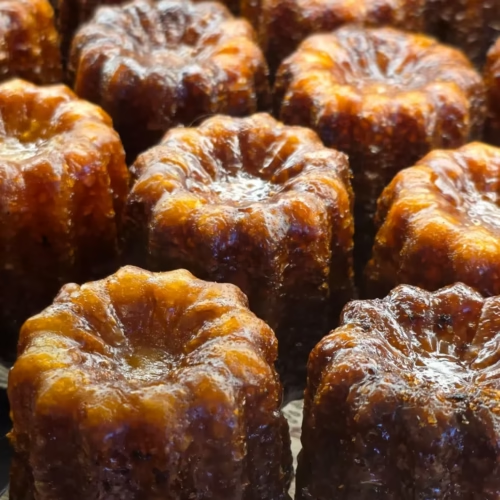
Canelés de Bordeaux
Canelés de Bordeaux are traditional French pastries with a deeply caramelized, crisp exterior and a soft, almost custard-like center. Made with whole milk, real vanilla, egg yolks, and a splash of dark rum, these little pastries develop their distinctive texture after the batter rests overnight in the refrigerator.
Ingredients
- 1 cup plus 1 teaspoon 250 ml whole milk
- 1 vanilla bean
- ⅝ cup 125 g superfine sugar (caster sugar)
- ½ cup plus 1 teaspoon 65 g all-purpose flour
- 3 large egg yolks
- 1 tablespoon plus 2 teaspoons 25 g unsalted butter
- 1 tablespoon plus 2 teaspoons 25 ml amber or dark rum (rhum ambré)
- Extra unsalted butter for greasing the molds
Instructions
The Day Before – Preparing the Batter
- Infuse the milk with vanilla. Split the vanilla bean lengthwise and scrape out the seeds. Place the whole milk, vanilla seeds, and empty pod in a saucepan. Heat until the milk is just about to boil, then remove from the heat. Allow the vanilla to infuse for approximately 15 minutes.
- Combine the dry ingredients. Meanwhile, combine the superfine sugar and flour in a mixing bowl. Add the egg yolks and stir with a whisk until the mixture is smooth.
- Add the warm milk. Remove the vanilla pod from the milk. Gradually pour the warm milk into the egg yolk mixture, stirring gently as you go. Try to incorporate as little air as possible into the batter.
- Add the butter and rum. While the batter is still warm, add the unsalted butter and stir until completely melted. Then mix in the rum.
- Rest the batter overnight. If necessary, pour the batter through a fine-mesh sieve to remove any lumps. Allow it to cool, cover, and refrigerate for at least 12 hours.
The Next Day – Baking the Canelés
- Preheat the oven. Preheat your oven to 425°F (220°C), using conventional heat rather than convection. If using silicone molds, check that they are suitable for this temperature.
- Prepare the molds. Carefully grease the canelé molds with a thin layer of softened unsalted butter. Make sure all the fluted grooves are evenly coated. Place the molds on a sturdy baking sheet.
- Stir the batter. Remove the batter from the refrigerator and stir gently. Some of the ingredients may have settled during the overnight resting period.
- Fill the molds. Divide the batter among the prepared molds, filling each approximately three-quarters full. This allows room for the batter to rise during baking.
- Begin baking. Place the baking sheet in the preheated oven. Bake large canelés for the first 15 minutes at 425°F (220°C).
- Reduce the temperature. Lower the oven temperature to 320°F (160°C) and continue baking for approximately 45 minutes. The exterior should be a deep chestnut brown with a well-caramelized crust. Exact baking times may vary depending on your oven and the material of your molds.
- Remove from the molds. Take the molds out of the oven and let them stand briefly. Carefully unmold the canelés while the molds are still warm. Be extremely careful, as the molds will be very hot.
- Cool completely. Transfer the canelés to a wire rack and allow them to cool completely. The exterior will become firmer as they cool.
- Important: Baking Mini Canelés
- The baking time of 15 minutes at 425°F (220°C), followed by approximately 45 minutes at 320°F (160°C), is intended for large canelés.
- For mini canelés, this total baking time is generally too long. Begin checking them earlier and adjust the baking time according to the size and material of your molds.
Notes
Use real vanilla. A whole vanilla bean gives the batter a richer, more complex flavor than vanilla extract alone.
Choose amber or dark rum. Amber or dark rum complements the deeply caramelized crust. There's no need to use an expensive bottle.
Let the batter rest overnight. This allows the flour to fully absorb the liquid and gives the flavors time to develop.
Avoid whisking too much air into the batter. Canelés should have a dense, custard-like interior rather than a light, cake-like texture. Gentle mixing is all you need.
Do not use baking powder. The distinctive texture of traditional canelés develops without any chemical leavening agents.
Don't be afraid of the dark color. Authentic canelés are considerably darker than ordinary cakes. The crust should be a deep brown, but it should never taste burnt.
Copper molds produce the best crust. Traditional copper canelé molds generally provide the most even caramelization. Maison Baillardran in Bordeaux is one place where traditional copper molds are available.