There is something wonderfully festive about duck confit with orange sauce. The golden, crispy skin, the beautifully tender meat, and that fragrant orange sauce make it feel like a dish you’d order in a lovely little French restaurant.
And yet, it’s also a dish that works beautifully at home, especially when you’re planning a Christmas dinner.
In France, confit de canard is a much-loved traditional dish, particularly in the southwest, where duck has been prepared this way for generations. The legs are slowly cooked in duck fat until the meat becomes exceptionally tender. Before serving, they’re heated until the skin turns beautifully golden and crisp.
I love pairing duck confit with orange sauce. The citrus adds a little brightness to the rich duck, creating a delicious balance of flavors.
It’s the sort of meal that makes an ordinary evening feel special. But at Christmas, with candles on the table, a good bottle of wine, and everyone gathered together, it’s especially lovely.
Why Duck Confit Is Perfect for Christmas Dinner
One of the things I particularly appreciate about duck confit is that so much of the work can be done ahead of time.
The duck legs are slowly cooked in fat, a traditional French preservation technique that produces incredibly tender meat. Once cooked and properly refrigerated, the duck can be kept until you’re ready to finish the dish, following safe storage guidelin
Duck Confit with Orange and Rosemary Sauce
Ingredients
- – 4 domestic duck legs approximately 2.6 lbs / 1.2 kg total
- – 18 g fine sea salt approximately 1.5% of the weight of the duck legs
- – 4 g black peppercorns coarsely crushed
- – 2 garlic cloves lightly crushed
- – 2 sprigs fresh thyme
- – 1 bay leaf
- – 4 juniper berries lightly crushed
- – 2.6–3.3 lbs 1.2–1.5 kg duck fat, or enough to completely submerge the legs
- – 2 oranges
- – 2 sprigs fresh rosemary
- – 2 garlic cloves lightly crushed
- – ⅓ cup plus 1 tablespoon 100 ml duck stock or chicken stock
- – 1 tablespoon red wine vinegar
- – 1 teaspoon honey
- – 2 tablespoons 25 g cold unsalted butter, cubed
- – 1 teaspoon duck fat
- – Salt and freshly ground black pepper to taste
Method
- Weigh the duck legs. Weigh all four duck legs together and calculate approximately 15 g of salt per kilogram of duck. For 1.2 kg (2.6 lbs) of duck legs, use 18 g of salt.
- Cure the duck legs. Mix the salt with the crushed black peppercorns. Rub the mixture evenly over the duck legs and place them in a dish with the crushed garlic, thyme, bay leaf, and juniper berries. Cover and refrigerate for 12 hours.
- Preheat the oven. Preheat the oven to 210°F (100°C), using conventional heat rather than convection. Choose an ovenproof pot or baking dish that holds the duck legs snugly together.
- Clean the duck legs. Remove the duck legs from the curing mixture and carefully wipe away the salt and herbs. Pat the legs thoroughly dry.
- Slow-cook the duck in fat. Arrange the duck legs in the pot. Gently melt the duck fat over low heat and pour it over the legs until they are completely submerged. Transfer the pot to the oven and cook for 2½ to 3 hours. Keep the fat at approximately 195–205°F (90–95°C); it should never boil vigorously. The duck is ready when a thin knife slides into the meat with very little resistance.
- Prepare the oranges. Squeeze the juice from one orange. Cut the second orange into thin slices. If desired, finely grate a little zest from the juiced orange.
- Start the sauce. Carefully lift the duck legs from the fat and allow the excess fat to drain off. Heat 1 teaspoon of duck fat in an ovenproof skillet. Add the orange slices and cook until lightly golden on both sides. Add the crushed garlic and rosemary and cook briefly until fragrant.
- Reduce the sauce. Pour the orange juice and stock into the skillet. Add the red wine vinegar and honey. Allow the sauce to simmer gently for 5–8 minutes, until slightly reduced and more concentrated in flavor. The sauce should remain fluid rather than becoming thick.
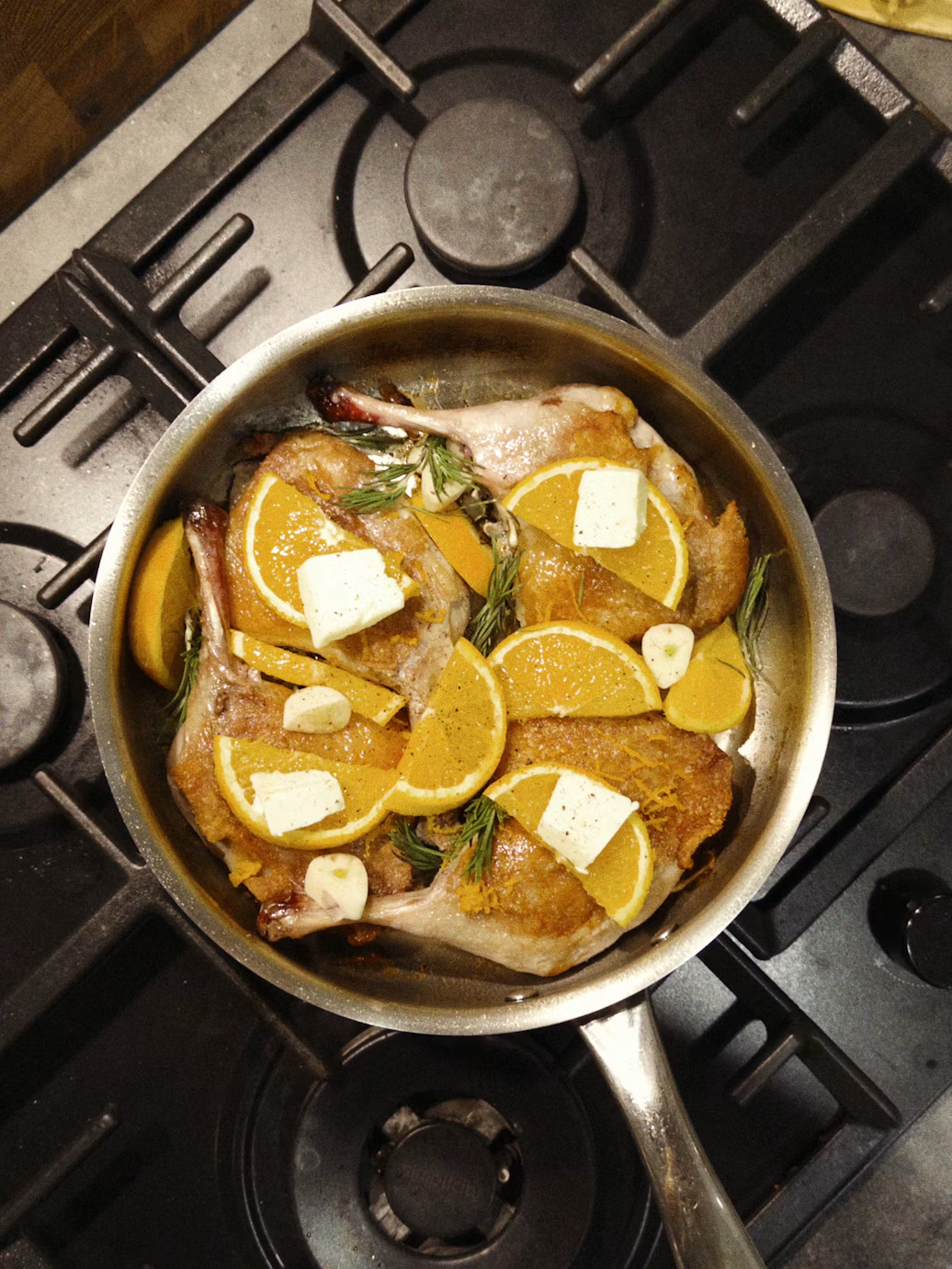
- Crisp the duck skin. Increase the oven temperature to 425°F (220°C), using conventional heat. Arrange the duck legs skin-side up in the skillet, nestled between the orange slices. Spoon a little sauce over the meat, keeping the skin as dry as possible. Transfer the skillet to the oven and roast for 10–15 minutes, until the duck is heated through and the skin is crisp. If necessary, finish under the broiler for 1–2 minutes.
- Finish the sauce. Remove the duck legs from the skillet and keep them warm. Place the skillet over low heat and remove the rosemary and garlic. Add the cold butter a few cubes at a time, stirring until the sauce becomes smooth and glossy. Do not allow the sauce to boil once the butter has been incorporated. Taste and season with salt and freshly ground black pepper.
- Serve. Place one duck leg on each plate with a few slices of orange. Spoon the orange and rosemary sauce alongside the duck rather than over the skin, so it stays beautifully crisp.