Discover what makes Spanish Marcona almonds so special, how to use them in Mediterranean cooking, and the changing story of almond growing in a small village on Spain’s Costa Blanca.
There are certain ingredients that seem to capture the Mediterranean in just one bite.
Good olive oil is one. A perfectly ripe fig is another. And for me, a handful of Spanish Marcona almonds belongs on that list too.
They are rounder than the almonds you usually find in a supermarket, with a delicate sweetness, a rich flavor, and a wonderfully satisfying texture.
In Spain, almonds are so much more than something to scatter over your breakfast or eat as a snack.
They appear in traditional sweets, savory sauces, pastries, cold soups, and countless regional dishes.
But almonds also have a very personal meaning for me.
Sam and I live in Alcalalí, a small village in the beautiful Vall de Pop, inland from Spain’s Costa Blanca.
For years, this valley was famous for its almond blossom. Every spring, the surrounding countryside would turn into a landscape of delicate pink and white flowers.
Sadly, much of that landscape has disappeared.
And the story behind those lost almond trees is an important reminder that even the most familiar Mediterranean ingredients have a deeper connection to the land.
What Are Marcona Almonds?
Marcona almonds are a traditional Spanish almond variety, prized for their distinctive shape, sweet flavor, and delicate texture.
Unlike the long, narrow almonds commonly sold in supermarkets, Marcona almonds are relatively short, round, and plump.
Their texture is often described as buttery, although they contain no butter.
They have a naturally rich flavor with less of the pronounced bitterness sometimes found in other almond varieties.
In Spain, Marcona almonds are especially appreciated for roasting, frying, confectionery, and traditional almond-based sweets.
They are often sold blanched, lightly fried in olive oil, and sprinkled with sea salt.
And if you have ever tasted a really good bowl of warm, salted Marcona almonds, you will understand why they are so popular.
What Makes Marcona Almonds Different From Regular Almonds?
The difference begins with the almond variety itself.
Marcona almonds have a more rounded shape and a delicate, rich flavor.
Common varieties such as Nonpareil, widely grown in California, are generally longer and flatter.
Marcona almonds are also particularly well suited to traditional Spanish preparations in which the almonds are gently fried or roasted.
Their naturally sweet character works beautifully with olive oil and salt.
That doesn’t mean ordinary almonds are inferior.
They simply have different characteristics.
For everyday baking, almond flour, or adding to breakfast, standard almonds can be perfectly suitable.
But when the almond itself is the star of the dish, Marcona almonds are worth trying.
Where Are Marcona Almonds Grown?
Marcona is a Spanish almond variety with a long history of cultivation.
Almond trees thrive in areas with suitable Mediterranean growing conditions: relatively mild winters, warm dry summers, and well-drained soil.
Spain has traditionally been an important almond-growing country, with production in several regions, including Aragón, Catalonia, Murcia, Andalusia, and the Valencian Community.
However, the name Marcona identifies the variety, not a single protected growing region.
Not every Spanish almond is a Marcona almond.
And not every almond grown in the Valencian Community belongs to the Marcona variety.
This is worth remembering when shopping for almonds in local markets or specialty food stores.
The Almond Blossoms of Alcalalí: A Landscape That Changed
One of the reasons almonds are so special to me is that we live in a village with a long connection to almond growing.
Alcalalí sits in the Vall de Pop, surrounded by mountains, terraces, vineyards, and traditional agricultural land.
For generations, almond trees were part of the local landscape.
In late winter, often around February, the blossom would turn the valley into a beautiful patchwork of pale pink and white.
It was one of the sights that made this part of the Costa Blanca so memorable.
I have always loved local festivals, and Alcalalí has its own annual celebration traditionally associated with the almond blossom, called Feslalí.
It is the sort of village event I look forward to every year.
But the festival now tells a rather different story.
What Happened to the Almond Trees?
Over recent years, almond trees throughout parts of the Marina Alta have been severely affected by a plant disease caused by the bacterium Xylella fastidiosa.
The bacterium can interfere with the movement of water through a plant, causing leaf scorch, branch dieback, and potentially the death of infected trees.
It can spread through certain insects that feed on plant sap.
Unfortunately, there is no simple cure that restores infected almond orchards.
To limit its spread, authorities have required the removal of affected trees and, in some circumstances, other susceptible plants within designated areas.
The result has been devastating for parts of the traditional almond-growing landscape.
Around Alcalalí, many of the trees that once filled the valley with blossom have been removed.
There are still almond trees in the wider region, but the famous expanses of flowers that once drew visitors to the area are no longer what they used to be.
It is difficult not to feel sad about that.
These were not just beautiful trees.
They represented generations of agricultural work, local traditions, and an important part of the region’s identity.
What Happened to Alcalalí’s Almond Festival?
Feslalí has traditionally celebrated the almond blossom and the agricultural heritage of Alcalalí.
Rather than disappearing along with so many of the trees, the festival has continued to evolve.
In February 2026, its tenth edition placed particular emphasis on the carob tree, known locally as the garrofer.
Carob trees have also been part of Mediterranean agriculture for centuries.
They are adapted to relatively dry growing conditions and offer different possibilities for local food production.
The festival’s changing focus reflects the challenges facing farmers and communities in this part of Spain.
For me, that makes these celebrations even more meaningful.
They are not simply an excuse to enjoy a lovely day in the village.
They are also a way of keeping local agricultural traditions alive, even as the landscape changes.
And whenever I enjoy Spanish almonds, I find myself thinking about those lost orchards and the people who cared for them.
When Do Almond Trees Blossom in Spain?
Almond trees are among the earliest fruit trees to flower in many Mediterranean regions.
Depending on the weather and the variety, blossoms can begin appearing in January, with February often being particularly beautiful.
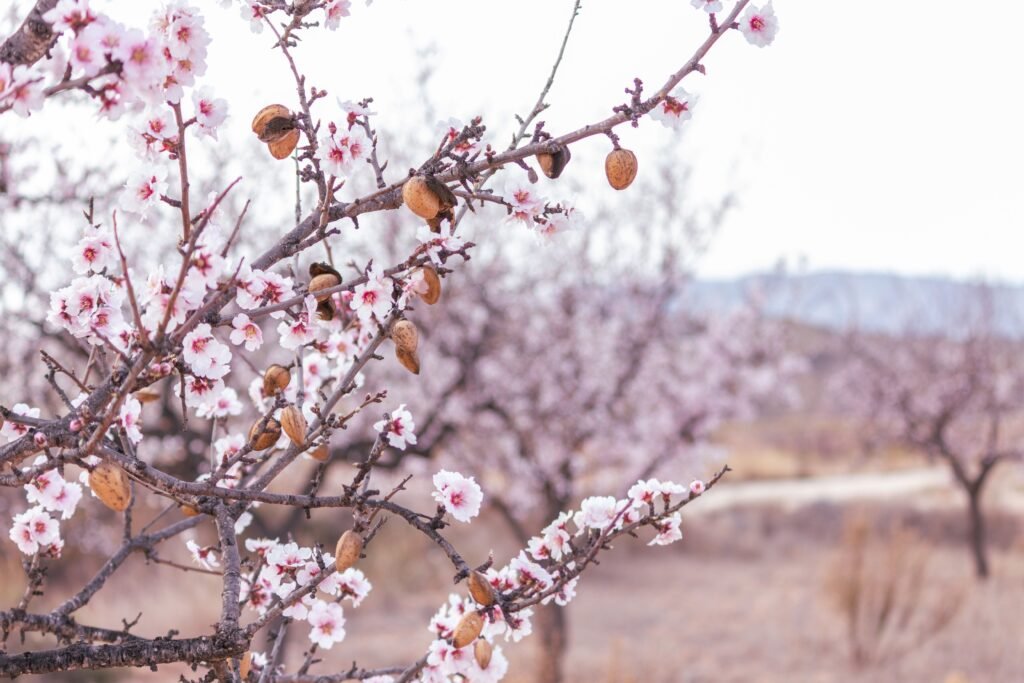
Almond blossoms can be white, pale pink, or deeper pink.
The flowers appear before or alongside the first leaves, creating the impression that the entire tree is covered in blossom.
Bees and other pollinators play an important role in the production of almonds, although pollination requirements vary between varieties.
After successful flowering and pollination, the almonds begin developing inside green, fuzzy outer hulls.
The harvest generally takes place later in the year, often from late summer into autumn, depending on the region and variety.
How Are Marcona Almonds Harvested?
Marcona almonds grow inside a hard shell, which is surrounded by a green outer hull.
As the almond matures, the hull begins to split.
The nuts can then be harvested using traditional methods or agricultural machinery, depending on the size and conditions of the orchard.
After harvest, the outer hulls are removed.
The almonds are dried and eventually shelled.
They may then be sold with their brown skins intact or blanched to remove the skins.
Many Marcona almonds sold for snacking have already been blanched and fried or roasted.
The final preparation has a considerable influence on their texture and flavor.
Why Are Marcona Almonds So Expensive?
Marcona almonds often cost more than ordinary almonds, especially outside Spain.
Part of the difference comes from their positioning as a specialty variety.
Cultivation costs, yields, sorting, processing, packaging, and export expenses can all affect the final price.
Blanched almonds that have been fried in olive oil and seasoned will naturally cost more than a basic bag of raw almonds.
However, prices vary considerably between producers and retailers.
A high price does not automatically guarantee better flavor.
When buying Marcona almonds, I recommend checking whether they are raw, roasted, fried, salted, or flavored.
It also helps to compare the price per kilogram rather than the price of the packet.
What Do Marcona Almonds Taste Like?
Marcona almonds have a naturally sweet, rich, delicate flavor.
They are less sharply nutty than some common almond varieties, with a pleasant texture that becomes particularly appealing when lightly roasted or fried.
Their flavor works beautifully with a little sea salt.
Olive oil adds another layer of Mediterranean richness.
They also pair surprisingly well with citrus, rosemary, honey, and certain cheeses.
This versatility is one reason Marcona almonds have become so popular with chefs.
How Are Marcona Almonds Used in Spanish Cooking?
Although a bowl of salted almonds is probably the easiest way to enjoy them, Spanish cuisine offers many other possibilities.
Spanish Tapas
Marcona almonds are wonderful served as a simple tapa.
Try them with olives, Manchego cheese, and slices of good Spanish cured ham.
A small bowl of almonds is also a lovely addition to a cheese board.
Turrón
One of the most famous uses of Spanish almonds is turrón, the traditional nougat particularly associated with Christmas.
Two famous varieties are Turrón de Jijona, which has a soft texture made with finely ground almonds, and Turrón de Alicante, which is firmer and contains whole almonds.
Marcona almonds are prized in high-quality examples of these sweets.
Ajo Blanco
Ajo blanco is a traditional Andalusian cold soup made with almonds, garlic, bread, olive oil, and water.
It is often served with grapes or other fresh garnishes.
Marcona almonds can be a lovely choice because of their mild, rich flavor.
Romesco Sauce
Romesco is a Catalan sauce typically associated with roasted peppers, tomatoes, nuts, garlic, olive oil, and vinegar.
Almonds are an important ingredient in many versions.
Marcona almonds work beautifully, although they are not essential to making a good romesco.
Salads
Chopped Marcona almonds add texture to salads.
They are particularly delicious with roasted vegetables, citrus, leafy greens, and soft cheeses.
Fish and Chicken
Ground or finely chopped almonds can also be used in crusts and sauces for fish or chicken.
Their natural richness pairs well with lemon, garlic, parsley, and olive oil.
Desserts and Baking
Marcona almonds are excellent in traditional almond cakes, biscuits, nougat, and pastries.
They can also be caramelized with sugar or honey to create a simple sweet treat.
A Simple Recipe: Spanish Marcona Almonds With Rosemary and Orange
One of my favorite ways to serve almonds is to keep the preparation simple.
Good almonds, a little olive oil, rosemary, orange zest, and sea salt.
It is an easy appetizer that feels very much at home on a Mediterranean table.
Ingredients
- 200 g (7 oz, about 1½ cups) raw, blanched Marcona almonds
- 1 tablespoon extra virgin olive oil
- 1 teaspoon finely chopped fresh rosemary
- Finely grated zest of ½ orange
- ¼ teaspoon flaky sea salt, or to taste
- A small pinch of smoked paprika, optional
Instructions
Step 1 — Preheat the oven
Preheat the oven to 160°C (320°F).
Line a small baking tray with parchment paper.
Step 2 — Season the almonds
Place the almonds in a bowl.
Add the olive oil, rosemary, and optional smoked paprika.
Toss until evenly coated.
Step 3 — Roast
Spread the almonds in a single layer on the baking tray.
Roast for approximately 12–16 minutes, stirring once halfway through.
Keep an eye on them during the final minutes, as almonds can darken quickly.
They should become lightly golden and fragrant.
Step 4 — Add the orange
Remove the almonds from the oven.
While still warm, add the finely grated orange zest and sea salt.
Toss gently to combine.
Step 5 — Cool and serve
Allow the almonds to cool for a few minutes before serving.
They are delicious slightly warm or at room temperature.
Tip
If you purchase Marcona almonds that are already fried or roasted, you don’t need to bake them again.
Simply warm them gently for a few minutes, then toss with a little rosemary, fresh orange zest, and sea salt.
The combination is particularly lovely with Spanish cheese, olives, and a glass of wine.
Marcona Almonds vs California Almonds
California produces a large proportion of the almonds sold around the world.
Common California varieties such as Nonpareil are typically longer and flatter than Marcona almonds.
Marcona almonds are rounder, with a richer, more delicate eating quality.
However, processing makes a difference.
A freshly roasted ordinary almond may taste better than an old, poorly stored Marcona almond.
For baking and everyday cooking, good-quality standard almonds are often a practical and economical choice.
For a special tapas board or a recipe where the almond flavor is particularly important, Marcona almonds can be worth the extra expense.
Can You Substitute Regular Almonds for Marcona Almonds?
Yes, in most recipes.
If you’re preparing a cake, almond sauce, or soup, ordinary blanched almonds can usually replace Marcona almonds.
The flavor and texture may be slightly different, but the recipe will generally still work.
For tapas, try using good-quality blanched almonds and lightly roasting them yourself.
Fresh preparation makes a considerable difference.
How to Store Marcona Almonds
Like other almonds, Marcona almonds contain natural oils that can deteriorate over time.
Store them in an airtight container, away from heat, moisture, and sunlight.
For longer storage, refrigeration or freezing can help maintain quality, particularly in warm climates.
Allow chilled almonds to come to room temperature before serving if you prefer their full aroma.
If almonds develop an unpleasant, stale, or rancid smell, discard them.
Are Marcona Almonds Healthy?
Marcona almonds have a nutritional profile broadly similar to other sweet almonds.
They provide unsaturated fats, plant protein, fiber, vitamin E, and minerals such as magnesium.
However, portion size matters because almonds are energy-dense.
A small handful is usually enough for a satisfying snack.
Salted or fried Marcona almonds may contain additional sodium and oil, depending on how they are prepared.
If you want more control over these ingredients, choose raw almonds and season them yourself.
Almonds are tree nuts and must be avoided by people with an almond allergy.
Frequently Asked Questions About Marcona Almonds
What is special about Marcona almonds?
They are a traditional Spanish variety known for their round shape, naturally sweet flavor, and rich, delicate texture.
Are Marcona almonds better than regular almonds?
They have different characteristics. Marcona almonds are particularly appreciated as a snack and in Spanish confectionery, while ordinary almonds work very well in many everyday recipes.
Are Marcona almonds always grown in Spain?
Marcona is a Spanish almond variety, but the variety name itself is not a guarantee of a particular geographical origin. Check the product label for the country of cultivation.
Can you eat Marcona almonds raw?
Yes, raw sweet Marcona almonds are edible, although many people prefer them roasted or lightly fried.
Why are Marcona almonds expensive?
They are commonly marketed as a specialty variety, and their price reflects production, processing, availability, packaging, and distribution.
Are Marcona almonds used in turrón?
Yes. They are prized for traditional Spanish almond confectionery, including certain high-quality varieties of turrón.
When do almond trees blossom in Spain?
Depending on variety, location, and weather, flowering often occurs from January through February, sometimes extending into early spring.
What happened to the almond trees in Alcalalí?
Many almond trees in the area were affected by Xylella fastidiosa, a serious bacterial plant disease. The disease and mandatory removal measures have greatly changed the traditional blossom landscape.
Can I make the rosemary almonds with regular almonds?
Absolutely. Raw blanched almonds are a good substitute, although the final texture and flavor will be somewhat different.
More Than Just an Almond
The longer I live in Spain, the more I realize how closely food is connected to the landscape.
A handful of almonds might seem like a simple snack.
But behind it lies a story of orchards, flowering trees, farmers, local traditions, and sometimes very difficult changes.
Here in Alcalalí, the disappearance of so many almond trees has changed a landscape that was once famous for its blossom.
Yet the village continues to celebrate its agricultural heritage and look toward the future.
Perhaps that is why I appreciate these small Mediterranean traditions even more.
A bowl of almonds with rosemary and orange, shared with friends, is a simple pleasure.
But knowing where the ingredients come from gives that pleasure a little more meaning.