Hi friends! Garlic is one of those ingredients that quietly runs the Mediterranean kitchen. In Spain, where we live now, and in France, where we shop twice a year, it’s simply part of life. It shows up in sizzling olive oil, creamy sauces, slow-simmered stews, and golden-brown bread, and as a result, it makes almost everything it touches taste better.
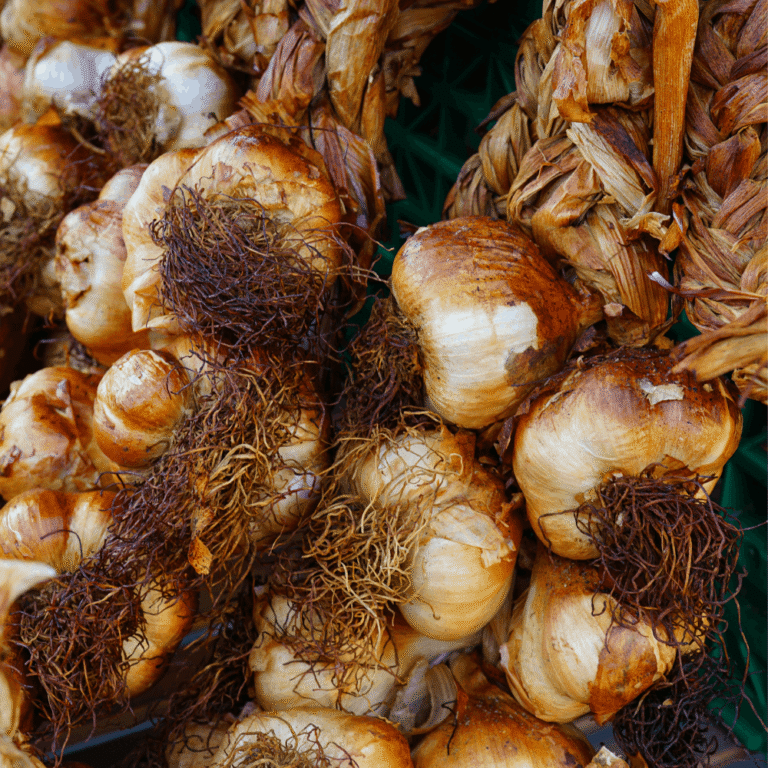
But here’s the thing: not all garlic is the same. Some heads are mild and sweet, while others are bold and fiery. Some even keep for most of a year. So let’s get to know them! Also, if you haven’t yet, take a peek at our smoked garlic guide, which is a delicious story of its own.
What Is Garlic?
Garlic is the bulb of a plant in the onion family. Each bulb, or “head,” is made up of several cloves wrapped in papery skin. Almost every head you’ll ever buy belongs to one of two families, and the difference starts with the stem.
| Softneck | Hardneck | |
|---|---|---|
| Stem | Soft and flexible | Stiff, woody center |
| Cloves | Many, smaller, in layers | Fewer, larger, in a single ring |
| Flavor | Milder, with a slight kick | Bolder and more complex |
| Peeling | A little fiddlier | Easier to peel |
| Storage | Keeps longest, up to about a year | Roughly 4 to 6 months |
| Extras | Can be braided | Produces edible scapes in spring |
The garlic in most grocery stores is softneck, mainly because it stores and travels so well. Hardneck, on the other hand, is the one many chefs and garlic lovers go looking for when they want more flavor. However, the family isn’t everything: the exact variety and the place it’s grown matter just as much, since soil and climate shape the final flavor.
Where Does It Come From?
Garlic is thought to have started in Central Asia, and it has been grown and prized for thousands of years. From there, it traveled across the ancient world and then settled in as a staple of Mediterranean cooking. Since then, it has been a cornerstone of the region’s kitchens.
Today, each country around the Mediterranean has its own famous garlic. Many have even earned protected status, which is a good sign when you’re shopping.
Spain
Ajo Morado de Las Pedroñeras is the star. It comes from Castilla-La Mancha, in the area around the town of Las Pedroñeras, which people nickname Spain’s “garlic capital.” The bulbs are round and white, with purple-tinged cloves inside. Also, it has IGP status, a European label that protects the name and the region.
Italy
- Aglio di Voghiera DOP: from the Ferrara area in Emilia-Romagna, with large, white, tightly packed bulbs.
- Aglio Bianco Polesano DOP: from the Polesine area in Veneto, nicknamed the “white gold of Polesine,” with bright white bulbs.
Italy also has plenty of red and pink varieties, which tend to be gentler than the white ones.
France
- Ail Rose de Lautrec: pink-skinned and from the south-west. It’s the only garlic in France with both IGP and Label Rouge status.
- Ail Blanc de Lomagne: big, plump white bulbs, also from the south-west.
- Ail Violet de Cadours: purple-streaked and from the Cadours area, with its own protected status.
What Does It Taste Like?
Raw garlic is sharp, pungent, and fiery. When it’s cooked, however, it becomes mellow, sweet, and almost buttery. Between regions, the personality changes quite a bit, too:
- Las Pedroñeras purple (Spain): a strong smell and a sharp, stimulating flavor. Producers say that one clove can do the work of two or three, so you can use less.
- Voghiera (Italy): famously mild and delicate, with a sweet, fresh character, which makes it great for gentle sauces.
- Polesano (Italy): a clean, classic white-garlic flavor that works beautifully in traditional dishes.
- Lautrec pink (France): gentle and a little less powerful than white or purple garlic.
- Lomagne white (France): a pronounced aroma with a hint of spice.
- Cadours purple (France): intense and spicy when raw, but delicately sweet once cooked.
How to Use It in Cooking
This is where garlic gets fascinating, because how you prepare it changes how it tastes. So let’s look at the techniques first, and then at the classic dishes.
Crush First, Then Wait
When you crush or chop garlic, a reaction starts that creates allicin, the compound behind garlic’s sharp aroma and flavor. If you let the chopped garlic rest for about 10 minutes before cooking, that flavor has time to develop. For this reason, I like to prep the garlic first and then chop everything else while it rests.
Size Matters
In general, the more you break garlic down, the stronger it tastes:
- Whole cloves: the gentlest, and great for roasting or infusing
- Sliced: mild and subtle
- Minced: bright and sharp
- Crushed or grated: the strongest and most pungent
Heat Changes Everything
Cooking softens garlic’s sharpness, which is why roasted garlic tastes sweet and buttery compared to raw. As a result, you can match the garlic to the dish: raw for punch, gently cooked for warmth, and roasted for sweetness.
Don’t Burn It
Garlic goes from golden to bitter in seconds. Instead of high heat, start it in gently warmed olive oil over medium-low heat. Then take it off as soon as it smells wonderful and turns pale gold.
A Quick Garlic Oil Base
First, gently warm 4 thinly sliced garlic cloves in ¼ cup of olive oil over low heat for 2 to 3 minutes, until fragrant but not browned. Then use it right away to start a pan of shrimp, vegetables, or pasta. However, don’t store it: homemade garlic-in-oil belongs in the fridge or freezer, never at room temperature.
Classic Ways to Use It
- Spain: gambas al ajillo (shrimp in garlic oil), allioli, and sopa de ajo (garlic soup)
- Italy: bigoli with anchovy sauce, mussels cooked with garlic and white wine, and aglio e olio pasta
- France: roasted whole heads, garlic butter, and rich stews
Which Garlic for Which Job?
If you’re not sure which garlic to buy, this cheat sheet will help.
| If you’re making… | Reach for… |
|---|---|
| Aioli, allioli, or a raw dressing | A bold garlic like Las Pedroñeras purple, used sparingly, or a milder one if you prefer |
| A delicate sauce or pasta dish | A mild garlic like Voghiera or Lautrec |
| Roasted garlic | Any large-clove garlic, like Lomagne white |
| Soups and stews | Any garlic, added early for depth |
| Sautéed dishes like gambas al ajillo | A flavorful garlic, sliced, in gently warmed oil |
| Long storage and braiding | A softneck variety |
How to Buy and Peel It
When you shop, look for firm, heavy bulbs with tight, papery skins, and skip any that feel soft or look shriveled. Once you’re home, peel a clove by placing it under the flat side of a knife and pressing down firmly, so the skin loosens right off. Also, a small green sprout in the middle isn’t dangerous. Still, you can remove it, because it can taste a little sharp.
What Can You Substitute?
Nothing is quite the same as fresh garlic. Still, in a pinch, you have a few options:
- Garlic powder or granulated garlic: roughly ⅛ teaspoon replaces one clove. Since it lacks the depth of fresh, it works best in rubs, soups, and long-simmered dishes.
- Jarred minced garlic: roughly ½ teaspoon per clove. Because it’s flatter in flavor, I’d use it only when you have no fresh garlic.
- Shallots: a gentler stand-in that gives a hint of garlic with onion sweetness.
- Garlic chives: good for a fresh, mild garlic note, especially as a garnish.
- Elephant garlic: this one is a relative of the leek, not true garlic, and it’s much milder. While it works in cooked dishes, I wouldn’t swap it one for one.
- Smoked garlic: a delicious swap anywhere you’d like a smoky edge. Our smoked garlic guide covers it in detail.
How to Store It
Keep whole heads in a cool, dry, dark spot with good airflow, like a pantry shelf or a basket on the counter. Don’t put them in the fridge. Softneck varieties keep the longest, up to about a year, while hardneck varieties keep for roughly 4 to 6 months. Once you’ve peeled or cut garlic, however, keep it in an airtight container in the fridge and use it within about a week. You can also freeze minced garlic in small portions for later.
One important safety note: garlic mixed into oil should always be kept in the fridge or freezer and never left out at room temperature. Garlic is low in acid, so storing it in oil at room temperature can create a risk of botulism. Keep homemade garlic oil refrigerated and use it within four days, or freeze it for longer storage.