From crispy duck confit in a countryside bistro to foie gras on a fine-dining menu, discover how these French specialties are made, how they are served, and why one of them remains controversial.
There are certain dishes that seem to capture the character of French cooking particularly well.
A golden duck leg with beautifully crisp skin, served with potatoes cooked in duck fat. A carefully prepared terrine presented with toasted brioche and a little fruit compote. Perhaps a glass of wine and a long lunch in a small restaurant somewhere in the French countryside.
These are the kinds of dishes that have helped shape the reputation of traditional French gastronomy.
But behind them are two very different stories.
Duck confit is an old method of preserving and cooking meat slowly in fat. Foie gras is a specialty made from the enlarged liver of a duck or goose, traditionally associated with festive meals and fine dining.
Both are deeply connected with southwestern France, particularly regions such as Gascony, Périgord, and the wider Dordogne area.
Yet they are not interchangeable, and their methods of production raise very different questions.
To understand these French classics properly, it is worth looking beyond the restaurant menu.
What Is Duck Confit?
Duck confit, known in French as confit de canard, is a traditional preparation in which duck is seasoned with salt and aromatics, then cooked very slowly in fat.
The word confit comes from the French verb confire, meaning to preserve.
Long before modern refrigeration, cooking meat in fat was one way of helping preserve it.
Traditionally, duck legs were salted, cooked gently in rendered fat, and stored beneath a layer of that fat.
The method helped protect the meat from exposure to air, although historical preservation practices should not be confused with modern food-safety standards.
Today, duck confit is appreciated primarily for its texture and flavor.
The slow cooking produces tender meat that can be pulled easily from the bone.
Before serving, the duck leg is usually reheated and the skin crisped until golden.
The contrast between the tender meat and crisp skin is what makes the dish so appealing.
Where Does Duck Confit Come From?
Duck confit is closely associated with southwestern France.
Regions such as Gascony, Périgord, and the Landes have long traditions of raising ducks and geese.
Historically, families used different parts of the bird in different preparations.
The legs could be preserved as confit.
Fat could be rendered for cooking.
Other parts were used in soups, stews, sausages, and regional dishes.
In areas where olive oil was less central to traditional cooking, duck and goose fat played an important role in everyday meals.
The result was a cuisine built around making careful use of available ingredients.
Many dishes now considered French restaurant classics began as practical farmhouse cooking.
Duck confit is a wonderful example.
How Is Duck Confit Made?
Traditional duck confit involves three principal stages.
1. Salting the Duck
Duck legs are seasoned with salt, garlic, and aromatic herbs.
Thyme, bay leaves, and black pepper are common choices.
The duck is refrigerated for several hours or overnight.
This stage seasons the meat and helps develop its characteristic flavor.
2. Slow Cooking in Duck Fat
The seasoned duck legs are placed in a pot and covered with rendered duck fat.
They are cooked at a low temperature for several hours.
The fat transfers heat gently and evenly, allowing the connective tissue in the legs to soften.
Unlike deep-frying, the cooking is slow and controlled.
The fat should not be bubbling vigorously.
3. Crisping Before Serving
After cooking, the meat is tender, but the skin is usually soft.
For the familiar restaurant finish, the duck leg is heated in an oven or skillet until the skin becomes deeply golden and crisp.
That final step is essential to the texture most people associate with confit de canard.
Why Is Duck Fat So Important?
Duck fat has long been an important cooking ingredient in southwestern France.
It has a rich, savory flavor and works beautifully with potatoes.
During confit cooking, it surrounds the duck legs and transfers heat without requiring direct contact with a hot pan.
Duck fat can also be used for roasted vegetables and certain savory pastries.
But remember that the fat itself is not what makes the meat tender.
Tenderness comes primarily from the combination of controlled heat, sufficient cooking time, and the gradual breakdown of connective tissue.
The fat helps make that cooking environment possible.
What Is Foie Gras?
Foie gras is a French culinary specialty made from the enlarged, fatty liver of a duck or goose.
The French expression foie gras literally means fatty liver.
It has a rich, delicate texture and is generally served in relatively small portions.
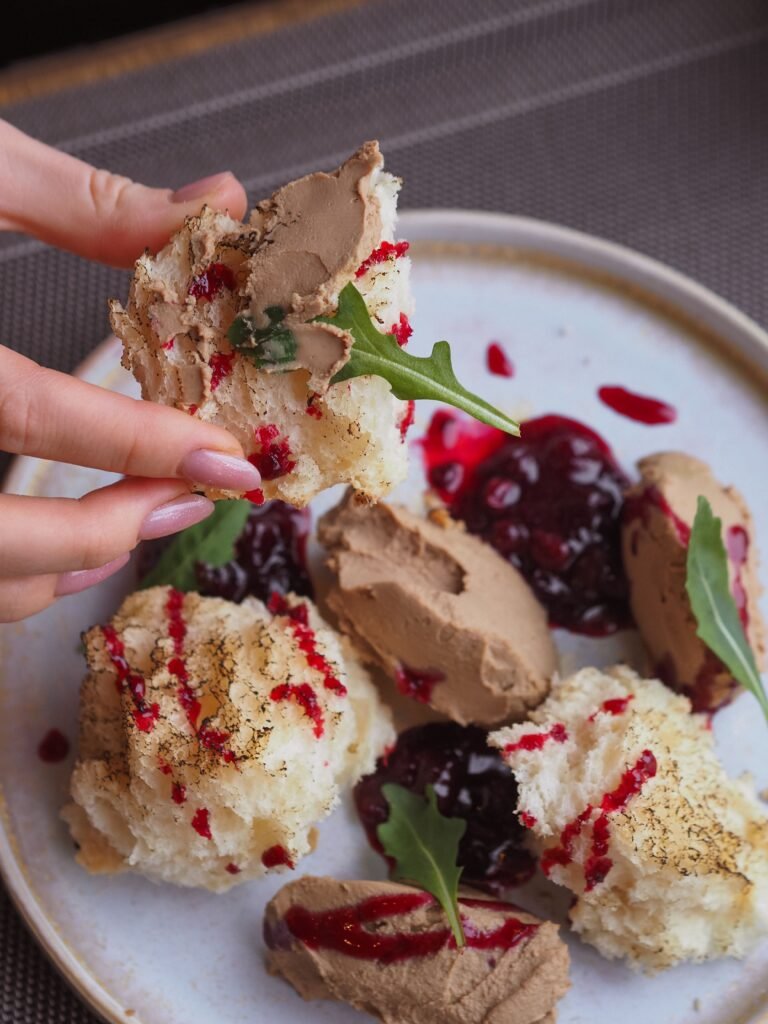
Depending on the preparation, foie gras may be served chilled as a terrine or pâté-style product, or cooked briefly in a hot pan.
It is particularly associated with festive meals, Christmas celebrations, and traditional French fine dining.
However, the production method is an essential part of understanding what foie gras actually is.
How Is Foie Gras Produced?
Traditional foie gras production involves a process called gavage.
During the final fattening period, ducks or geese are fed through a tube inserted into the esophagus.
The additional feed causes fat to accumulate in the liver, producing a condition called hepatic steatosis.
This results in a liver considerably larger and fattier than it would otherwise be.
Under French law, foie gras is specifically defined as the liver of a duck or goose fattened by gavage.
It is therefore important not to describe conventional foie gras simply as ordinary duck or goose liver.
The production method is part of the product’s legal and culinary identity.
Why Is Foie Gras Controversial?
Foie gras occupies an unusual place in French food culture.
For many producers, chefs, and consumers, it represents an important gastronomic tradition associated with craftsmanship, regional identity, and festive food.
France formally recognizes foie gras as part of its protected cultural and gastronomic heritage.
At the same time, force-feeding raises substantial animal-welfare concerns.
The use of feeding tubes, repeated handling, and the deliberate enlargement of the liver are central points of criticism.
Scientific reviews have identified risks including injuries to the upper digestive tract, impaired mobility, changes in liver function, and increased mortality under some production conditions.
Producers and industry representatives have disputed some interpretations of animal-welfare research and emphasize husbandry practices and the biology of waterfowl.
Nevertheless, the scientific evidence raises significant welfare concerns that cannot reasonably be ignored.
This is why foie gras production is restricted or prohibited in various jurisdictions, and why the product continues to be debated internationally.
Understanding that controversy does not require pretending that foie gras has no place in French culinary history.
Nor does appreciating French gastronomy require overlooking how the product is made.
For readers who prefer not to consume force-fed foie gras, there are ordinary duck liver preparations and plant-based alternatives, although these have different flavors and textures.
Is Duck Confit Connected to Foie Gras Production?
This is an important distinction.
Duck confit does not require foie gras production.
The legs of ordinary ducks can be prepared using the traditional confit method.
However, some commercial duck confit comes from ducks raised within the foie gras industry, because different parts of those birds are used for different products.
So the relationship depends on the producer and the supply chain.
If this matters to you, ask your butcher or supplier about the origin of the duck.
A label saying confit de canard describes how the meat is prepared. It does not, by itself, tell you whether the bird was force-fed.
Duck Foie Gras vs Goose Foie Gras
Foie gras can be made from duck or goose liver.
Both are traditional, but their culinary characteristics differ.
Duck foie gras tends to have a somewhat more pronounced flavor.
Goose foie gras is often described as more delicate, with a subtly different texture and aroma.
Individual producers, processing methods, and serving temperatures also influence the result.
Goose foie gras is generally less common and can be more expensive.
Neither type should be confused with ordinary duck or goose liver.
Understanding Foie Gras on a French Menu
French restaurants and delicatessens use several different terms.
Knowing what they mean is helpful, particularly when choosing a product.
Foie Gras Entier
This refers to a preparation made from one whole foie gras or one or more intact lobes, together with permitted seasoning.
It is often associated with premium presentations.
Foie Gras
Under French labeling rules, this describes a preparation made from pieces of foie gras lobes brought together with seasoning.
Bloc de Foie Gras
This is a reconstituted preparation made from processed foie gras.
It usually has a smooth, uniform texture.
Foie Gras Mi-Cuit
Mi-cuit describes a gently heat-treated product that is commonly sold refrigerated.
It differs from shelf-stable sterilized preparations and must be stored according to the manufacturer’s instructions.
Foie Gras Poêlé
This means pan-seared foie gras.
Slices are cooked briefly over high heat, developing a browned exterior while retaining a soft interior.
It is commonly served as a warm restaurant dish.
Terrine de Foie Gras
A terrine is a preparation cooked and shaped in a mold, then generally served chilled in slices.
It is often accompanied by toasted bread and fruit-based condiments.
What Is the Difference Between Foie Gras and Pâté?
Foie gras and pâté are not the same thing.
Pâté is a broad culinary category.
It may contain liver, meat, fat, vegetables, herbs, and other ingredients depending on the recipe.
Foie gras is a specific ingredient subject to legal definitions in France.
A pâté may contain foie gras, but not every pâté does.
And ordinary duck liver pâté is not automatically foie gras.
This distinction matters when reading labels or restaurant menus.
How Is Duck Confit Served in French Restaurants?
One of the most traditional presentations is a crisp duck leg served with potatoes cooked in duck fat.
You may see pommes sarladaises on the menu.
These are potatoes associated with the Sarlat area of Périgord, traditionally prepared with duck or goose fat, garlic, and parsley.
Duck confit can also be served with lentils, white beans, seasonal vegetables, or a simple green salad.
Another famous use is cassoulet.
This hearty southwestern French dish combines slow-cooked white beans with meat, often including duck confit and pork.
The result is rich, substantial, and deeply comforting.
How to Make Duck Confit at Home
Although traditional duck confit takes time, the technique itself is straightforward.
The most important things are gentle cooking, proper seasoning, and a good finish.
For home cooking, this version is intended to be eaten shortly after preparation rather than preserved for extended storage.
Classic French Duck Confit
Serves: 4
Preparation time: 20 minutes
Curing time: 12–18 hours
Cooking time: Approximately 3–4 hours
Finishing time: 15–20 minutes
Ingredients
- 4 duck legs, approximately 300–350 g (10–12 oz) each
- 20 g fine salt
- 4 garlic cloves, lightly crushed
- 4 sprigs fresh thyme
- 2 bay leaves
- 1 teaspoon freshly cracked black pepper
- Approximately 1–1.5 kg (2.2–3.3 lb) rendered duck fat, enough to submerge the legs in a snug ovenproof pot
Instructions
Step 1 — Season the duck
Place the duck legs in a shallow dish.
Rub them evenly with the salt and black pepper.
Add the garlic, thyme, and bay leaves.
Cover and refrigerate for 12–18 hours.
Step 2 — Prepare for cooking
Preheat the oven to 120°C (250°F).
Remove the duck legs from the refrigerator and brush off the excess surface salt and aromatics.
Pat the skin and meat dry with clean kitchen paper.
Step 3 — Add the duck fat
Arrange the legs in a snug, ovenproof pot.
Melt the duck fat gently and pour it over the duck until the legs are submerged.
Cover the pot.
Step 4 — Cook slowly
Place the pot in the oven and cook gently for approximately 3–4 hours.
The fat should remain at a very gentle simmer, never a vigorous boil. Check occasionally and adjust the oven if needed.
The duck should become tender enough that the meat yields easily when tested with a fork.
For food safety, use a thermometer to confirm the thickest part of each leg has reached at least 74°C (165°F), away from the bone.
Step 5 — Remove the duck
Carefully lift the cooked duck legs from the fat.
Allow any excess fat to drain away.
If you are serving them immediately, continue with the next step.
Step 6 — Crisp the skin
Increase the oven temperature to 220°C (425°F).
Place the duck legs skin-side up on a baking tray.
Roast for approximately 15–20 minutes, or until the skin becomes golden and crisp.
Keep an eye on the skin during the final minutes to prevent burning.
Step 7 — Serve
Serve with potatoes roasted in duck fat, a little garlic, and fresh parsley.
A simple green salad with a sharp vinaigrette is particularly good alongside.
Isabeau’s Tip
Don’t throw away all that duck fat.
Strain the fat through a fine sieve while it is still liquid, taking care to separate it from meat juices and moisture.
Cool it promptly and refrigerate or freeze it in a clean container.
It is wonderful for roasting potatoes.
However, homemade confit stored beneath fat is not automatically shelf-stable. Treat the cooked duck as a perishable food and refrigerate leftovers promptly.
How Long Can Homemade Duck Confit Be Stored?
Traditionally, confit was associated with preservation.
But modern home cooks should not assume that duck covered in fat can safely be stored for weeks at room temperature.
The fat layer does not guarantee protection against dangerous bacteria.
For this home recipe, cool and refrigerate leftovers within two hours.
Keep the cooked duck refrigerated at 4°C (40°F) or below and use it within three to four days.
Alternatively, freeze portions for longer storage.
Reheat leftovers thoroughly to 74°C (165°F).
These precautions are particularly important because slow cooking in fat is not the same as a validated commercial preservation process.
How to Choose Duck for Confit
For confit, choose duck legs with the skin attached.
Legs contain more connective tissue than breast meat, making them particularly suitable for extended gentle cooking.
Ask your butcher about the breed and origin if that information matters to you.
In France, you may encounter duck from breeds and crosses associated with the country’s traditional duck industry.
However, breed alone does not tell you everything about farming conditions.
If you want to avoid birds raised for foie gras, ask specifically whether the ducks were force-fed.
What Can You Serve With Duck Confit?
Duck confit is rich, so it benefits from sides that provide contrast.
Potatoes roasted in duck fat are a classic choice.
Other delicious accompaniments include creamy white beans, lentils, sautéed mushrooms, braised red cabbage, or a sharply dressed green salad.
For a slightly more modern presentation, roasted carrots or a fruit-based sauce can work well.
The important thing is to balance the richness rather than making every component of the plate equally heavy.
What About Foie Gras Alternatives?
The debate surrounding foie gras has encouraged interest in other products.
Some chefs make pâtés using ordinary duck or chicken liver.
Others prepare plant-based terrines using mushrooms, nuts, lentils, or vegetable fats to create a rich spreadable texture.
There are also producers exploring alternative methods of fattening without force-feeding.
These products may appeal to people who enjoy the culinary style but want to avoid conventional foie gras.
However, ordinary liver pâté and plant-based terrines should not be presented as identical to traditional foie gras.
They have their own ingredients, textures, and production methods.
Frequently Asked Questions About Duck Confit and Foie Gras
Is duck confit the same as foie gras?
No. Duck confit is meat, usually a duck leg, cooked slowly in fat. Foie gras is the enlarged liver of a duck or goose produced through a specific fattening process.
Does duck confit involve force-feeding?
Not necessarily. Ordinary duck legs can be used for confit, but some commercial confit comes from ducks raised for foie gras. Ask the producer about the origin.
Why is foie gras controversial?
Conventional foie gras production uses force-feeding to enlarge the liver. Animal-welfare concerns include injuries, impaired mobility, and changes to liver function.
Is foie gras illegal in France?
No. France recognizes foie gras as part of its gastronomic heritage, and production remains legal under applicable regulations.
Can you make duck confit without duck fat?
You can slowly cook duck in other fats, but it will not have quite the same traditional character. Duck fat is an important part of classic confit de canard.
Can duck confit be made in advance?
Yes. After cooking, cool it promptly, refrigerate it, and finish crisping the skin when ready to serve. Follow normal cooked-poultry storage recommendations.
What is the difference between duck breast and duck confit?
Duck breast is a cut of meat, often cooked by roasting or pan-searing. Duck confit is a cooking method traditionally used for duck legs.
Is foie gras always made from duck?
No. It can be made from duck or goose liver.
Understanding French Food Beyond the Restaurant Menu
French cuisine is full of dishes whose histories are much more interesting than their elegant restaurant presentations might suggest.
Duck confit began as a practical method of cooking and preserving meat.
Today, it remains one of the most recognizable dishes of southwestern France, appreciated for its tender meat and beautifully crisp skin.
Foie gras has a different history.
It remains an important part of French gastronomic identity, but its production raises serious questions about animal welfare.
Both deserve accurate explanations.
For me, understanding where food comes from is part of learning to cook well.
It allows us to appreciate the techniques, traditions, and ingredients behind a dish while making informed decisions about what we choose to eat.
And when it comes to duck confit, there is something especially satisfying about discovering that a dish served in a beautiful French restaurant can also be made in your own kitchen.