Hi friends! In most countries, a tin of fish is something you keep at the back of the pantry for emergencies. In Spain, it’s a delicacy. Walk into a tapas bar, and you may find tins of mussels or anchovies on the menu, served with bread and a glass of vermouth. And in France, you’ll find shelves of sardine tins with beautiful old-fashioned labels.
We see them in both countries, and we love them. So let’s find out what conservas are, what the main types are, how to choose a good one, and how to eat them. We’ll also look at what they cost.
What Are Conservas?
Conservas is the Spanish word for preserved food, and in practice, it usually means tinned seafood. The fish or shellfish is cooked or cured, packed in a tin with oil or a sauce, and sealed. The result keeps for a long time, but the best ones are far from basic. In fact, Spain makes some of the highest-quality tinned food in the world.
The Main Types
Here are the ones you’re most likely to see:
| Type | What it is |
|---|---|
| Cantabrian anchovies | Salt-cured for 8 to 18 months, then packed in oil. The most artisanal of all |
| Bonito del norte | A white tuna from the Cantabrian season, sold in olive oil, natural, or escabeche |
| Light tuna | Cheaper, firmer, and less flavorful. Good for budget salads |
| Mussels | In escabeche, oil, or natural. Galician mussels are rated the best |
| Cockles | In their natural juices. The size is the main sign of quality |
| Sardines | In olive oil or tomato. They improve with age |
| Clams | In their own broth. Clams from the Galician rías are rated highest |
| Mackerel | In oil. Fattier, richer in omega-3, and more affordable |
You’ll also find more luxurious ones, such as zamburiñas (small scallops) from Galicia and razor clams.
Oil, Escabeche, Natural, or Tomato?
What’s in the tin with the fish makes a big difference:
| Liquid | What it’s like | Best for |
|---|---|---|
| Olive oil | Rich and silky | Eating straight from the tin, and on toast |
| Escabeche | Acidic and complex, with vinegar and spices | A ready-to-eat appetizer |
| Natural | Pure, marine flavor | Cooking, especially rice dishes |
| Tomato | Sweet and tangy | Toast and sandwiches |
| Sunflower oil | Neutral | Salads |
How to Read the Tin
If you want to buy a good one, check the label for these signs:
- The cannery’s name: not just a factory code.
- A specific origin: “Cantabrian Sea” is better than a vague “Atlantic.”
- Olive oil: extra virgin olive oil is a better sign than “vegetable oil.”
- The size: fewer pieces per tin means bigger, higher-grade seafood.
- A canning date: not just a best-before date.
Keep in mind that this advice comes from a shop that sells gourmet tins, so use it as a guide, not a rule.
Where Does It Come From?
Spain and France both have a long tradition of tinned fish, and it all began with one invention.
The Invention
In the early 1800s, a Frenchman named Nicolas Appert found a way to preserve food in airtight containers. Napoleon had offered a reward of 12,000 francs to anyone who could find a way to keep food fresh for his armies, and Appert won it. The tin can industry was born.
France: Sardines From Nantes to Brittany
Around 1824, Joseph Colin, a confectioner in Nantes, used the method to preserve sardines in oil. Soon, canneries opened up and down the Atlantic coast, from Loire-Atlantique to southern Finistère in Brittany, and especially in Concarneau. By 1880, about 150 factories in the region employed more than 15,000 people, most of them women. Production declined in the 1960s, but the tradition lives on.
Spain: Galicia, Cantabria, and the North
In Spain, most of the conserva businesses are in Galicia. The Cantabrian coast, the Basque Country, and parts of Andalucía are also known for their quality. Cantabria is famous for anchovies and bonito del norte, and Galicia for mussels, clams, and cockles.
What Does It Taste Like?
Good tinned seafood tastes fresh, rich, and savory, and it’s quite different from the dry, bland fish you may remember.
- Anchovies: artisanal ones are buttery, while the cheaper ones are firmer and saltier.
- Sardines: soft and rich, and they soften further in the oil over time.
- Mussels in escabeche: tangy, with paprika, vinegar, and spice.
- Bonito del norte: white, tender, and mild.
Vintage Sardines
In France, some sardines are labeled millésimées, which means “vintage,” just like wine. The idea is that the oil slowly softens and flavors the fish over the years. Cans should be turned about every six months so the fish and the oil stay in contact. Experts think most tins peak between one and five years after they’re made, and some French houses say their special vintage editions improve for seven to ten years.
How to Use It in Cooking
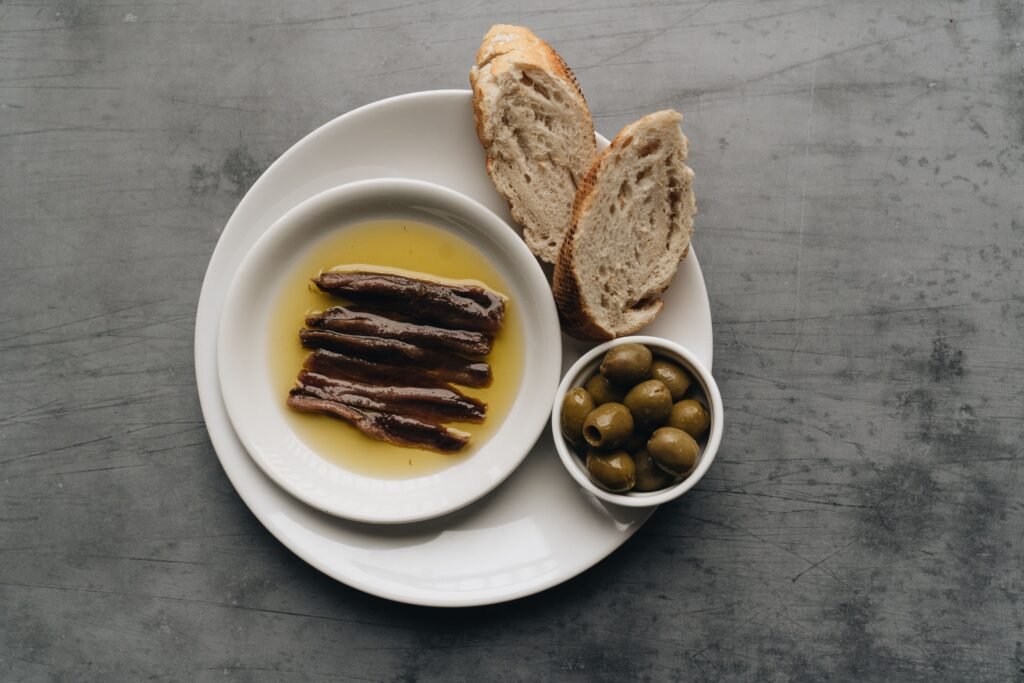
The best way to enjoy conservas is the simplest: open the tin, put it on a plate, and eat it with good bread.
The Spanish Way
In Spain, conservas are part of the aperitivo, the salty, briny snacks you have with wine or vermouth before a bigger meal. Put the tin on the table with bread, olives, and a glass of vermouth or sherry, and you have an instant tapa.
Three Easy Ideas
1. Tin and bread. Serve a tin of mussels in escabeche or sardines in olive oil on a plate, with crusty bread and a cold drink.
2. Mackerel toast. Spoon mackerel in escabeche onto toast, and top it with chopped fresh tomato.
3. Sardine spaghetti with lemon. Cook 8 ounces of spaghetti. Meanwhile, warm a tin of sardines in oil in a pan with a clove of garlic, and stir in lemon zest and chopped parsley. Toss with the pasta, and add a squeeze of lemon.
Don’t throw away the oil from an anchovy tin. You can drizzle it over salads, pasta, or toast.
What Does It Cost?
Here’s what we found in Spain. The prices are for tins, and we’ve noted the dates.
| Product | Price | Date |
|---|---|---|
| Sardines in olive oil, Mercadona (Hacendado), 117 g per tin | €1.90 for a pack of 2 | August 2024 |
| Large mussels in escabeche, Mercadona (Hacendado), 6 to 8 pieces | €4.95 (limited release) | July 2026 |
| Mackerel fillets in tomato, Mercadona (Hacendado), 160 g | €2.85 | undated |
| Mackerel fillets in olive oil, low salt, Mercadona (Hacendado), 170 g | €3.45 | undated |
| Anchovies in olive oil, Mercadona, 50 g tin | about €2 to €7 | March 2026 |
Artisanal anchovies cost much more, at about €8 to €20 for a 50 g tin, according to a gourmet shop. That’s a big step up, so it’s worth tasting a good one at least once.
What Can You Substitute?
Nothing is quite the same as a good tin, but here are some options:
- Fresh sardines or mackerel: grill them with olive oil and salt. It’s a different dish, but just as delicious.
- Anchovy paste: a good way to add the savory flavor of anchovies to sauces.
- Regular tinned tuna: fine for salads, but it won’t have the same depth as bonito del norte.
How to Store It
An unopened tin lasts for a long time. The date on the tin is a best-before date, not an expiry date, and a tin stored in a cool, dark place can last for years after it. Avoid tins that are dented, bulging, or leaking.
Once you open a tin, move the leftovers to a glass or plastic container, and keep it in the fridge. Eat it within two or three days. Vintage sardines, on the other hand, should be turned every five or six months, so the oil keeps coating the fish.