From brightly painted garlic graters to traditional brown cooking dishes, Spanish pottery is as much a part of Mediterranean food culture as olive oil, fresh seafood, and a good loaf of bread. But how do you know which ceramics are safe for cooking, and which are simply meant to look beautiful?
I have a weakness for Spanish pottery.
Give me a little village shop filled with hand-painted bowls, traditional clay dishes, and colorful ceramics, and there’s a very good chance I’ll disappear inside for quite some time.
Since Sam and I moved to our old farmhouse in Alcalalí, I’ve discovered that pottery is everywhere in this part of Spain.
You’ll find it at local markets, in family-run shops, at artisan workshops, and in restaurants where traditional dishes are still brought to the table in earthenware.
Some pieces are beautifully decorated, with bright blues, yellows, and greens. Others are wonderfully simple: brown glazed dishes that look as though they have belonged in a Spanish kitchen forever.
But there is an important difference between buying a pretty ceramic bowl and choosing a clay dish you can actually cook in.
And it’s a difference worth understanding before you put your latest Spanish market find into a hot oven.
Why Is Pottery So Important in Spain?
Pottery has been part of everyday life on the Iberian Peninsula for thousands of years.
Long before modern cookware and plastic storage containers, people relied on clay vessels to carry water, preserve food, store olive oil, cook meals, and serve dishes at the table.
Different regions developed their own traditions, influenced by locally available clay, techniques passed between generations, and centuries of cultural exchange.
Roman pottery, Islamic ceramic traditions in medieval Spain, and later regional workshops all contributed to the enormous variety of Spanish ceramics.
Some places became famous for decorative tiles and richly painted tableware.
Others specialized in the more practical pieces that farmers, cooks, and families needed every day.
And that is why Spanish pottery is such a fascinating subject.
Behind almost every jug, bowl, and cooking pot is a story about how people once lived.
Colorful Spanish Pottery: More Than a Souvenir
If you’ve ever visited a Spanish market, you’ll probably recognize those displays of brightly painted ceramics.
There are bowls in every imaginable size, olive dishes, plates, pitchers, tiles, and small kitchen accessories decorated with traditional patterns.
Some are produced in large quantities for the souvenir trade.
Others are genuinely handmade by skilled ceramic artists.
And quite a few fall somewhere in between.
I think that’s an important distinction.
Colorful doesn’t automatically mean tourist pottery, and simple brown pottery isn’t automatically handmade or suitable for cooking.
What matters is how the piece was made and what it was designed to do.
Those Colorful Spanish Garlic Graters
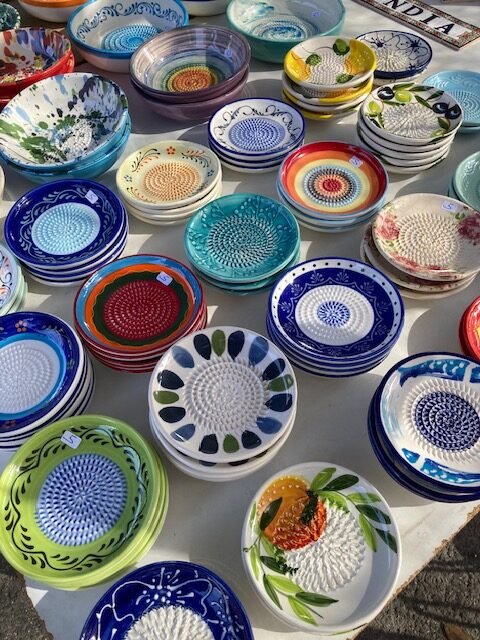
One of my favorite examples is the little ceramic garlic grater, known as a plato rallador.
You may have seen them in Spanish markets: small, shallow ceramic dishes with a textured circle in the center, often surrounded by beautiful painted patterns.
They’re surprisingly useful.
Rub a peeled clove of garlic over the raised ceramic surface and it becomes a fine pulp.
You can do the same with ginger or fresh tomato, depending on the design and texture of the grater.
Add a little olive oil to the garlic, perhaps some salt and lemon juice, and you have the beginning of a delicious dressing or marinade.
Some are sold with small brushes that help you collect every last bit of garlic.
I love kitchen tools like this.
They’re attractive enough to leave on a shelf, but they actually earn their place in the kitchen.
Just make sure the surface is intended for food preparation and that the glaze is food-safe.
Can You Serve Food in Decorative Spanish Ceramics?
Yes, provided the ceramic piece has been made and sold for food contact.
A colorful bowl can be perfectly suitable for olives, almonds, dips, or a little tapas dish.
But a decorative plate intended for hanging on the wall should not be assumed safe for serving food.
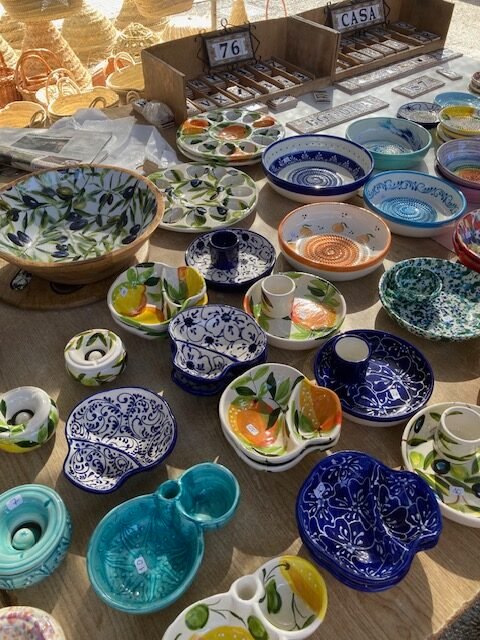
Appearance alone tells you very little.
A glossy glaze does not guarantee food safety, and traditional patterns do not necessarily mean a piece was handmade.
If you’re buying pottery from a market or small shop, it’s always worth asking the seller what the piece is intended for.
What Is a Cazuela de Barro?
Now let’s talk about the other side of Spanish pottery.
The simple brown dishes you often see in traditional restaurants.
These are known as cazuelas de barro, literally clay cooking dishes.
The word cazuela refers to a cooking dish or casserole, while barro means clay.
They come in different shapes and sizes.
Some are small, shallow dishes for individual portions of tapas.
Others are larger vessels for stews, baked dishes, and traditional family meals.
Many are made from earthenware and finished with a brown glaze.
They’re practical, attractive, and closely connected with Spanish cooking.
Why Are Cazuelas Used for Gambas al Ajillo?
One of the most recognizable dishes served in a cazuela is gambas al ajillo, Spanish garlic prawns.
If you’ve ordered them in a traditional Spanish restaurant, you probably remember the dish arriving at the table with the olive oil still bubbling around the prawns and sliced garlic.
That little brown clay dish is part of the experience.
Suitable cooking cazuelas retain warmth well, helping the food stay hot at the table.
But there’s something important to understand.
Not every dish that looks like a traditional cazuela is designed to withstand cooking temperatures.
Some are intended only for serving prepared food.
Others can be used in an oven.
And certain specially manufactured models can be used over direct heat.
Always check before using one.
The Difference Between Cooking Pottery and Serving Pottery
This is probably the most useful thing to know before buying Spanish ceramics.
There are three different questions to ask:
Is it safe for food?
Can it go into the oven?
Can it be used on the stovetop?
Those are three separate properties.
A food-safe bowl may be excellent for serving a salad but unsuitable for the oven.
An oven-safe casserole may not tolerate direct contact with a gas flame.
And a traditional-looking clay pot might be decorative rather than functional.
The color of the clay or glaze doesn’t tell you which category it belongs to.
Oven-Safe Pottery
Some cazuelas are manufactured specifically for oven cooking.
They may be suitable for baked vegetables, meat dishes, casseroles, and other recipes.
However, there is no universal maximum temperature for all Spanish earthenware.
Always follow the manufacturer’s instructions.
Earthenware can also be sensitive to thermal shock, which happens when the material experiences a sudden, extreme temperature change.
Putting a cold clay dish into intense heat, or placing a very hot dish onto a cold or wet surface, can cause cracking.
Pottery for Direct Heat
Some traditional Spanish cooking vessels are specifically designed for use over a flame.
These may be described as barro refractario, apto para fuego, or cazuela de fuego, depending on the product.
But even these pieces have limits.
Certain types require gradual heating or a heat diffuser.
Ordinary earthenware is generally unsuitable for induction cooking unless the manufacturer provides a compatible system.
Never put a ceramic dish directly onto a burner simply because it looks like a traditional Spanish cooking pot.
Serving-Only Pottery
Other pieces are designed to serve food rather than cook it.
They may be completely food-safe, but they shouldn’t be placed in the oven or over a flame.
A beautiful hand-painted bowl for olives belongs in this category unless its maker tells you otherwise.
And there’s absolutely nothing wrong with that.
Not everything in the kitchen needs to be cookware.
Some pieces are there to make the table beautiful.
A Visit to Alfarería Berenguer in Orba
One of the lovely things about living in the Marina Alta is discovering how many traditional crafts are still connected to the surrounding villages.
Not far from our farmhouse in Alcalalí is Orba, a village with a particularly interesting pottery history.
I’ve visited Alfarería Berenguer, also known as Orbalfar, several times.
It is exactly the kind of place I find difficult to resist.
Instead of looking at pottery as anonymous merchandise, you’re visiting a business connected with a local craft that has survived for generations.
And one of the most fascinating things there is the old traditional kiln.
Seeing a historic wood-fired pottery oven gives you a completely different appreciation of the work involved.
Before modern temperature controls, experienced potters had to understand their clay, their fuel, and the behavior of the fire.
Making pottery required much more than shaping something attractive.
The pieces had to be dried carefully, fired successfully, and finished according to their intended purpose.
A mistake during the process could mean losing hours or days of work.
And what I particularly love about Orba is that the pottery tradition isn’t simply something invented for visitors.
It belongs to the history of the village.
Orba and Orbeta: Two Different Pottery Traditions
There is a fascinating historical distinction between Orba and the nearby village of Orbeta.
Traditionally, potters in Orba specialized in everyday items such as jugs, mortars, plant pots, and other household or agricultural vessels.
In Orbeta, the craft developed a particular association with pottery intended for cooking.
Potters produced clay casseroles, cooking pots, and even vessels used for making hot chocolate.
The local tradition used different types of clay according to the items being made.
Orba was associated with lighter-colored pottery, while Orbeta became known for red-clay cooking vessels.
The distinction wasn’t absolute, and workshops changed over time, but it tells us something fascinating about the importance of local specialization.
People didn’t simply make pottery because it looked attractive.
They made the objects their neighbors needed.
The documented history of pottery production in Orba and Orbeta stretches back to the seventeenth century.
And remarkably, the tradition hasn’t disappeared entirely.
The Museu del Fang: Orba’s Pottery Museum
If you’re interested in pottery and happen to visit Orba, there’s another place worth knowing about.
The village has a pottery museum called the Museu del Fang, or Museum of Clay.
It explores the history of the local pottery industry and the people who worked in it.
The collection includes traditional pieces and material connected with the craft, helping visitors understand how important pottery once was to the village economy.
It’s a lovely reminder that ordinary household objects are also part of cultural history.
A simple clay jug or casserole can tell us just as much about everyday life as a more elaborate decorative object.
Famous Pottery Traditions Across Spain
Orba is only one example of Spain’s rich ceramic heritage.
Different parts of the country are known for their own distinctive styles.
Manises, Valencia
Manises, near Valencia, has a long and internationally important ceramic tradition.
Its history includes the production of decorated wares and lustre ceramics, particularly associated with medieval and later Valencian craftsmanship.
Today, Manises remains an important name in Spanish ceramics.
Talavera de la Reina, Castilla-La Mancha
Talavera is famous for its decorated ceramic tableware and tiles, often featuring blue, yellow, and other distinctive colors.
The town has a rich tradition of pottery craftsmanship, and its ceramics are among the best-known in Spain.
La Bisbal d’Empordà, Catalonia
La Bisbal is another celebrated ceramic town, particularly known for its pottery shops, workshops, and local production.
Its ceramics include both decorative pieces and useful household wares.
The interesting thing is that there isn’t one single style of Spanish pottery.
Spanish ceramics reflect regional materials, history, artistic tastes, and everyday needs.
Is Spanish Pottery Food-Safe?
This is an important question, particularly when buying ceramics from markets or antique shops.
Some traditional glazes and decorative materials have historically contained lead or cadmium.
These substances can be harmful if they migrate into food.
In the European Union, ceramic products intended to come into contact with food are subject to specific rules limiting the transfer of these substances.
That means it is sensible to choose ceramics sold for food use and to ask the seller for clarification if you are unsure.
Be especially careful with older, unmarked, damaged, or purely decorative items.
Acidic foods such as tomato sauces, vinegar-based dishes, and lemon dressings deserve particular attention because unsuitable glazes may release unwanted substances into food.
If you cannot establish that a piece is suitable for food contact, use it for decoration instead.
And remember: food-safe does not automatically mean oven-safe.
How to Choose Spanish Pottery for Your Kitchen
Whenever I’m tempted by a beautiful piece of Spanish pottery, I try to think about how I will actually use it.
For Olives, Nuts, and Tapas
Choose small bowls or serving dishes that are clearly intended for food contact.
Colorful designs can look wonderful on a simple Mediterranean table.
For Garlic and Dressings
A ceramic plato rallador is a useful little tool.
Look for a comfortable size, a good textured grating surface, and a finish suitable for food preparation.
For Hot Tapas
If you want to serve dishes such as gambas al ajillo in traditional brown pottery, check whether the cazuela is suitable for hot food and how it should be heated.
A serving dish may be perfect for transferring already-cooked prawns, but it must not be used as cookware unless approved for that purpose.
For Oven Cooking
Buy a cazuela specifically rated for oven use.
Check the maximum temperature, whether preheating is allowed, and any special care instructions.
For Cooking Over a Flame
Choose pottery explicitly designed for direct heat.
Ask about compatible burners, diffusers, and heating precautions.
If the seller cannot confirm that it is suitable, don’t take the risk.
How to Care for Traditional Earthenware
Earthenware can be a wonderful addition to the kitchen, but it benefits from thoughtful handling.
Wash and dry each piece according to the maker’s instructions.
Some traditional unglazed or partially glazed cookware needs special preparation before its first use, while other pieces are ready to use immediately.
Don’t assume all clay cookware needs soaking or seasoning.
Avoid sudden temperature changes, which can cause cracks.
Never place a hot clay dish on a cold or wet countertop.
A wooden board or suitable heatproof trivet is usually a better choice.
If a piece becomes cracked, chipped, or develops damage to the food-contact glaze, stop using it for food until its suitability has been assessed.
And if you’re unsure whether something is dishwasher-safe, handwashing is generally the more cautious option.
Frequently Asked Questions About Spanish Pottery
What is traditional Spanish pottery called?
Spanish pottery is commonly referred to as cerámica or alfarería. Earthenware is often called barro, while traditional clay cooking dishes are known as cazuelas de barro.
What is a cazuela de barro?
A cazuela de barro is a clay cooking or serving dish used in traditional Spanish kitchens. Different designs may be suitable for oven cooking, stovetop use, or serving only.
Can you put Spanish pottery in the oven?
Only if the piece is explicitly rated for oven use. Decorative ceramics and many serving dishes are not designed to withstand cooking temperatures.
Can cazuelas de barro be used on a gas stove?
Some can, but only models specifically approved for direct heat. Follow the manufacturer’s instructions, including any requirement for gradual heating or a heat diffuser.
Are colorful Spanish ceramic bowls safe for food?
They can be, provided they are manufactured for food contact. Bright colors are not themselves a sign that a piece is unsafe.
What are Spanish ceramic garlic graters?
They are small dishes with a raised, textured surface that can be used to grate garlic, ginger, or other suitable ingredients. In Spain, they are often called platos ralladores.
Where can you buy traditional pottery on the Costa Blanca?
You can find pottery in artisan shops, markets, and workshops throughout the region. Orba, in the Marina Alta, has a particularly interesting pottery heritage, including traditional workshops such as Alfarería Berenguer.
Is all brown Spanish pottery suitable for cooking?
No. Brown glaze and traditional appearance do not guarantee oven or stovetop suitability. Always confirm the intended use before heating a piece.
Bringing a Little Spanish Pottery Home
I think one of the nicest things about furnishing a kitchen in Spain is collecting pieces that have a story behind them.
A small ceramic garlic grater discovered at a village market.
A hand-painted bowl for olives.
A traditional brown cazuela for serving tapas.
Or a beautiful piece of earthenware from a workshop in Orba, where pottery has been part of the village’s identity for centuries.
They don’t all need to match.
In fact, I rather like it when they don’t.
Every piece reminds me of a market, a village, a conversation, or a place we’ve visited.
And once you understand the difference between decorative ceramics, food-safe serving dishes, and genuine cooking pottery, choosing the right piece becomes much easier.
Spanish pottery isn’t simply something to bring home as a souvenir.
At its best, it’s a small part of Mediterranean life that you can use and enjoy every day.