There is something about the Mediterranean that seems to encourage extraordinary stories.
Perhaps it’s the islands rising unexpectedly from the sea, the ancient villages, or the way mountains can disappear into mist and reappear when the sun comes out.
Living in our old farmhouse in Alcalalí, I’ve become increasingly fascinated by the legends of this part of Spain.
There’s the giant Roland, who supposedly split the mountain behind Benidorm with his sword.
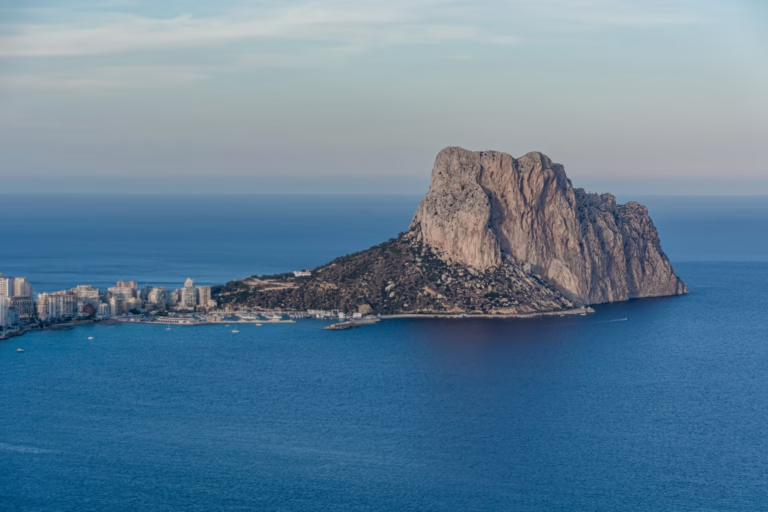
Then there’s the Peñón de Ifach in Calpe, where an evil spirit is said to have been trapped in stone after terrorizing the local mermaids.
And just when I thought these stories couldn’t possibly become any more peculiar, I discovered something rather extraordinary.
According to a modern legend, the great rock of Calpe is connected to another remarkable limestone formation across the Mediterranean: Es Vedrà, a small, uninhabited island off the southwestern coast of Ibiza.
And apparently, there’s a third point.
Somewhere along the southwestern coast of Mallorca.
Together, these three places are said to form an extraordinary geographical mystery known as the Triangle of Silence.
Naturally, I had to find out more.
Three Rocks, One Mysterious Mediterranean Triangle
On a map, the arrangement seems almost deliberate.
The Peñón de Ifach rises above the town of Calpe on mainland Spain. Across the water, Es Vedrà stands just off Ibiza. Further east, the rugged coastline of Mallorca completes the triangle.
Three very different places, separated by stretches of Mediterranean water.
Yet according to the legend, something invisible connects them.
The story claims that within this triangle, navigational instruments occasionally malfunction, unusual lights appear over the sea, and sailors experience strange disturbances they struggle to explain.
Some accounts even suggest that the area possesses an unusual magnetic force.
It’s occasionally compared to the Bermuda Triangle, although on a much smaller scale.
Of course, a triangle drawn between three geographical landmarks doesn’t establish the existence of anything extraordinary.
And there’s no convincing scientific evidence that this particular stretch of the Mediterranean possesses unusual magnetic properties.
But the legend becomes considerably more interesting when you explore the stories associated with each of its corners.
Especially Es Vedrà.
Es Vedrà: The Island of Sirens, Goddesses and Strange Lights
Imagine standing on the western coast of Ibiza as the late afternoon sun begins to descend.
Out beyond the cliffs, rising almost vertically from the Mediterranean, is an enormous limestone island.
This is Es Vedrà.
At approximately 380 metres high, it’s an extraordinary sight. The island is uninhabited, protected, and surrounded by waters that can shift from deep blue to brilliant turquoise depending on the light.
It’s also one of the most mythologised places in the Balearic Islands.
And some of its stories are truly remarkable.
The Sirens of the Mediterranean
One of the most romantic legends connects Es Vedrà with the sirens of Homer’s Odyssey.
In Greek mythology, the sirens were dangerous creatures whose irresistible songs lured passing sailors towards destruction.
They weren’t necessarily the beautiful, fish-tailed mermaids we imagine today. In early Greek art, sirens were often depicted as creatures with the bodies of birds and the heads of women.
But over the centuries, the distinction between sirens and mermaids became blurred.
Some modern storytellers have suggested that Es Vedrà might have been the home of these mythical beings.
It’s an enchanting idea.
A lonely island, surrounded by open water, where mysterious singing once drifted across the waves.
There’s no historical evidence connecting Homer’s sirens specifically to Es Vedrà, and other Mediterranean locations have much stronger associations with the ancient story.
But standing before such an extraordinary rock, you can understand how the imagination begins to wander.
Tanit, the Ancient Goddess of Ibiza
Long before Ibiza became famous for its beach clubs and summer parties, the island was deeply connected with the ancient Mediterranean world.
Phoenician settlers established a presence here, and the island later became an important centre of Punic culture.
Among the deities worshipped in this world was Tanit, a goddess associated with fertility and protection.
Archaeological discoveries on Ibiza provide fascinating evidence of her importance.
Over time, Tanit also became associated with Es Vedrà in local spiritual traditions and modern interpretations of the island’s mythology.
Some stories describe the rock as a sacred place connected to her power.
It’s important to distinguish these later associations from archaeological evidence. There is no established proof that Es Vedrà itself was a sanctuary dedicated to Tanit.
Nevertheless, the connection between the island, an ancient goddess, and the mysterious rock has become part of Ibiza’s remarkable collection of legends.
And then there are the lights.
The Strange Lights Over Es Vedrà
For decades, stories have circulated about unusual lights appearing near Es Vedrà.
Fishermen, sailors, and visitors have described glowing objects above the water, unexplained movements in the sky, and occasionally lights that appear to vanish into the sea.
Some believers associate these accounts with unidentified flying objects.
Others suggest more conventional explanations, including aircraft, atmospheric effects, distant vessels, and misidentified natural phenomena.
The most famous incident connected with these stories happened in November 1979.
The 1979 Manises UFO Incident
On the evening of November 11, 1979, a commercial aircraft flying from Salzburg to Tenerife encountered what its crew believed were unexplained red lights over the western Mediterranean.
The aircraft, operated by the Spanish airline TAE, was diverted to Valencia’s Manises Airport.
The incident became one of Spain’s best-known UFO cases.
Spanish military aircraft were subsequently involved in investigating the reported phenomenon, and the episode generated considerable public interest.
The important detail is that the diversion itself was real.
What caused the reported lights remains a matter of interpretation and debate.
Over the years, the incident has become closely associated with the mythology surrounding Es Vedrà, although that association doesn’t establish that anything unusual occurred at the island itself.
It’s a fascinating example of how a documented event can become intertwined with a much larger collection of legends.
And Es Vedrà has another unusual story.
One involving a nineteenth-century priest.
The Priest Who Saw Mysterious Visions
In the nineteenth century, a Carmelite priest named Francisco Palau spent periods of solitude and religious contemplation in the area around Es Vedrà.
Palau, who later became known as Saint Francisco Palau, recorded intense spiritual experiences and visions.
His writings and his association with the island contributed to its reputation as a place of extraordinary spiritual significance.
For some people, these experiences are evidence of the island’s mysterious energy.
For others, they belong to the long Christian tradition of religious contemplation, symbolism, and mystical visions.
Whatever interpretation you prefer, the historical connection is genuine.
And I find that rather more interesting than the idea of compasses spinning wildly for no apparent reason.
Because it means Es Vedrà was attracting people searching for something beyond ordinary life long before the modern stories about UFOs and magnetic energy became popular.
The Peñón de Ifach: Our Own Mysterious Rock in Calpe
Back on the mainland, the other end of this supposed triangle feels considerably closer to home.
The Peñón de Ifach dominates the coastline at Calpe, not far from our village in the Jalón Valley.
It’s one of those landmarks you never quite stop noticing.
Sometimes its enormous limestone walls appear pale and almost golden. At other times, particularly beneath dark clouds, the rock looks dramatic and forbidding.
And naturally, a place like this has its own collection of legends.
One story tells of an evil spirit threatening the mermaids who lived in the surrounding waters.
According to versions of the tale, the spirit was eventually defeated and imprisoned within the great rock itself.
It’s a wonderful piece of coastal folklore, although its precise origins and age are difficult to establish.
What fascinates me is the similarity between the stories on either side of the water.
At Calpe, we have mermaids and a mysterious limestone giant.
At Es Vedrà, we find sirens, an ancient goddess, spiritual visions, and strange lights.
Two extraordinary rock formations, both rising dramatically from the Mediterranean, both attracting stories about supernatural beings.
Is there a mysterious force connecting them?
Or are people simply drawn to invent extraordinary stories about extraordinary landscapes?
I suspect the second explanation is more likely.
But that doesn’t make the connection any less interesting.
And What About Mallorca?
The third point of the Triangle of Silence is generally placed along the southwestern coast of Mallorca, although descriptions of its precise location vary.
Unlike Es Vedrà and the Peñón de Ifach, it isn’t always associated with one clearly defined rock or landmark.
Instead, the connection appears to be geographical: the stretch of Mediterranean coastline that completes the supposed triangle.
Mallorca, of course, has no shortage of myths of its own.
Its mountains, caves, remote coves, and ancient settlements have inspired generations of storytellers.
The Serra de Tramuntana in particular is a landscape that almost invites legends, with steep limestone mountains descending towards the sea.
Yet I couldn’t find convincing evidence of a historical tradition describing all three locations as a single mysterious triangle.
The name appears to belong primarily to modern accounts of Mediterranean mysteries rather than to a clearly documented ancient legend.
That distinction matters.
A story can be beautiful, intriguing, and worth preserving without necessarily being thousands of years old.
Is Es Vedrà Really One of the Most Magnetic Places on Earth?
This is probably the most frequently repeated claim about Es Vedrà.
According to some versions, the island is one of the three most magnetic places on Earth, alongside the North Pole and the Bermuda Triangle.
It’s a memorable statement.
Unfortunately, it isn’t supported by scientific evidence.
There is no recognised scientific ranking that places Es Vedrà among the most magnetic locations on the planet.
Nor is there reliable evidence that its limestone geology produces the extraordinary navigational disturbances described in popular accounts.
The Triangle of Silence itself has no established scientific status.
Which raises an obvious question.
Why has the story become so popular?
Perhaps because Es Vedrà looks exactly like the sort of place where something extraordinary ought to happen.
Its isolation, unusual shape, ancient associations, and dramatic setting create a perfect atmosphere for mystery.
Add a few stories about strange lights, a famous aviation incident, and a nineteenth-century mystic, and you have all the ingredients of an irresistible Mediterranean legend.
Why the Mediterranean Creates Such Extraordinary Legends
The more I explore the history of this region, the more I realise how closely its landscapes and mythology are connected.
For thousands of years, the Mediterranean was both a highway and a barrier.
Merchants, fishermen, soldiers, pilgrims, and travellers crossed its waters carrying stories from one civilisation to another.
Greek myths encountered Phoenician beliefs.
Roman traditions merged with local folklore.
Later generations added Christian saints, spirits, giants, and supernatural creatures.
And the sea itself remained an enormous source of uncertainty.
Before modern navigation, weather forecasting, and satellite technology, a sudden storm or unfamiliar coastline could transform an ordinary voyage into something terrifying.
A distant light might have been a vessel.
An unusual sound might have come from the wind moving through coastal caves.
An unexpected current might have seemed like the work of an unseen force.
Over time, such experiences became stories.
And stories, particularly the good ones, have a remarkable ability to survive.
The Real Mystery of the Triangle of Silence
One evening, sitting outside our farmhouse in Alcalalí, I found myself thinking about those three places again.
Calpe, Ibiza, and Mallorca.
On a clear day, the mountains surrounding our valley seem almost close enough to touch. Yet beyond them lies an enormous stretch of sea, scattered with islands and thousands of years of human history.
Somewhere out there stands Es Vedrà, its limestone cliffs catching the last light of the day.
Further away, Mallorca rises from the horizon.
And here on the Costa Blanca, the Peñón de Ifach watches over the Mediterranean, just as it has for countless generations.
I don’t believe these places are connected by an invisible magnetic force.
There is simply no convincing evidence for that.
But I do believe they are connected by something equally fascinating.
Human imagination.
For centuries, people have looked at the Mediterranean and tried to explain what they couldn’t understand.
They invented mermaids, giants, spirits, enchanted islands, and mysterious creatures beneath the waves.
Today, we’ve added UFOs, magnetic anomalies, and invisible triangles to the same extraordinary collection of stories.
Perhaps the real mystery isn’t what’s hiding beneath the water.
Perhaps it’s why we find it so difficult to look at a beautiful, lonely island without imagining that something magical must be happening there.
And to be perfectly fair, the next time I stand on the cliffs of Ibiza watching the sun disappear behind Es Vedrà, I’ll probably be wondering exactly the same thing.