Two traditional French sea salts, harvested from the same salt marshes but used in very different ways. Discover what makes fleur de sel so special, why coarse Guérande salt is naturally grey, and when to use each one in your kitchen.
I have a particular weakness for good salt.
Not because I believe every dish needs more of it, but because the right salt, used at the right moment, can make a surprising difference to the way food tastes.
And if you’ve ever stood in front of a display of beautiful French sea salts, you may have wondered about the difference between fleur de sel and gros sel de Guérande.
One is delicate, almost white, and often sold in a small, rather expensive container.
The other is coarse, slightly damp, and grey.
They come from the same part of France, sometimes even from the same salt pan.
So why are they so different?
The answer lies in how they’re harvested.
And once you understand that, knowing which one to use becomes wonderfully simple.
Where Does Guérande Salt Come From?
Guérande is a historic town near the Atlantic coast of western France, in the Loire-Atlantique department.
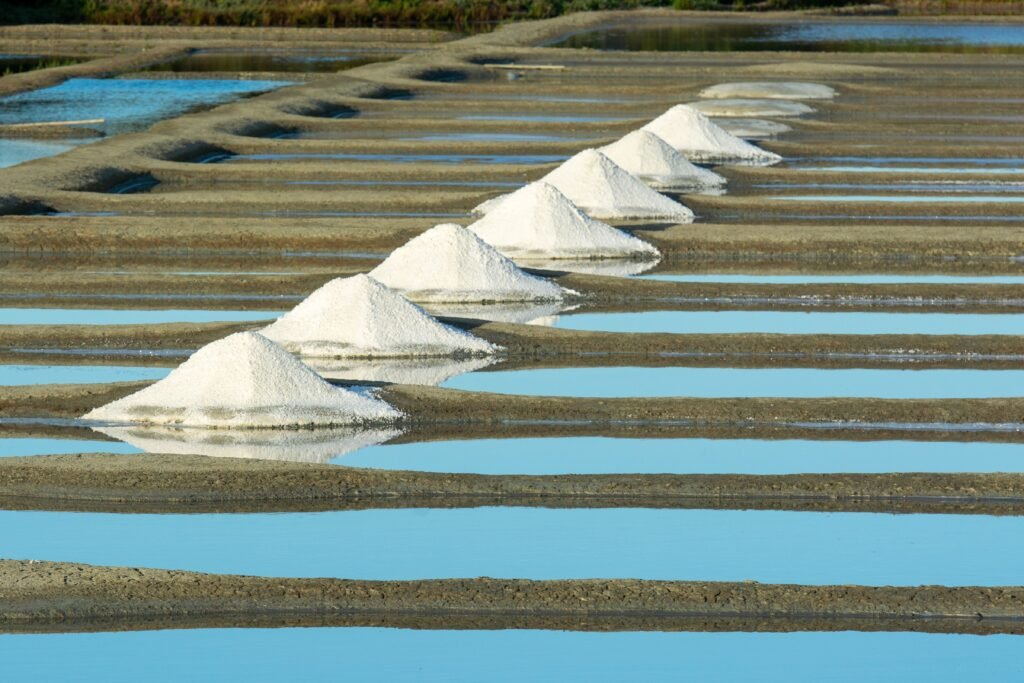
The surrounding salt marshes are part of a remarkable landscape of shallow pools, narrow channels, earthen banks, and open skies.
Salt has been produced here for centuries.
Rather than boiling seawater to extract the salt, traditional producers rely on the movement of water, sunshine, and wind.
Seawater passes through a series of shallow basins, gradually becoming more concentrated as water evaporates.
Eventually, the brine reaches the final harvesting pools, known as œillets.
This is where the salt crystals form.
The people who maintain and harvest these salt marshes are called paludiers.
Their work requires an intimate understanding of the weather, the water levels, and the delicate balance of the salt pans.
And here’s the fascinating part.
Two different salts can be collected from the very same harvesting pool.
What Is Fleur de Sel?
Fleur de sel translates literally as ‘flower of salt’.
It’s a wonderfully poetic name for a salt that forms in an equally delicate way.
Under favorable weather conditions, small, fragile salt crystals begin to form at the surface of the concentrated seawater.
The salt worker carefully gathers this thin layer by hand using a special harvesting tool known as a lousse.
The crystals are collected before they sink.
Because fleur de sel forms at the water’s surface rather than against the clay bottom of the pool, it is naturally pale, usually white or off-white.
The crystals are light, delicate, and slightly irregular.
When you sprinkle them over food, they provide tiny bursts of saltiness and a lovely texture.
That is why fleur de sel is traditionally valued as a finishing salt.
What Does Fleur de Sel Taste Like?
Fleur de sel tastes salty, of course, but its appeal comes largely from its structure.
The delicate crystals can provide a gentle crunch before dissolving on the tongue.
Their slightly moist texture is different from the hard, dry grains of ordinary table salt.
Some people describe fleur de sel as having a rounded or subtle mineral character.
But the important difference in cooking is less about dramatic differences in flavor and more about how those little crystals behave when you eat them.
Sprinkled over a sliced tomato, a piece of fish, or a square of dark chocolate, fleur de sel becomes part of the eating experience.
Dissolved into a large pot of water, much of that special texture disappears.
And that would be rather a waste.
What Is Gros Sel de Guérande?
Gros sel simply means coarse salt.
In Guérande, the traditional coarse sea salt is also called sel gris, meaning grey salt.
Unlike fleur de sel, its crystals form at the bottom of the salt pan.
The bottom is made of natural clay.
As the salt forms and is collected, tiny particles from this clay environment contribute to the salt’s characteristic grey color.
The result is a coarse, naturally moist salt with larger, denser crystals.
It may not look as delicate as fleur de sel, but it is an incredibly useful ingredient in the kitchen.
And for many everyday cooking tasks, it is the more practical choice.
Why Is Guérande Sea Salt Grey?
The grey color is not a sign that the salt is old or poor quality.
It is a natural characteristic of the traditional harvesting process.
The salt crystallizes against the clay-lined bottom of the salt pan.
Small amounts of fine clay particles give the crystals their pale grey appearance.
This is one of the distinguishing features of traditional Guérande coarse salt.
It is not artificially colored.
Nor does its grey appearance automatically mean it is more nutritious than white salt.
It simply reflects where and how the crystals formed.
Fleur de Sel vs. Gros Sel: The Main Differences
Both salts are produced from seawater in the Guérande salt marshes.
Both are traditionally harvested by hand.
Both contain primarily sodium chloride.
Yet they behave quite differently in the kitchen.
| Feature | Fleur de Sel | Gros Sel de Guérande |
|---|---|---|
| Harvested from | Water surface | Clay-lined bottom |
| Color | White to off-white | Light grey |
| Texture | Delicate, flaky crystals | Coarse, denser crystals |
| Best use | Finishing dishes | General cooking |
| Availability | More limited | More abundant |
| Relative price | Usually higher | Usually lower |
| Ideal moment to add | Just before serving | During cooking |
The simple rule is this:
Use coarse Guérande salt when you want salt to dissolve into your cooking. Use fleur de sel when you want to taste and feel the crystals on the finished dish.
Of course, there are exceptions.
But it’s an excellent place to start.
When Should You Use Fleur de Sel?
I love fleur de sel for simple food where the finishing details really matter.
Fresh Tomatoes and Salads
A few delicate crystals scattered over ripe tomatoes with extra virgin olive oil can be wonderful.
The salt draws attention to the natural sweetness and acidity of the fruit.
Add it just before serving so the crystals keep some of their texture.
Grilled Fish
A little fleur de sel over freshly grilled sea bass, sea bream, or sardines gives the fish a delicate salty finish.
I prefer using it after cooking rather than allowing all the crystals to dissolve in the heat.
Roasted Vegetables
Try it over warm roasted potatoes, asparagus, or carrots.
You don’t need much.
A small amount added at the table is often enough.
Steak and Other Grilled Meats
Fleur de sel can be lovely sprinkled over sliced steak just before serving.
It adds small bursts of saltiness without needing to season the entire surface again heavily.
Chocolate and Caramel
This is one of my favorite uses.
A few crystals on dark chocolate, chocolate brownies, or homemade caramel create a beautiful contrast between sweetness and saltiness.
The crunchy texture is part of what makes the combination special.
Butter and Good Bread
Spread a little unsalted butter on a piece of fresh sourdough bread, then add a tiny pinch of fleur de sel.
It’s such a simple combination, but the contrast between creamy butter, good bread, and delicate salt crystals is wonderful.
When Should You Use Coarse Guérande Sea Salt?
Coarse Guérande salt is particularly useful when the salt needs to become part of the dish rather than remain visible on the surface.
Cooking Potatoes
Coarse sea salt can be used to season the cooking water for potatoes.
Because the crystals are large, allow enough time for them to dissolve.
Pasta Water
You can also use coarse salt to season pasta water.
But this is one place where expensive artisanal salt doesn’t necessarily offer a practical advantage.
Once dissolved, the difference in texture is lost.
I generally reserve my more expensive fleur de sel for finishing food instead.
Salt-Baked Fish
Coarse salt is particularly useful for making a salt crust around a whole fish.
The salt forms a protective covering that helps the fish cook gently while retaining moisture.
For this technique, always follow a recipe developed specifically for salt-baking, as quantities and cooking methods vary.
Cooking Vegetables
Coarse Guérande salt works well when seasoning water for boiled vegetables or adding salt to dishes that will cook long enough for the crystals to dissolve.
Soups and Stews
Coarse salt can also be used in soups and slow-cooked dishes.
However, the crystals may take longer to dissolve in thick sauces.
For precise seasoning, finely ground salt can be easier to control.
Can You Use Fleur de Sel for Cooking?
Yes, you can.
Fleur de sel is still salt.
It will dissolve into sauces, soups, and cooking water just like other culinary salts.
But once it dissolves, you lose much of the delicate texture that makes it special.
That is why I prefer keeping it for finishing.
If you have a beautiful little container of fleur de sel from Guérande, enjoy it where you’ll notice the difference.
Over grilled fish.
On ripe tomatoes.
Or sprinkled over a chocolate dessert.
Those are the moments when it truly earns its place in the kitchen.
Why Is Fleur de Sel More Expensive?
Fleur de sel is more limited in production than coarse salt.
It forms only under suitable weather conditions and must be carefully collected from the surface before the crystals sink.
The harvesting process is delicate and entirely dependent on the skill of the salt worker.
By comparison, coarse grey salt forms at the bottom of the salt pans and is produced in larger quantities.
This makes fleur de sel rarer and generally more expensive.
It’s not necessarily a better salt in every situation.
It’s simply a different product that requires more particular harvesting conditions.
And in my kitchen, both have their place.
What Does IGP Mean on Guérande Salt?
When shopping for authentic Guérande salt, look for the European Protected Geographical Indication, abbreviated PGI in English and IGP in French.
Both Sel de Guérande and Fleur de sel de Guérande are protected names under this geographical indication.
The designation connects the product with its defined geographical origin and traditional production requirements.
For these salts, the protected production method includes hand harvesting and specific standards for the salt.
How to Read the Label
Look for the following details:
1. The protected product name
Look for Sel de Guérande or Fleur de sel de Guérande.
2. The PGI or IGP logo
The official geographical indication helps identify the protected product.
3. The type of salt
Check whether you’re buying gros sel, sel gris, ground salt, or fleur de sel.
These are not interchangeable in texture, even when they come from the same region.
4. The ingredients
Authentic PGI Guérande salt is unrefined, unwashed after harvesting, and contains no added ingredients.
5. The texture
Fleur de sel should have delicate, friable crystals.
Traditional coarse Guérande salt is larger-grained and may feel slightly moist.
If you’re looking for something to sprinkle over finished dishes, choose fleur de sel.
If you’re looking for salt for cooking, the coarser variety is often the more economical option.
Is Guérande Salt Healthier Than Regular Salt?
This is one of those questions where it’s important to separate culinary quality from nutritional claims.
Traditional Guérande salt contains naturally occurring minerals and trace elements.
But like other culinary salts, it consists primarily of sodium chloride.
The additional minerals are generally present in relatively small amounts compared with the quantities needed for good nutrition.
That means Guérande salt should not be treated as a meaningful source of essential minerals.
And it is not a reason to eat more salt.
Another detail worth knowing is that unfortified sea salt is not a reliable substitute for iodized salt if you depend on iodized salt as a dietary iodine source.
I choose Guérande salt for its harvesting tradition, texture, and usefulness in cooking, not because it is a health supplement.
How to Store Fleur de Sel and Coarse Sea Salt
Both types of salt benefit from being stored in a clean, dry place.
Keep them away from steam and splashes from the stove.
A container with a well-fitting lid is useful, particularly in a humid kitchen.
Traditional Guérande salt can be naturally moist, so don’t be surprised if it clumps slightly.
That doesn’t automatically mean anything is wrong.
Fleur de sel should be handled gently to preserve its delicate crystals.
I like keeping a small container near the dining table so I can add a pinch to a finished dish.
The larger container of coarse salt stays in the pantry.
Frequently Asked Questions
Is fleur de sel the same as sea salt?
Fleur de sel is a type of sea salt, but not all sea salt is fleur de sel. It refers to delicate crystals harvested from the surface of salt pans under suitable conditions.
Is Guérande salt always grey?
No. Traditional coarse Guérande salt is characteristically grey, while fleur de sel from the same salt marshes is pale or white.
Can I substitute coarse sea salt for fleur de sel?
Yes, for basic saltiness, but the texture will be different. For finishing food, a delicate flaky salt is generally a closer substitute than large, hard crystals.
Can I use fleur de sel in pasta water?
You can, but it is an expensive choice for a situation where its delicate texture will disappear.
Why is fleur de sel harvested by hand?
The fragile crystals form on the surface and must be carefully skimmed off before they sink. Traditional Guérande fleur de sel is hand-harvested.
Is Guérande salt iodized?
Traditional protected Guérande salt contains no added ingredients, so it is not iodine-fortified. Naturally occurring iodine levels should not be relied upon to meet dietary iodine needs.
Is fleur de sel more salty than regular salt?
Both are primarily sodium chloride. Differences in crystal size, moisture, and how much fits in a spoon can make them seem different. For accurate recipe substitutions, weigh the salt rather than relying on teaspoons.
Which One Would I Buy?
If I were choosing just one salt for everyday cooking, I would choose a practical coarse or fine culinary salt that suits the way I cook.
But if I wanted something special for finishing beautiful ingredients, I’d choose fleur de sel.
A little sprinkled over grilled Mediterranean fish, ripe tomatoes, or warm sourdough bread is lovely.
And I think that’s the real secret.
It’s not about buying the most expensive salt.
It’s about knowing when a particular salt makes a difference.
Coarse Guérande salt belongs in the cooking process.
Fleur de sel belongs in those final little moments, just before the dish reaches the table.
Two salts from the same Atlantic marshes, each with its own purpose.
And once you’ve used them both, you’ll understand why French cooks have appreciated them for generations.