Look beyond Benidorm’s beaches, bars, and towering hotels and you’ll discover a remarkable mountain with a mysterious gap in its summit. According to an old Valencian legend, that gap was made by a heartbroken giant who tried to save the woman he loved.
Benidorm. You either love it or you hate it.
Personally, I’m somewhere in between.
There’s the sunshine, the beautiful Mediterranean, the endless beaches, and that extraordinary skyline rising above the coast.
And then there’s the other Benidorm.
The crowded bars, the mobility scooters navigating their way from one terrace to another, and the occasional group of football fans who seem determined to celebrate their holiday as loudly as possible.
It’s certainly not everyone’s idea of Mediterranean paradise.
Mine included, at least not all the time.
But here’s the thing about Benidorm.
Most visitors are so busy looking at the beaches, the bars, and the enormous apartment buildings that they forget to look beyond them.
So, next time you’re in Benidorm, do me a favor.
Turn away from the boulevard for a moment.
Look inland, beyond the hotels and the high-rise buildings.
See that enormous mountain rising above the landscape?
The one with the strange, unmistakable notch cut into its summit?
That’s Puig Campana.
And according to an old Valencian legend, that enormous piece of mountain didn’t simply disappear.
It was torn away by a giant named Roland.
A giant who was desperately trying to save the woman he loved.
And if you turn back toward the Mediterranean, you might just see where that missing piece of mountain supposedly landed.
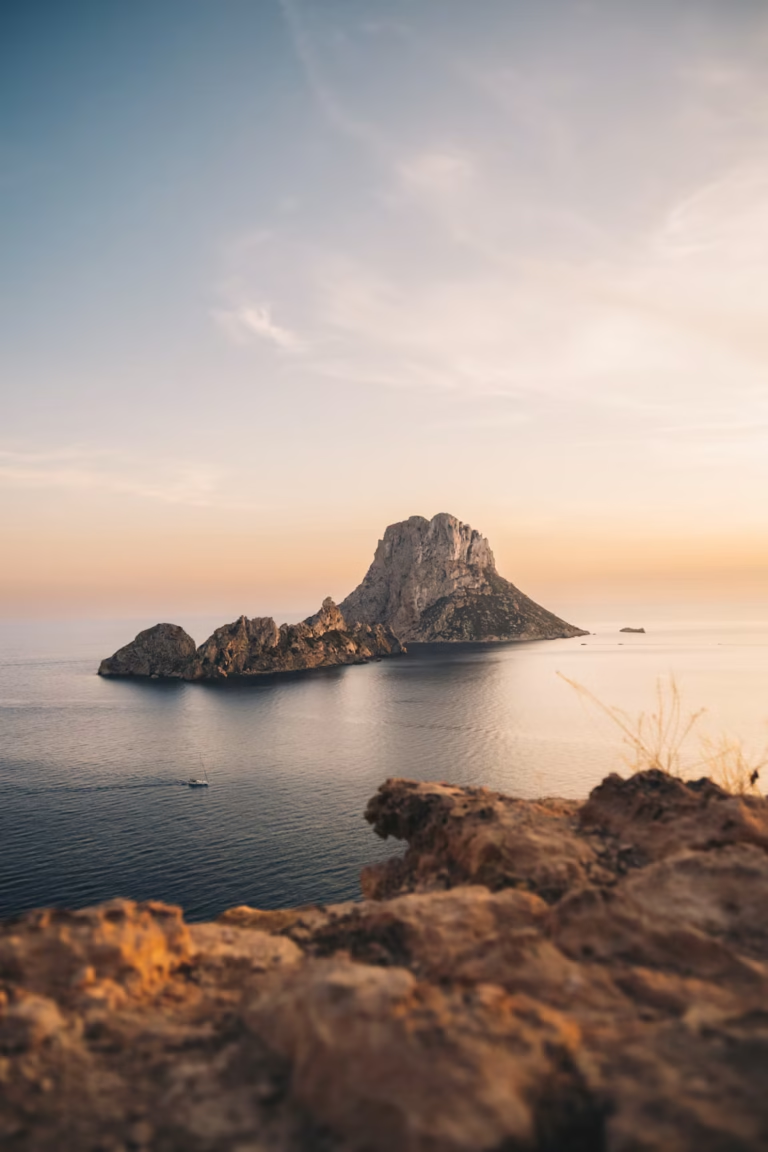
There, out in the sea, lies the island of Benidorm.
And this is where our story begins.
The Giant of Puig Campana
Long before Benidorm became a landscape of apartment towers, hotels, and crowded beaches, people living along this stretch of the Mediterranean told stories about the mountains.
One of the most memorable is the legend of Roldán, known in English as Roland.
The story has been told in different ways over the generations. In some versions, Roland is a knight with an extraordinary sword. In others, he is a giant whose strength is almost beyond imagination.
I particularly love the version preserved in the local folklore of Finestrat.
It’s a story about a young woman named Neus, a jealous admirer, a terrible curse, and a giant who believed that even the setting sun could be defeated.
Once Upon a Time, There Was a Girl Named Neus
According to the legend, Neus was a beautiful young woman who lived with her parents in the valley beneath Puig Campana.
Her family was poor, but the countryside around them was rich with forests, streams, and wildlife.
A wealthy young man named Cerivert wanted to marry her.
Her parents approved of the match, believing that marriage to such a rich man would give their daughter a more comfortable life.
But Neus’s heart had other plans.
One day, while she was gathering almonds in the hills, she encountered an enormous giant.
His name was Rondán, a local variation of the name Roland.
He was a frightening sight, with a scarred face and a single eye.
Yet despite his appearance, the giant had a gentle heart.
When he saw Neus, he fell deeply in love.
Terrified at first, Neus fled into a cave.
But Rondán began speaking to her in beautiful verses, and gradually her fear turned into affection.
Before long, she loved him too.
It was an unlikely romance.
And unfortunately, it was one that Cerivert could not accept.
The Jealous Suitor and the Sorcerer’s Curse
When Cerivert discovered that Neus had fallen in love with the giant, he was furious.
Instead of accepting her choice, he sought revenge.
According to the story, he turned to a wicked sorcerer named Calegás.
The sorcerer placed a terrible curse upon Neus.
When the last rays of sunlight of the appointed day disappeared from her face, she would die.
Rondán learned of the curse but kept his fears to himself.
He and Neus continued their life together, although the giant knew that the dreadful moment was approaching.
Then, one day, Neus suddenly became ill.
She grew weaker as the afternoon passed.
And slowly, the sun began to sink behind Puig Campana.
The Giant Who Fought the Setting Sun
Imagine the scene.
A giant stands beside the woman he loves, watching the mountain cast an ever-growing shadow across the valley.
He knows that when the last sunlight disappears, he will lose her.
And then he has an impossible idea.
If the mountain is blocking the sun, perhaps he can move the mountain.
Rondán takes his enormous sword and strikes the summit of Puig Campana with all his strength.
The blow tears a great opening through the rock.
A huge piece of the mountain breaks away.
And for a few precious moments, sunlight passes through the gap.
The giant has done something extraordinary.
He has opened a window in the mountain.
But it is not enough.
The sun continues to set.
And Neus dies.
What Happened to Roland?
In the Finestrat telling of the story, the ending becomes even more tragic.
Overcome with grief, Rondán walks into the Mediterranean and disappears beneath the water.
The tale says that fishermen could once hear his sorrowful voice carrying across the sea.
Other versions of the legend tell the ending differently.
But they all share the same heartbreaking idea.
A man with enough strength to break a mountain could not prevent the death of the woman he loved.
Did Roland Create the Island of Benidorm?
This is where the story becomes even more extraordinary.
In a widely told version of the legend, the enormous piece of rock struck from Puig Campana falls into the Mediterranean.
There, just off the coast of Benidorm, it becomes an island.
Today, that island is known as Illa de Benidorm or Isla de Benidorm.
If you’ve stood on the beach and looked out to sea, you’ve probably noticed it.
It is a small, rocky island with a distinctive elongated shape.
And once someone tells you the legend, it’s almost impossible not to imagine it as the missing piece of the mountain.
Of course, the connection is mythical rather than geological.
But I rather love the thought that two familiar landmarks, one towering over the coast and the other resting in the sea, could belong to the same story.
The Other Legend: Roland and His Sword
There is another traditional version of the story that connects Roland with the famous medieval hero of Charlemagne’s legends.
In this telling, Roland is not simply a giant in love.
He is a warrior fighting an enemy high on the mountain.
During the battle, he raises his mighty sword to strike his opponent.
But the blow misses.
Instead, the blade strikes the rock with such force that it cuts an enormous opening in the summit.
The missing piece tumbles toward the Mediterranean, eventually becoming Benidorm Island.
This version resembles other legends associated with Roland, including the famous Brèche de Roland in the Pyrenees.
It is fascinating how the same legendary figure appears in stories attached to dramatic landscapes in different parts of Europe.
For centuries, people have looked at unusual mountains and tried to explain them through tales of heroes, giants, battles, and impossible feats.
Puig Campana is a wonderful example.
What Is Puig Campana?
Beyond the legend, Puig Campana is a genuinely remarkable mountain.
It rises above the village of Finestrat, just inland from Benidorm in Alicante province.
At approximately 1,406 meters (4,613 feet) above sea level, it is one of the highest and most distinctive mountains in the province.
Its steep limestone slopes make it particularly impressive because it stands so close to the Mediterranean coast.
From many places around Benidorm, Villajoyosa, and Finestrat, its silhouette dominates the inland horizon.
And that famous notch makes it instantly recognizable.
What Is the Tajo de Roldán?
The opening in the mountain is commonly known as El Tajo de Roldán.
The Spanish word tajo can refer to a cut or cleft, which is wonderfully appropriate for a gap supposedly made by a giant’s sword.
You’ll also encounter the name El Portell, meaning a small opening or passage.
From a distance, the notch looks surprisingly precise.
Almost as though someone really did take an enormous blade to the rock.
But its true origins belong to geology rather than mythology.
How Was the Gap in Puig Campana Really Formed?
Puig Campana is made largely of ancient limestone that formed during the Jurassic period.
Over immense stretches of geological time, movements of the Earth’s crust fractured and uplifted the rock.
Weathering, erosion, gravity, and the natural weaknesses created by fractures all contributed to shaping the mountain.
The famous notch is part of this geological landscape.
It wasn’t created by a sword, of course.
And Benidorm Island wasn’t carved out of Puig Campana and thrown into the sea.
But the geological explanation doesn’t really take anything away from the story.
In fact, I think it makes the landscape even more fascinating.
A mountain can have a perfectly natural geological history and still inspire an extraordinary legend.
A Mountain That Plays Tricks With the Sun
There is another intriguing detail about Puig Campana.
Around the summer solstice in June, the sun can be seen shining through the notch from certain viewpoints when the geometry of the landscape and the time of day align.
For people familiar with Roland’s legend, the sight is particularly evocative.
It almost looks as though the giant’s attempt to let sunlight through the mountain has left a lasting mark.
Naturally, you need to be in the right position to observe the alignment, and the conditions are not identical from every viewpoint.
But it is a lovely example of the way natural phenomena can become connected to folklore.
Where Can You See Puig Campana?
One of the nice things about Puig Campana is that you don’t have to climb it to appreciate its unusual shape.
From Benidorm
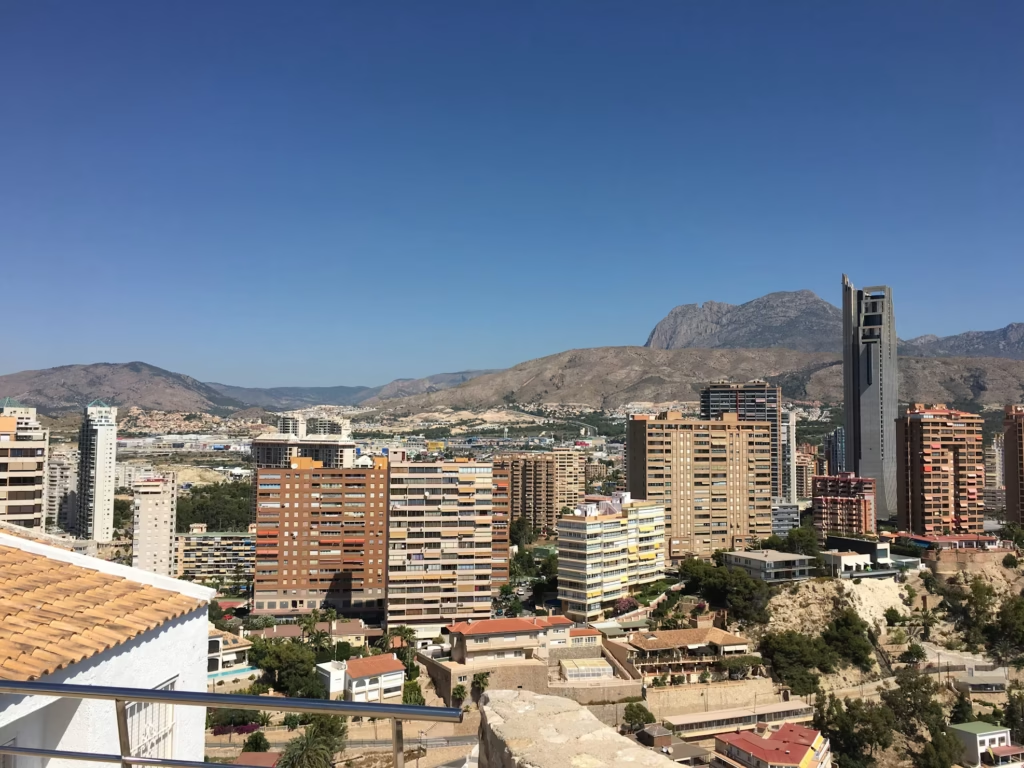
On a clear day, look inland from the city and you’ll see the mountain rising behind the developed coastline.
The contrast is remarkable.
In one direction, modern high-rise buildings and busy beaches.
In the other, a rugged limestone mountain that has inspired stories for generations.
From Finestrat
The historic village of Finestrat is an excellent place to appreciate the mountain.
Its narrow streets, traditional houses, and hillside setting provide an entirely different atmosphere from nearby Benidorm.
Puig Campana rises dramatically above the village, making it a beautiful destination for photography.
From the Surrounding Countryside
You’ll also see the mountain from various viewpoints and roads around the northern Costa Blanca.
Its outline changes depending on your position.
And once you know to look for that distinctive notch, you’ll start recognizing Puig Campana surprisingly often.
Can You Hike Puig Campana?
Yes, Puig Campana is a popular destination for experienced hikers.
However, climbing it is a serious mountain outing rather than an easy coastal walk.
The terrain is steep and rocky, the elevation gain is substantial, and conditions can be demanding.
The summit route is not something to attempt without suitable footwear, sufficient water, navigation, and preparation.
Summer heat can make the ascent particularly challenging.
If you simply want to admire the mountain, there are easier walking options around its lower slopes and the surrounding countryside.
The Font del Molí area near Finestrat is a well-known starting point for local walking routes.
Check current route conditions and official trail information before heading out.
For me, there’s no need to stand on the summit to appreciate the legend.
Sometimes the best view is from a little farther away, where you can see the whole mountain and that extraordinary missing piece.
What About Benidorm Island?
Benidorm Island lies offshore in the Mediterranean, separated from the city’s beaches.
Although it looks small from the coast, it is an important natural feature of the area.
The surrounding marine environment forms part of a protected coastal landscape, while the rocky island supports wildlife, particularly seabirds.
Its profile is visible from various points along the waterfront.
You can enjoy the view from the shore without needing to visit the island itself.
And if you know the story of Roland, there’s an extra reason to look at it.
The island suddenly becomes more than a rocky shape on the horizon.
It becomes the final piece of a legend that began high in the mountains.
Benidorm Beyond the Beaches and Bars
I think this is what I find most interesting about Benidorm.
It’s easy to arrive with a ready-made opinion.
And yes, much of what the city is famous for is impossible to ignore.
The enormous hotels, the busy nightlife, and the holiday atmosphere are all part of its identity.
But there’s more to this coastline than its most obvious attractions.
Look a little farther and you’ll find old villages, mountain paths, traditional landscapes, local food, and stories that have been told for generations.
Puig Campana is one of the most spectacular reminders of that.
It stands behind Benidorm as though it belongs to an entirely different world.
And perhaps that’s why I love the legend so much.
You can be standing beside a busy beach, surrounded by modern buildings and holidaymakers, and only a short distance away is a mountain that has inspired stories about giants and impossible love.
It’s a wonderful contrast.
Frequently Asked Questions About the Legend of Roland
Who was Roland in the legend of Benidorm?
Roland, known locally as Roldán or Rondán, is a legendary figure associated with Puig Campana. In some versions he is a giant who breaks the mountain to save his beloved; in others he is a warrior whose sword creates the famous notch.
What is the mountain with the gap near Benidorm?
The mountain is Puig Campana, near Finestrat in Alicante province. The notch is commonly known as El Tajo de Roldán or El Portell.
Did Roland really split Puig Campana?
No. The story is a traditional legend. The mountain and its distinctive notch were shaped by natural geological processes.
Is Benidorm Island the missing piece of Puig Campana?
According to the legend, yes. Geologically, however, the island was not created by a piece of the mountain falling into the sea.
How high is Puig Campana?
Puig Campana rises approximately 1,406 meters (4,613 feet) above sea level, although some sources give slightly different measurements.
Where is Puig Campana located?
The mountain stands near Finestrat, just inland from Benidorm on Spain’s Costa Blanca.
Can you see the mountain from Benidorm?
Yes. On clear days, Puig Campana is visible from various parts of Benidorm and the surrounding coast.
Is Puig Campana difficult to climb?
Yes. The summit hike is steep and demanding, requiring experience, proper equipment, and careful preparation.
Next Time You’re in Benidorm, Look Up
I’m still not entirely sure whether I love Benidorm or not.
Some days I enjoy its energy, its beaches, and the extraordinary contrast between the city and the mountains.
Other days, I find myself longing for the quieter villages and countryside around our farmhouse in Alcalalí.
But one thing is certain.
I’ll never look at that mountain in quite the same way again.
And now that you know the story, perhaps you won’t either.
So next time you’re walking along the promenade, don’t just look at the beach.
Don’t let the hotels and the crowds take up all your attention.
Turn around.
Look toward the mountains.
Find that enormous notch in the summit of Puig Campana.
Then look back out to sea, toward the little island of Benidorm.
And imagine, just for a moment, a giant with a broken heart, raising his sword against the setting sun.