There is much more to Calpe than beautiful beaches and luxury apartments. Behind its modern skyline lies a saltwater lagoon filled with flamingos, an extraordinary limestone mountain, and an ancient legend about mermaids, Neptune, and an evil spirit imprisoned in stone. O yes..now were talking! I love those old legends and saga’s…
Calpe is changing.
Every time I visit, it seems as though another impressive apartment building has appeared along the coastline. Tall, modern towers with enormous balconies, glass façades, and wonderful views across the Mediterranean.
Some are undeniably beautiful. Others make me wonder just how much more development this little stretch of coastline can accommodate.
But I have to admit something.
I rather like Calpe.
Not necessarily because of its increasingly luxurious skyline, but because the town has managed to retain something quite extraordinary right in the middle of all that development.
A saltwater lagoon where flamingos gather.
A working fishing harbor.
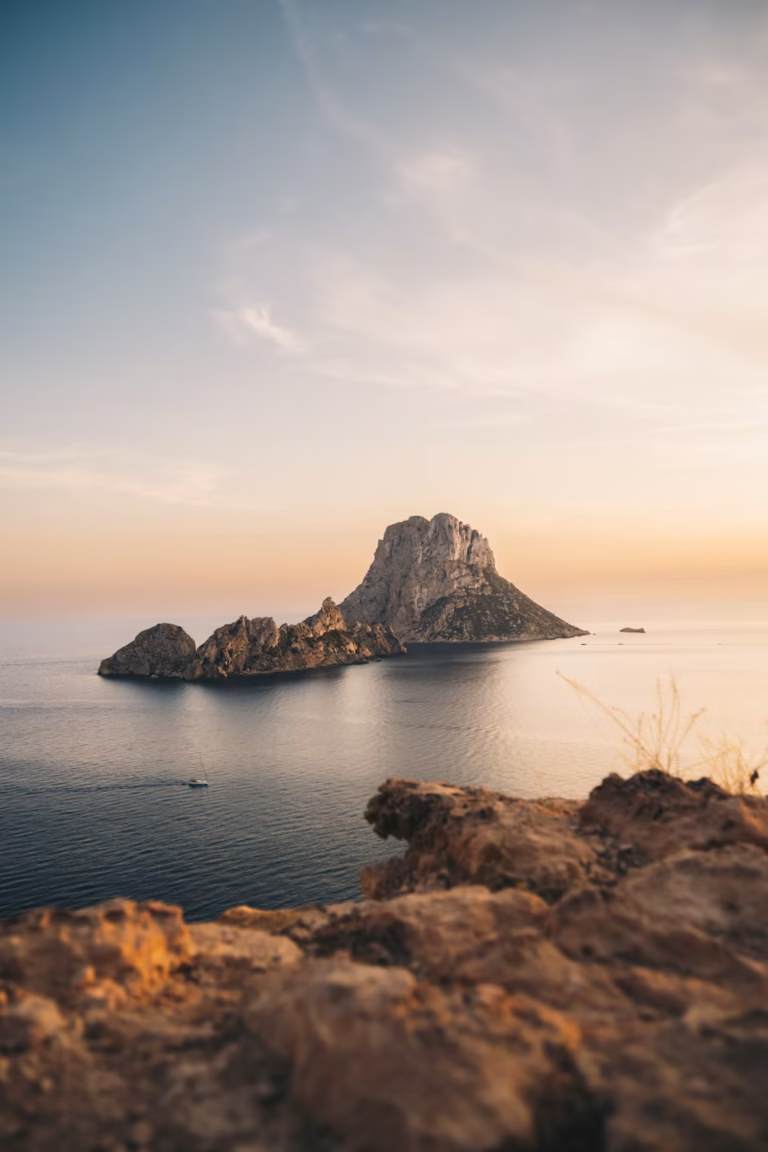
And an enormous limestone rock rising 332 meters above the Mediterranean.
The Peñón de Ifach.
You can see it from almost everywhere in Calpe. Sometimes it appears golden in the afternoon sunlight. At other times, dark clouds gather around its summit, giving it an almost mysterious appearance.
And according to an old Valencian legend, there is a very good reason for that.
Because the Peñón de Ifach isn’t simply a mountain.
It’s a prison.
And something ancient and rather unpleasant is supposedly trapped inside.
The Legend of the Peñón de Ifach
Long before Calpe became a popular holiday destination, before the apartment towers and busy beaches, the waters along this stretch of the Mediterranean were said to be home to beautiful mermaids.
They lived beneath the waves, among the rocks and coral, in a peaceful underwater world.
But these weren’t the dangerous creatures who lured sailors toward shipwrecks in some European folktales.
The mermaids of Calpe were kind.
They watched over the local fishermen, helped guide schools of fish toward their boats, and even freed fishing nets when they became tangled among the rocks.
For generations, the fishermen benefited from their mysterious underwater friends.
And the mermaids lived happily in the clear Mediterranean waters.
Until one day, something terrible arrived.
A Dark Creature Comes to Calpe
According to the legend, an evil being appeared in the waters off Calpe.
It had fled from the Alborán Sea, the westernmost part of the Mediterranean, where it had apparently been pursued by seals.
Whatever this creature was, it brought nothing but trouble.
It began tormenting the mermaids.
Whenever they appeared, the creature pursued them, disturbing their peaceful existence and making their underwater world a place of fear.
The mermaids tried to escape its attention, but the creature refused to leave them alone.
Eventually, they decided there was only one being powerful enough to help them.
Neptune.
The Mermaids Ask Neptune for Help
In Roman mythology, Neptune ruled the seas.
He commanded the waters, controlled their mysteries, and possessed powers far beyond those of ordinary creatures.
The frightened mermaids approached the sea god and begged him to free them from their tormentor.
Neptune listened.
Moved by their suffering, he sent a compassionate being to confront the evil creature and restore peace to the waters of Calpe.
When the two finally came face to face, the wicked creature realized that it had met something more powerful than itself.
And it fled.
It rushed toward the shore, desperately trying to escape the sea.
But the moment it reached the land, something extraordinary happened.
The creature turned to stone.
Its enormous body became the Peñón de Ifach.
And there it remained.
A gigantic limestone prison rising above the Mediterranean.
The mermaids were finally free.
Once again, they could swim through the clear waters, help the fishermen, and return to the peaceful life they had known before.
But the story doesn’t end there.
The Spirit That Still Tries to Escape
According to the old legend, the evil spirit never completely surrendered.
On certain mornings, when mist gathers around the Peñón de Ifach, the imprisoned creature attempts to escape.
Hidden beneath drifting clouds of fog, it tries to slip away from its rocky prison before anyone notices.
But the sun is its enemy.
As the first rays of morning sunlight reach the mountain, the mist begins to disappear.
And with it, the creature’s only chance of freedom.
Once again, it becomes trapped inside the enormous rock.
Waiting for another misty morning.
And now comes my favorite part of the story.
The legend says that anyone fortunate enough to witness the Peñón surrounded by this mysterious morning mist will enjoy happiness for the rest of their life.
Whether you believe in legends or not, I think that’s rather lovely.
And I can promise you one thing.
After hearing this story, you’ll never look at a mist-covered Peñón de Ifach in quite the same way again.
The Real Peñón de Ifach
Of course, the real story of the Peñón is geological rather than supernatural.
The mountain is a huge limestone formation connected to the mainland by a narrow strip of land.
It rises approximately 332 meters (1,089 feet) above sea level and is one of the most recognizable natural landmarks on Spain’s Costa Blanca.
Its dramatic appearance is the result of geological processes that took place over immense periods of time.
The Peñón is now protected as a natural park.
And despite being surrounded by a busy resort town, it supports a surprisingly rich variety of plants and wildlife.
There are Mediterranean shrubs, aromatic herbs, unusual plant species, and numerous birds that nest or shelter among its cliffs.
The contrast is extraordinary.
At the foot of the rock, you have restaurants, beaches, fishing boats, and holiday apartments.
Above them, an almost vertical limestone wall rises toward the sky.
And beyond that, nothing but the Mediterranean.
Can You Climb the Peñón de Ifach?
Yes, and for experienced walkers, it can be one of the most memorable hikes on the Costa Blanca.
But there is something important to understand before setting off.
The climb is not an easy tourist stroll.
The walking route is divided into two sections.
The First Section: Walking to the Tunnel
The first part of the route follows a maintained path uphill through the natural park.
Along the way, there are viewpoints offering beautiful views across Calpe, the beaches, and the surrounding coastline.
You’ll also encounter interesting Mediterranean vegetation and traces of the area’s long history.
Eventually, the path reaches a tunnel through the rock.
The tunnel is approximately 30 meters long and was constructed in 1918 to provide safer access through the mountain.
For many visitors, this is a sensible point to turn around.
Because beyond the tunnel, things become considerably more demanding.
The Second Section: From the Tunnel to the Summit
Once you’ve passed through the tunnel, the route becomes narrower, steeper, and more exposed.
There are rocky surfaces, uneven footing, and sections where ropes have been installed to help walkers negotiate difficult terrain.
The limestone can be particularly slippery, especially if there is moisture on the rock.
This part of the route is not suitable for everyone.
You need suitable hiking shoes, enough water, a reasonable level of fitness, and confidence on steep mountain paths.
The full excursion is commonly described as taking around two and a half hours, although your actual time will depend on your pace and the conditions.
And there’s another important detail.
Visits to the natural park’s walking route require advance reservation.
The rules and permitted access can change, so always check the latest official information before visiting.
If you aren’t comfortable with exposed mountain paths, there is absolutely no need to attempt the summit.
The Peñón is just as impressive from below.
And personally, I think you get the best appreciation of its extraordinary shape when you can see the entire rock rising from the sea.
A Forgotten Settlement Beneath the Rock
Something many visitors don’t realize is that the Peñón de Ifach also has a fascinating human history.
People lived around the rock long before modern Calpe existed.
Archaeological remains reveal traces of an Iberian settlement dating back to several centuries before Christ.
During the Roman period, people also occupied the area around the narrow strip of land connecting the rock to the mainland.
And in the Middle Ages, a fortified settlement was established on the slopes.
Known as the Pobla Medieval de Ifac, it dates from the late thirteenth century.
The settlement included defensive walls, towers, houses, and a church.
It occupied an extraordinary position overlooking the Mediterranean, but life there wasn’t always peaceful.
The coast was vulnerable to attacks and conflict, and the settlement was eventually abandoned.
Today, its archaeological remains tell a much older story about Calpe.
One involving merchants, fishermen, soldiers, and families who lived in the shadow of the great rock centuries before anyone thought of building a holiday apartment.

Las Salinas de Calpe: Flamingos in the Middle of Town
And now for something completely different.
If the Peñón de Ifach feels like a giant watching over Calpe, the salt lake beside it is one of the town’s most unexpected treasures.
Right among the roads, apartment buildings, and busy streets lies Las Salinas de Calpe.
A remarkable saltwater lagoon where you can see flamingos.
Yes, actual flamingos.
In the middle of a modern Spanish coastal town.
I still think there’s something rather wonderful about that.
Why Are There Salt Flats in Calpe?
The lagoon has a long geological history connected with the formation of the coastline and the Peñón de Ifach.
Over time, coastal sandbars helped create a shallow basin in which saline water could accumulate.
People eventually began using the area for salt production.
And salt was once an enormously valuable commodity.
Long before refrigerators, salt was essential for preserving food, particularly fish.
For a coastal community such as Calpe, that made the salt flats economically important.
Salt production here developed during Roman times, when it was closely connected with the area’s fishing and fish-processing activities.
Over the centuries, the salt flats became an important regional resource, supplying salt to communities far beyond Calpe itself.
Commercial production eventually declined, with the final modern operations ending in the late twentieth century.
Today, the lagoon has a different kind of importance.
It is a valuable wetland habitat.
And the flamingos have become some of its most recognizable residents and visitors.
Why Are the Flamingos Pink?
One of the first things you notice about flamingos is their extraordinary color.
Some are a delicate pale pink.
Others have deeper rose-colored feathers.
But their color isn’t simply something they’re born with.
Flamingos obtain the pigments responsible for their pink coloration from their diet.
They feed on organisms such as small crustaceans, other tiny aquatic animals, and algae-associated food sources that contain carotenoid pigments.
Over time, these pigments contribute to the color of their feathers.
Their appearance can vary depending on age, diet, and individual condition.
Young flamingos are generally much greyer than mature birds.
And while the saltwater environment helps support the food web they rely on, the salt itself isn’t what turns the birds pink.
When Can You See Flamingos in Calpe?
Flamingos can be observed at Las Salinas throughout different parts of the year, although their numbers vary.
Some days, you may see large groups standing in the shallow water.
On other days, fewer birds may be present.
That uncertainty is part of watching wildlife.
The wetland is also home to many other birds.
Birdwatching records for Las Salinas include herons, ducks, stilts, avocets, and numerous migratory species.
In fact, up to 173 bird species have been recorded in the wider wetland area.
An accessible, semicircular path provides opportunities to observe the birds without entering their habitat.
Bring binoculars if you have them.
And if you enjoy photography, a telephoto lens is much more useful than trying to get closer to the flamingos.
The birds deserve to be admired without being disturbed.
The Strange Contrast Between Nature and Luxury Apartments
One of the things I find most interesting about Calpe is how dramatically the town has changed.
The coastline has seen extensive tourist development, particularly since the second half of the twentieth century.
And in more recent years, modern apartment towers and luxury developments have become increasingly prominent.
Some of these buildings are architecturally impressive.
Others make the coastal skyline feel rather crowded.
I have mixed feelings about it.
On the one hand, I understand why people want to live somewhere with beautiful Mediterranean views.
On the other, I always wonder how much development a coastal town can accommodate before it begins to lose some of its original character.
But here is what makes Calpe so unusual.
The town still has these remarkable pockets of nature.
You can stand beside a modern apartment building and watch flamingos feeding in a saltwater lagoon.
You can look past luxury balconies and see a limestone mountain that has stood here for geological ages.
And just beyond the busy beaches lies a Mediterranean landscape that inspired stories about mermaids and ancient sea gods.
For me, those contrasts make Calpe far more interesting than a typical resort town.
What Else Is There to Discover in Calpe?
If you have time to explore beyond the Peñón and the salt flats, there are several other places worth visiting.
The Fishing Harbor
Calpe has a working fishing harbor where the town’s maritime traditions are still visible.
It’s a lovely place to watch the boats and discover the connection between local fishing and Mediterranean cooking.
Seafood is an important part of the local food culture, and you’ll find restaurants serving fish and rice dishes around the harbor.
Baños de la Reina
Another fascinating place is the Baños de la Reina, or Queen’s Baths.
Despite the romantic name, these are archaeological remains associated with a Roman coastal complex.
The excavated pools near the sea were connected with fish keeping and other activities.
Naturally, there’s also a legend about these baths.
According to local folklore, a queen once used the pools for bathing, supposedly reaching them through a secret passage.
The real Roman history is fascinating enough, but I do love the way these old stories continue to survive alongside it.
The Old Town of Calpe
Away from the modern waterfront, Calpe’s historic center offers a different atmosphere.
There are narrow streets, traditional buildings, old defensive remains, and reminders of the town’s earlier life.
It’s worth taking the time to explore rather than spending your entire visit along the seafront.
The Beaches and Promenades
Of course, Calpe also has beautiful beaches.
Playa de la Fossa and Playa del Arenal-Bol are among the best known.
Both offer wonderful views, and the Peñón provides a dramatic backdrop.
But for me, the real pleasure of Calpe is discovering how much more there is beyond the beach.
Practical Tips for Visiting Calpe
If you’re planning a day in Calpe, you can combine several of its most interesting sights.
Start with Las Salinas to look for flamingos, preferably when the light is beautiful and the area isn’t too busy.
Then head toward the Peñón de Ifach.
Even if you don’t plan to climb it, the surrounding area offers wonderful views.
If you’d like to hike, make sure you’ve checked the reservation requirements, weather, and current access conditions.
Later, you could visit the fishing harbor or explore the old town.
And if you enjoy photography, try to see the Peñón at different times of day.
Its appearance changes dramatically with the light.
A clear blue sky makes it look monumental.
Golden evening sunlight brings out the warm colors of the limestone.
And when mist gathers around the summit?
Well, now you know what the old legend says about that.
Perhaps it’s worth getting your camera ready.
Frequently Asked Questions About Calpe and the Peñón de Ifach
What is the legend of the Peñón de Ifach?
According to a traditional Valencian legend, mermaids living off the coast of Calpe were tormented by an evil creature. They asked Neptune for help, and the creature was eventually turned to stone, becoming the Peñón de Ifach.
Why is the Peñón de Ifach sometimes covered in mist?
Mist and low clouds form because of atmospheric conditions such as humidity, temperature, and wind interacting with the mountain. According to the legend, the mist is also when the spirit trapped inside the rock tries to escape.
How high is the Peñón de Ifach?
The Peñón rises approximately 332 meters (1,089 feet) above sea level.
Can you climb the Peñón de Ifach?
Yes, but the route beyond the tunnel is steep, rocky, and challenging. It is suitable only for properly prepared walkers who are comfortable with the terrain.
Do you need a reservation to hike the Peñón?
Yes. The walking route in the natural park requires advance reservation. Always check current access rules before visiting.
Where can you see flamingos in Calpe?
Flamingos can be seen at Las Salinas de Calpe, a saltwater lagoon in the town near the Peñón de Ifach.
Are there flamingos in Calpe all year?
Flamingos are observed at different times throughout the year, although numbers vary with the season and local conditions.
Why are the flamingos pink?
Their pink coloration comes from carotenoid pigments obtained through their diet.
Is Calpe worth visiting outside the summer?
Absolutely. The natural park, salt flats, historic center, and fishing harbor offer plenty to discover beyond the summer beach season.
When a Rock Becomes More Than a Rock
I think this is one of the reasons I love discovering the stories behind the landscapes of the Costa Blanca.
At first, you see a beautiful place.
Then you learn something about its history.
And suddenly, everything looks different.
Calpe may have changed enormously, and its modern skyline may continue to grow, but the Peñón de Ifach remains.
Standing above the town.
Watching over the Mediterranean.
And, if the old legend is to be believed, keeping a rather unpleasant spirit safely imprisoned inside its limestone walls.
So the next time you’re in Calpe, look beyond the apartment towers.
Visit the flamingos.
Admire the great rock.
And if you happen to see mist drifting around its summit in the early morning, remember the mermaids, Neptune, and the creature that tried to escape.
Who knows?
Perhaps the legend about everlasting happiness might just be true.