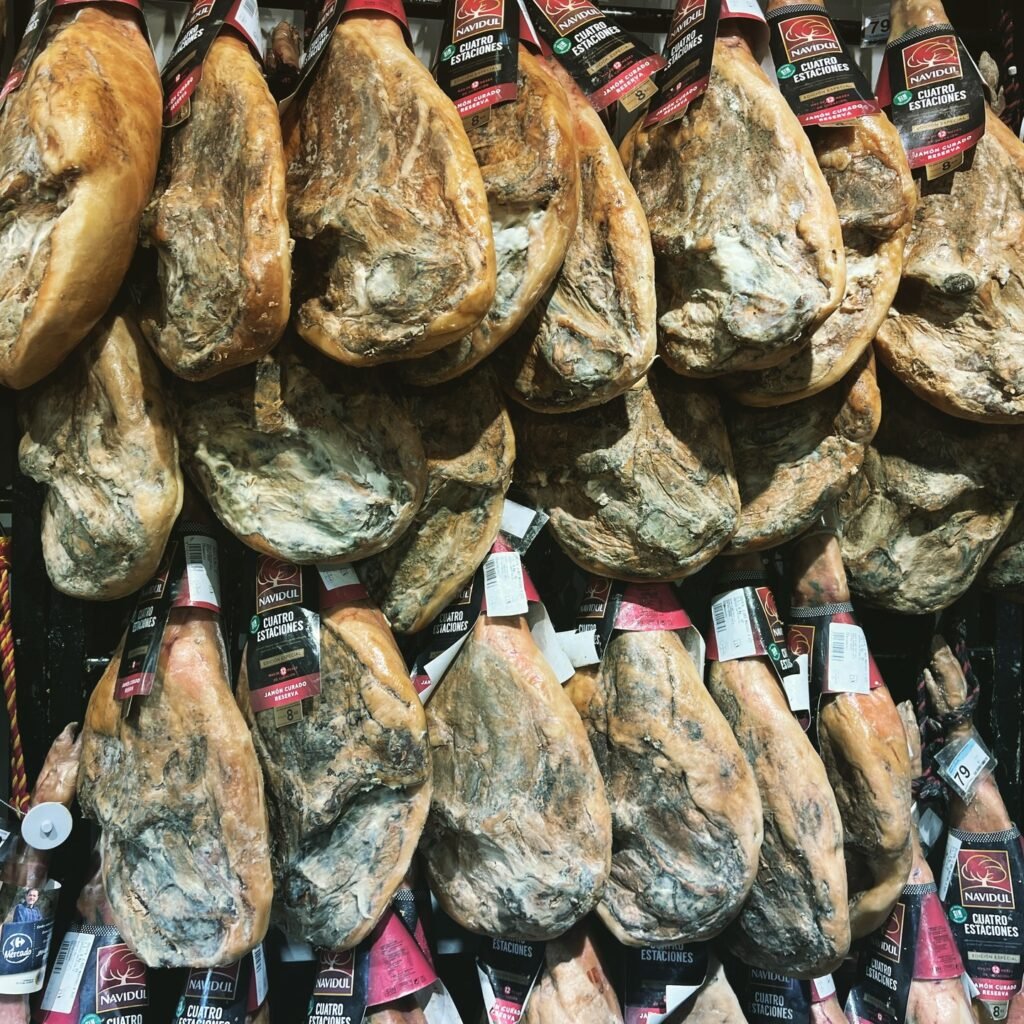
Hi friends! If you’ve ever walked into a big supermarket in Spain, you know the moment. You turn a corner, and suddenly you’re surrounded by ham. There are whole legs hanging from hooks, rows of vacuum-packed slices, and a smell that hits you long before you see the counter.
We live in Spain, and we still have a little routine: we eat something before we go grocery shopping. The ham and fish counters are strong, so an empty stomach makes them hard to ignore. Still, Spanish ham is one of the great pleasures of life here. So let’s go through the types, the labels, the price, and how to enjoy it, so you know exactly what you’re buying.
What Is Spanish Ham?
Spanish ham, called jamón, is a raw ham that’s salted and then cured for months or years until it’s firm, deeply savory, and ready to eat without cooking. The two big names are jamón ibérico and jamón serrano, and they’re very different.
Walking Into a Spanish Supermarket
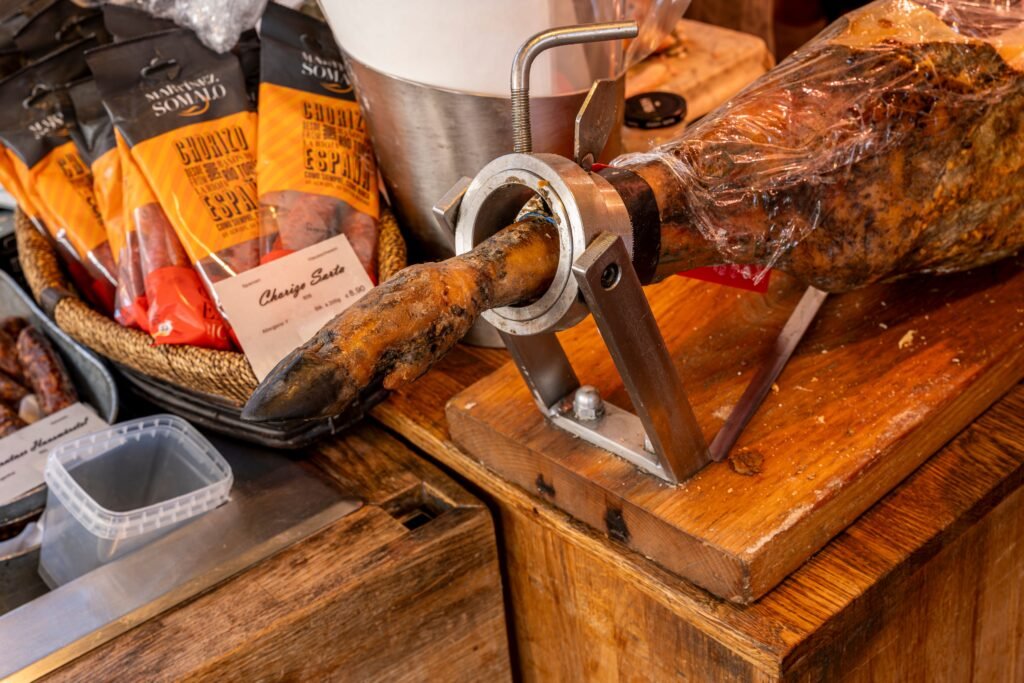
In a large supermarket, you’ll see whole hind legs hanging up, often dozens at a time. Usually there’s also one clamped onto a stand, called a jamonero, with a person slicing thin pieces off it. Those slices are then sold in vacuum packs. We’ve never bought a whole leg ourselves, and most visitors don’t either, so the packs are a very easy way to start.
Ibérico vs. Serrano
| Jamón ibérico | Jamón serrano | |
|---|---|---|
| The pig | The black Iberian pig, a breed from Spain and Portugal | White pigs, such as Duroc or Landrace |
| The name | The breed | From sierra, the Spanish word for mountain range |
| Fat | Fat runs through the meat, so it’s juicier | Leaner and drier |
| Price | One of the most expensive hams in the world | Much more affordable |
Serrano is the everyday ham. It’s what you’ll find in sandwiches and tapas bars all over Spain. Ibérico, on the other hand, is a luxury product, and it’s priced like one. We’ll look at real supermarket prices in a moment.
The Four Colored Seals
Spain has a legal quality norm for ibérico, and it makes the labels much easier to read. Every ham and shoulder gets a numbered seal, and the color tells you what kind it is:
| Seal | What it means |
|---|---|
| Black | De bellota, 100% ibérico: acorn-fed, from pure Iberian pigs |
| Red | De bellota ibérico: acorn-fed, from pigs that are at least 50% Iberian |
| Green | De cebo de campo ibérico: fed on feed, raised outdoors |
| White | De cebo ibérico: fed on feed, raised in intensive farming |
The term pata negra, or “black foot,” is only allowed for the top category, the 100% ibérico acorn-fed ham. Keep in mind that the seal stays on the piece even when it’s sold sliced, so look for it on vacuum packs too. Also, if the pack doesn’t state the percentage of Iberian breed, that’s a good reason to ask questions.
What Does It Cost? 250 Grams of Serrano vs. Ibérico
Now for the question everyone asks: how much is it, really? Here’s a look at sliced ham in Spanish supermarkets in late October 2026. Most packs are only 80 to 150 grams, so we’ve worked out what 250 grams would cost at the same price per kilo.
| Ham | Example (pack) | Price per kilo | About 250 g |
|---|---|---|---|
| Serrano (12 months, reserva) | Auchan, 250 g pack: €4.11 | €16.44 | €4 |
| Serrano (12 months, reserva) | Mercadona, 120 g: €2.45 | €20.42 | €5 |
| Serrano gran reserva | Carrefour, 90 g: €2.39 | €26.56 | €6.60 |
| Ibérico de cebo (50% Iberian, feed-fed) | Auchan, 100 g: €4.90 | €49.00 | €12 |
| Ibérico de cebo de campo (50% Iberian) | Alcampo Collection, 100 g: €9.71 | €97.10 | €24 |
| Ibérico de bellota (50% Iberian, acorn-fed) | Villar, 100 g: €13.22 | €132.20 | €33 |
| Ibérico de bellota 100% (black seal) | Carrefour, hand-cut, 80 g: €15.20 | €190.00 | €47 |
In short, 250 grams of everyday serrano costs about €4 to €7, while 250 grams of top acorn-fed ibérico costs about €47 or more. That’s roughly ten times as much. The cheapest ibérico (de cebo) is only about €12 to €22 for 250 grams, so it’s a good way to try the name without the luxury price tag.
Keep in mind that prices change, and they vary by store, brand, and region. For a whole leg, you pay less per kilo, but a whole 100% ibéric acorn-fed ham is still a big purchase, often several hundred euros.
Where Does It Come From?
Ibérico ham is made in Spain and Portugal, and the best of it comes from the dehesa, a wide, open woodland of oak trees in the southwest of Spain. Serrano, in contrast, was traditionally cured in the cold, dry mountain air of regions like the Pyrenees and the Cantabrian mountains.
Do the Pigs Only Eat Acorns?
Almost, but not quite. During the montanera, the acorn season, the pigs roam the dehesa for about four months, from November to February. During that time, they eat about 1 kilo of acorns a day, along with grass, herbs, and other things they find, and they gain about 50% of their weight. Before that, the pigs are first fed on feed until they reach around 100 kilos. So when a ham is labeled de bellota, it means the pigs finished their lives on acorns and pasture, with no extra feed.
Protected Regions
Several ham regions carry a protected European label. The best-known are Jabugo, Guijuelo, Los Pedroches, and Dehesa de Extremadura, and Teruel and Trevélez are well known too. A regional name on the package is another sign of quality.
How Ham Is Cured
The process starts the same way for all ham: the leg is salted, washed, and dried. For serrano, the legs are salted for about two weeks, washed, and dried for about six months, and they then hang in a cool, dry place for several more months. In total, serrano can cure for 6 to 18 months. Under the EU’s “Traditional Speciality Guaranteed” label, serrano must be cured for at least 7 months, and the Consorcio del Jamón Serrano, a group of producers, ages its hams for at least 12 months. Ibérico usually cures much longer, often two years or more, according to producers.
What Does It Taste Like?
Good ham tastes salty, savory, and a little sweet, with a long finish. Serrano is firm and mildly nutty. Ibérico, in contrast, is rich, juicy, and aromatic, with many layers of flavor. The fat is soft and glossy, and it melts on your tongue.
The reason is simple. In ibérico, fat is stored within the muscle, giving it that marbled look. A white pig doesn’t store fat the same way, even if it eats acorns, so serrano never reaches the same depth. That’s also why acorn-fed ibérico is so special.
How to Use It in Cooking
The best way to enjoy good ibérico is simple: thin slices on a plate, at room temperature, with a piece of bread and perhaps a glass of wine. There’s no need to cook it. Serrano is more flexible, and it’s the better choice for cooking.
Ways to Enjoy It
- On its own: ask for it sliced very thin, and let it come to room temperature before eating.
- On toast: top bread rubbed with ripe tomato and olive oil with a slice or two of ham.
- With melon or figs: the sweet fruit balances the salty ham.
- In cooked dishes: use serrano in croquettes, eggs, beans, and soups.
A Word on Slicing
A whole leg is hand-carved on a jamonero with a long, thin knife. A whole leg costs less per kilo than sliced ham, because you’re paying for bone, fat, and skin as well. Once the meat is cut, it starts to dry out, so it’s best eaten fairly quickly. That’s why most home cooks, ourselves included, prefer vacuum-packed slices.
Is Ibérico Ham Healthy?
Healthy, sort of. Here’s the honest picture. Producers say that the fat of acorn-fed ibérico is rich in oleic acid, which is the same fat found in olive oil, and they quote levels of more than 55%. That’s a big reason people call it one of the better hams to eat. However, those numbers come from producers, not independent studies.
On the other hand, ham is still salty and rich in calories, at about 250 calories per 100 grams, according to one producer. Ham is also a cured meat, and the World Health Organization has warned that eating processed meat regularly, such as 50 grams a day, can raise the risk of cancer. As a result, we think of ibérico as a treat: a few thin slices at a time, enjoyed slowly.
What Can You Substitute?
If ibérico is out of reach, you have options:
- Serrano ham: the closest and most affordable choice. It’s leaner, but still delicious.
- Prosciutto: Italian dry-cured ham is a good substitute in most recipes.
- A lower-grade ibérico: a green or white seal costs less than a black or red one, and it can still be very good.
How to Store It
A whole leg is best kept in a cool place on its stand, and you’ll want to cover the cut surface after carving. Vacuum-packed slices should stay in the fridge until you open them. Once opened, sliced ham must be kept in the fridge, and it’s best eaten quickly. Before serving, take it out about 20 minutes ahead so the fat softens and the flavor opens up.