Hi friends! If you’ve ever stood in a shop in France with a jar of golden honey in your hand, you know how tempting it is. The labels are pretty, the word “Provence” sounds dreamy, and every jar promises lavender fields. However, not every jar is the real thing, and the label is where you find out.
Provencal lavender honey is one of France’s best-known honeys, and it has two official quality marks to prove it. We’re half French, and we travel to France twice a year to stock up on ingredients, so we’ve learned to read French labels carefully. So let’s find out what makes this honey special, what the labels really mean, and how to enjoy it in your kitchen.
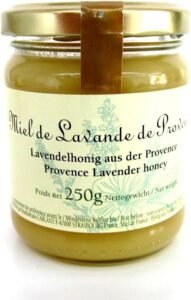
What Is Provencal Lavender Honey?
Provencal lavender honey is a monofloral honey, which means the bees collect nectar mostly from one type of flower. Here, that flower is lavender, and the honey is made in the south of France. It’s pale, floral, and gentle, and it sets into a smooth, fine texture.
Lavender vs. Lavandin
Here’s a detail most people miss. Most “lavender” honey in France actually comes from lavandin, which is a sterile hybrid of true lavender (Lavandula angustifolia) and another lavender species. Lavandin is a larger plant, and it makes up most of the lavender crop in France. True lavender, on the other hand, is the mountain parent, and it gives less nectar per flower.
For the French quality marks, both count. In fact, the Label Rouge for this honey is called “Miel de lavande et de lavandin,” so it covers lavender and lavandin honey together.
Why It’s Creamy
All honey crystallizes in time, and lavender honey does so at a moderate pace, into a fine grain. As a result, it turns smooth and creamy rather than hard and gritty. The French authority that oversees these labels (INAO) also notes that beekeepers can help the process along to get a fine, creamy texture. Because of this, a creamy jar isn’t a sign that something is wrong. In fact, it’s exactly what you’d expect.
Where Does It Come From?
Provencal lavender honey comes from the hills and plateaus of southeastern France. The lavender hives sit in an area that’s limited in the north by the line from Montélimar to Digne, and in the south by places like Mont Ventoux, the plateau d’Albion, the Luberon, and the Vaucluse mountains. Within that area, two famous places are the Banon sector and the Valensole plateau.
The Miel de Provence IGP
IGP stands for Indication Géographique Protégée, or Protected Geographical Indication. It’s a European label that protects a product’s link to its place. The Miel de Provence IGP was registered in 2005, and it covers lavender and lavandin honey, as well as all-flowers honey. The name “Provence,” when it’s used for honey, is protected, so it’s reserved for producers who follow the rules. The IGP also requires a perfectly even structure, whether the honey is liquid or crystallized.
The Label Rouge
Next to the IGP, there’s the Label Rouge, which literally means “Red Label.” It’s a French quality mark, and it’s often paired with the IGP. For honey, there are two: one for lavender and lavandin honey, from 1989, and one for all-flowers Provence honey, from 1994. Where the IGP is about origin, the Label Rouge is about quality.
How to Read the Label
When you shop, look for these signs:
- The exact words “Miel de Provence” with IGP: this is the protected name.
- The Label Rouge logo: a red label that shows the honey meets the quality mark’s rules.
- “Lavande” on the jar: it should say lavender, or lavender and lavandin, not just “Provence honey.”
- A single origin: a label that names where the honey came from is a good sign.
Can You Spot Fake Honey?
It’s tempting to think a simple test at home will show whether honey is real, but we can’t recommend one. Adulterated honey is hard to detect, even for experts. In 2021 and 2022, the European Commission tested 320 honey samples at the EU’s borders, and 46% were suspected of being adulterated with sugars. These were imports, not honey from France’s quality marks, but it shows why labels matter.
So the best defense is a trustworthy label. Words like “pure” have no legal standing, so they don’t tell you much. Instead, look for the protected name and the Label Rouge, choose a single-origin honey when you can, and buy from beekeepers or shops you trust.
What Does It Taste Like?
Provencal lavender honey is sweet, floral, and a little woody, with a fresh, fruity edge and no bitterness. Some people notice a hint of blackcurrant at the end. It tastes of the flowers, not of lavender oil, so it isn’t soapy or perfumed.
The honey is very pale and clear when it’s liquid, and it turns lighter and creamier as it crystallizes. Because it’s so delicate, it lets other flavors shine instead of covering them.
How to Use It in Cooking
Lavender honey is gentle, so it works best where you can taste it. Here are our favorite ways to use it.
Three Easy Ideas
Goat cheese and honey. Lavender honey pairs best with goat cheese, and it’s also lovely with creamy cheeses such as Brillat-Savarin and Chaource. Spread soft goat cheese on toasted baguette, and drizzle it with a teaspoon of honey.
Yogurt, bread, and tea. Stir a spoonful into plain yogurt, spread it on warm bread, or sweeten a cup of tea or warm milk.
A glaze for duck. Honey is a classic glaze for duck, and lavender honey adds a floral note.
Nougat
The French Label Rouge for nougat requires Provence IGP lavender honey, so it’s a true taste of the region. If you spot Label Rouge nougat in a French shop, it’s worth trying.
What Can You Substitute?
Nothing tastes exactly like Provencal lavender honey, but you have options:
- Another mild floral honey: acacia or orange blossom honey is a gentle choice. You’ll lose the lavender notes, but the sweetness and softness remain.
- Plain honey plus culinary lavender: a little dried culinary lavender, steeped in warm honey, adds a floral touch. Use very little, because it’s strong.
How to Store It
Keep the jar tightly closed, in a cool, dark cupboard. Honey doesn’t need the fridge. If it crystallizes, don’t worry, because that’s natural, and it’s what gives lavender honey its creamy texture. If you prefer it liquid, set the jar in a bowl of warm water, not boiling, and stir gently.