When Sam and I first got the keys to our finca in Spain, one of the first things he brought home was a paella set.
Not just a pan, mind you.
A proper outdoor setup with a gas burner, a tripod stand and a large paella pan.
I think he was trying to tell me something.
And apparently, his little hint worked, because these days I make paella at least once every two weeks.
Over the years, I’ve changed the recipe, adjusted ingredients and experimented with different techniques until I arrived at the version we both love.
And this is it. Our very own Paella de la Casa.
Yes, I Know About the Paella Debate
If you’ve spent any time in Spain, you’ll probably know that paella can be a surprisingly serious subject.
Especially in Valencia, where traditional paella has a very particular identity, people have strong opinions about which ingredients belong in the pan.
And I understand that.
Food traditions matter, and I have enormous respect for the people who keep them alive.
But this isn’t a recipe for traditional Paella Valenciana, and I’m not pretending it is.
This is the paella I make at home, the way Sam and I love to eat it.
You’re welcome to change the ingredients, leave something out or even call it something else.
As far as I’m concerned, cooking should also be about discovering what tastes good to you.
And after making this dish so many times, I know exactly how we like ours.
Two Little Things That Make All the Difference
There are two ingredients I never skip when making this paella.
The first is my homemade sofrito, a slowly cooked mixture of onion, garlic and ripe tomatoes. I let it reduce until it’s thick, concentrated and full of flavor.
The second is Aceite de Ajo y Perejil, a fresh garlic and parsley oil that adds another layer of flavor.
Both can be made ahead, and any leftovers can be frozen for another day.
I also use chicken, Spanish paella rice, saffron, a little rosemary, peas and a sachet of Carmencita paella seasoning.
The saffron and spices go into the hot chicken stock first, so their flavor is evenly distributed.
Then comes the part where I become rather strict.
Once the stock has been added to the rice, nobody stirs the paella.
Not once.
You can look, you can smell, you can admire it, but please leave the spoon alone.
And Don’t Forget the Socarrat
One of my favorite parts of a good paella is the socarrat, that thin, golden, lightly toasted layer of rice at the bottom of the pan.
It takes a little practice to get it just right, but when you hear that gentle crackling sound and smell the toasted rice, you know you’re close.
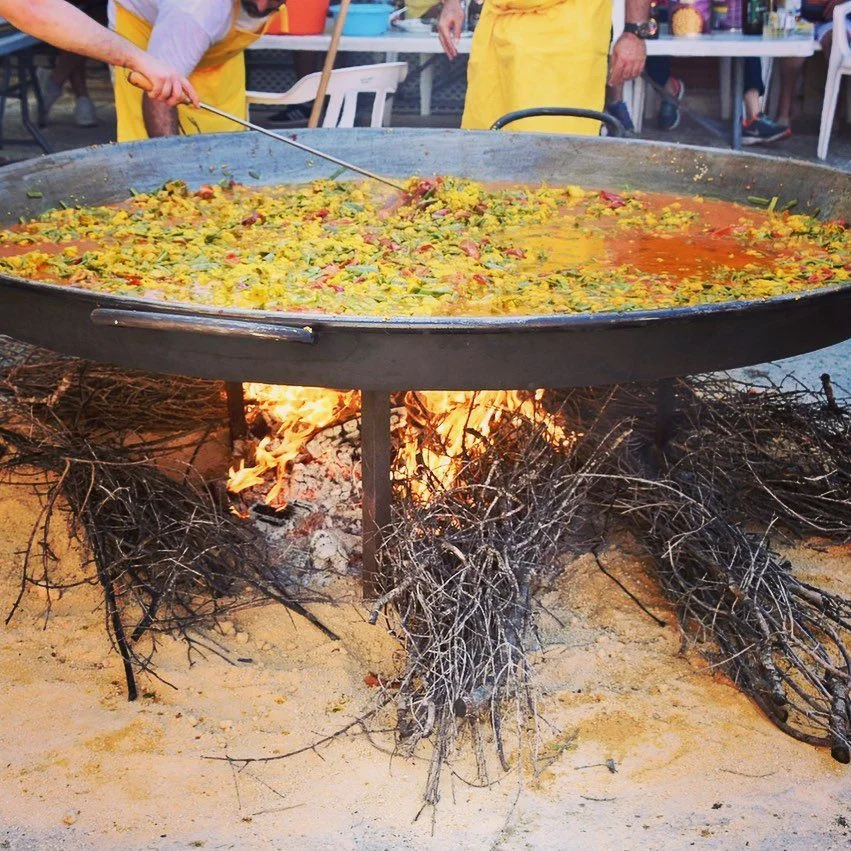
We usually make our paella outside on the gas burner, although a smaller pan works beautifully indoors too.
I bring the whole pan to the table, add a few lemon wedges and let everyone help themselves.
And yes, after all these years, Sam still gets plenty of use out of that paella set.
So perhaps his hint wasn’t such a bad idea after all.
Paella de la Casa – Our Favorite Spanish Chicken Paella
Our favorite homemade Spanish chicken paella, made with tender chicken, Bomba rice, saffron, peas and rosemary. Two homemade flavor bases, a slow-cooked tomato sofrito and fresh garlic-parsley oil…give this Paella de la Casa its wonderful depth. Finished with a delicate layer of crispy socarrat, just the way we love it.
**For the Aceite de Ajo y Perejil (garlic-parsley oil)**
30ml2 tbsp extra virgin olive oil
8gabout ¼ cup loosely packed fresh flat-leaf parsley, leaves and tender stems only
1small garlic clove
A small pinch of sea salt
**For the chicken paella**
200gapproximately 1 cup Spanish paella rice, preferably Bomba
400–500 g14–18 oz chicken, preferably boneless chicken thighs or small bone-in pieces
4tbsphomemade sofrito
2tspAceite de Ajo y Perejil
4tbspmild olive oil
500mlapproximately 2⅛ cups chicken stock, plus a little extra hot stock or water if needed
1sachet Carmencita paella seasoningusing the quantity appropriate for your particular product and adjusting the salt accordingly
A generous pinch of saffron threads
1tspvery finely chopped fresh rosemary
50gapproximately ⅓ cup fresh or frozen peas
Sea saltto taste
½lemoncut into wedges
A little chopped fresh flat-leaf parsleyoptional, for serving
Method
Place the roughly chopped onion in a small food processor and blend until very finely minced.
Transfer the onion to a small saucepan and cook over low heat, stirring regularly, until most of its natural moisture has evaporated. Do not let the onion brown.
Meanwhile, combine the garlic clove and 25 ml of olive oil in a tall measuring jug. Blend briefly with an immersion blender until the garlic is finely incorporated into the oil.
When most of the liquid has evaporated from the onion, add the garlic oil. Increase the heat slightly and cook for approximately 2–3 minutes, stirring frequently.
Add a small pinch of sugar and sea salt. Blend the ripe tomatoes until finely chopped or puréed, then stir them into the onion mixture.
Cook the sofrito gently over low heat for approximately 30–40 minutes, stirring regularly, until it becomes deep red, thick and highly concentrated. Measure out 4 tablespoons for the paella and reserve any remaining sofrito.
To make the garlic-parsley oil, combine the extra virgin olive oil, fresh parsley, garlic and a small pinch of sea salt in a mini food processor or tall measuring jug. Blend until you have a fine, fragrant green oil. Measure out 2 teaspoons for the paella. Refrigerate or freeze any unused oil promptly.
Pour the chicken stock into a small saucepan and heat until almost boiling. Add the Carmencita paella seasoning, saffron threads and finely chopped rosemary. Stir well and allow the flavors to infuse for approximately 10 minutes. Keep the stock hot while preparing the chicken. Taste and add salt only if needed.
If using boneless chicken thighs, cut them into generous bite-sized pieces. If using bone-in chicken, choose small pieces that can cook through within the paella’s total cooking time; larger bone-in pieces should be partially cooked before the rice is added. Season the chicken lightly with sea salt.
Heat the 4 tablespoons of mild olive oil in a 30 cm (12-inch) paella pan over medium-high heat. Add the chicken and brown well on all sides. The chicken does not need to be fully cooked at this stage, but it should develop a lovely golden surface.
Reduce the heat slightly. Add 4 tablespoons of homemade sofrito and 2 teaspoons of garlic-parsley oil. Stir for approximately 2 minutes, coating the chicken with the concentrated tomato and herb mixture.
Sprinkle the paella rice evenly into the pan. Gently stir for approximately 1 minute, allowing the grains to become coated in the sofrito and oil.
Pour the hot saffron-infused chicken stock evenly over the rice. Use your spoon just once to distribute the grains in a thin, even layer across the bottom of the pan.
From this point onward, do not stir the rice.
Let the paella cook at a lively simmer over medium-high heat for approximately 7–8 minutes. Then reduce the heat to medium-low and continue cooking for another 8–10 minutes. Adjust the heat to maintain an even simmer across the pan.
During the final 5 minutes of cooking, scatter the peas evenly over the rice. Do not stir them in.
Check the rice toward the end of cooking. If the liquid has evaporated but the grains are still too firm, add a small splash of hot chicken stock or hot water around the edges of the pan. Continue cooking without stirring. Make sure the chicken is completely cooked through, reaching at least 74°C (165°F) in its thickest part.
When the rice is nearly tender and the liquid has been absorbed, increase the heat slightly for approximately 30–60 seconds to encourage the formation of the socarrat, the thin toasted layer of rice at the bottom of the pan.
Listen for a gentle crackling sound and pay attention to the aroma. As soon as you notice a pleasantly toasted, nutty smell, remove the pan from the heat. Do not let the rice burn.
Cover the pan loosely with aluminum foil or a clean kitchen towel and allow the paella to rest for approximately 5 minutes.
Scatter over a little finely chopped parsley if desired and arrange the lemon wedges around the edge of the pan.
Bring the paella pan directly to the table and serve immediately, making sure everyone gets a little of the delicious toasted rice from the bottom.
Which paella pan should I use? For 200 g of rice and two servings, I recommend a paella pan approximately 30 cm (12 inches) in diameter. A 32 cm pan also works. The rice should cook in a relatively thin layer.Cooking outside: We usually make our paella outdoors using a traditional gas paella burner. It provides broad, even heat, which is especially useful when making a larger quantity. A smaller paella pan can also be used on a suitable indoor burner.Choosing the chicken: Boneless chicken thighs are my favorite because they remain juicy. Small bone-in pieces give the stock extra flavor, but larger piecestake longer to cook. If necessary, partially cook bone-in chicken before adding the rice. Always check that the chicken is fully cooked before serving.The rice: Use Spanish paella rice, preferably Bomba. It absorbs plenty of flavor while keeping a defined grain. Do not substitute risotto rice if you want the same texture.Chicken stock or caldo de pollo: In Spain, it’s easy to buy cartons of ready-made chicken stock labeled caldo de pollo. I often use these for paella. Choose a good-quality stock and check its salt content, especially when adding a seasoned spice mix. Homemade chicken stock is lovely too, but not essential.Can I use caldo de pescado? Spanish supermarkets also sell cartons of fish stock, known as caldo de pescado. This is useful for seafood paella and other rice dishes. For my chicken paella, I prefer caldo de pollo.The homemade sofrito: Be patient and allow the tomato mixture to reduce properly. A thick, concentrated sofrito gives much more flavor than a watery one and helps maintain the correct balance between rice and liquid.The garlic-parsley oil: This is one of my favorite additions. Only 2 teaspoons are needed, but they give the paella a lovely herbal note. Make the oil fresh, then refrigerate any leftovers immediately. For longer storage, freeze in small portions.Carmencita paella seasoning: I use a sachet of Carmencita paella seasoning, a product commonly available in Spain. Different Carmencita blends and sachet sizes may have different recommended quantities. Check your particular packet before adding the seasoning, and taste the stock before adding any extra salt.Saffron: Even when the seasoning already contains saffron, I like adding a generous pinch of saffron threads to the warm stock for additional fragrance. The amount can be adjusted to personal taste.Rosemary: Finely chop the fresh rosemary so its flavor is distributed throughout the paella without leaving large, woody pieces.Stock-to-rice ratio: For 200 g of Bomba rice, I start with 500 ml of hot chicken stock. Depending on your rice, pan size and cooking heat, you may need a little more. Keep extra hot stock or water nearby.Do not stir the rice: Once the stock has been added and the rice distributed, stop stirring. This allows the grains to cook in place and helps the socarrat form underneath.What is socarrat? Socarrat is the thin, toasted layer of rice that can develop at the bottom of the paella pan. It should taste pleasantly roasted, not burnt.The final rest: Let the paella stand for approximately 5 minutes before serving. This allows the remaining moisture to settle and helps the rice finish cooking.Lemon: Serve the lemon wedges on the side so everyone can decide whether to squeeze a little juice over their paella.Make ahead: Prepare the sofrito in advance and refrigerate it promptly or freeze it in portions. The garlic-parsley oil can also be made ahead, but must be refrigerated immediately and used within 3–4 days or frozen.Leftovers: Rice dishes need careful handling. Cool leftovers quickly in shallow containers and refrigerate promptly, ideally within 1 hour. Use within 24 hours, reheating thoroughly only once. Do not leave cooked rice standing at room temperature for an extended period
What Makes Our Paella de la Casa Different?
There are probably as many opinions about paella as there are paella pans in Spain.I know that traditional Valencian paella has its own ingredients and cooking traditions, and I have great respect for them.But our Paella de la Casa is the version I’ve developed over several years of cooking paella at home.I use chicken, Spanish rice, saffron, rosemary and a little Carmencita seasoning. And there are two homemade flavor bases that make a real difference: my tomato sofrito and garlic-parsley oil.Neither is complicated to prepare, and both can be made in advance.For me, the most important thing is building flavor before the rice even goes into the pan.
Why I Make the Sofrito Separately
Sofrito is one of the foundations of Spanish cooking.It usually involves gently cooking ingredients such as onion, garlic and tomato in olive oil until their flavors become concentrated.For my version, I mince the onion very finely and allow it to lose much of its moisture before adding the garlic oil and tomatoes.Then I cook everything until it becomes thick, deep red and wonderfully fragrant.This takes approximately 30–40 minutes, but it’s worth the time.When I make sofrito, I often prepare more than I need and freeze the rest in small portions.That way, the next paella is already halfway started.
What Is Aceite de Ajo y Perejil?
Aceite de ajo y perejil simply means garlic and parsley oil.I make it by blending fresh flat-leaf parsley, garlic and extra virgin olive oil with a little sea salt.The result is a fragrant green mixture that adds another layer of flavor to the paella.You only need two teaspoons for this recipe.Fresh garlic and herbs in oil must be refrigerated promptly rather than left on the kitchen counter. If I make more than I need, I freeze the remainder in small portions.It’s a lovely ingredient to have ready when you’re cooking.
Why I Use Cartons of Caldo de Pollo
One of the things I appreciate about cooking in Spain is how easy it is to find good pantry ingredients.In Spanish supermarkets, you’ll often see cartons of ready-made stock labeled caldo.Caldo de pollo is chicken stock, while caldo de pescado is fish stock.I frequently use a carton of chicken stock when making this paella.Of course, homemade stock is wonderful, but it’s not something I insist on making every time.The important thing is choosing a stock you like and being careful with the seasoning.Because Carmencita paella seasoning also contains salt, I always taste the hot stock before adding more.
Why Use Bomba Rice for Paella?
Bomba is a Spanish short-grain rice particularly well suited to paella.It absorbs flavorful stock while maintaining a relatively firm, distinct grain.That makes it ideal for a dish where the rice should remain separate rather than creamy.The amount of liquid Bomba needs can vary depending on the pan, burner and cooking time.For this recipe, I start with 500 ml of hot stock for 200 g of rice.If the liquid disappears before the rice is tender, I add a little extra hot stock around the edge of the pan.But I never stir it into the rice.
Why Shouldn’t You Stir Paella?
This is probably the instruction I’m most particular about.Once the hot stock goes into the pan and the rice is evenly distributed, I leave it alone.Unlike risotto, where you encourage a creamy texture, paella should have distinct grains of rice.Stirring can release more surface starch, disturb the rice layer and make it harder to develop a good socarrat.So once the stock is in, the spoon stays out.You can adjust the heat, rotate the pan if necessary and check the liquid level.Just don’t stir.
How to Get the Perfect Socarrat
Socarrat is the famous toasted layer of rice at the bottom of a well-made paella.It’s one of my favorite parts.The important thing is to wait until most of the cooking liquid has evaporated and the rice is almost ready.Then I increase the heat slightly for a very short time.You may hear a gentle crackling sound as the rice begins to toast against the bottom of the pan.The aroma should be pleasantly nutty and roasted.If it smells burnt, the heat is too high or the paella has been left too long.Don’t worry if you don’t get a perfect socarrat the first time. It takes practice, and different burners behave differently.
Can I Make This Paella Indoors?
Absolutely.Although we usually cook paella outside on our gas burner, this recipe is designed for a small 30 cm pan and two people.That makes it suitable for an indoor stovetop, provided the burner can heat the pan reasonably evenly.A traditional outdoor paella burner is especially useful for larger pans because it spreads the heat over a wider area.Whichever method you use, adjust the heat throughout cooking and watch the liquid level carefully.
Why Do I Add Peas to My Chicken Paella?
Because we like them!I know peas aren’t part of every traditional paella recipe, and I’m perfectly happy with that.This is our house recipe, not a claim about how every Spanish family should cook paella.I like the little pops of sweetness and color the peas add, particularly alongside the saffron, chicken and rosemary.I scatter them over the rice during the final five minutes so they stay bright and don’t become overcooked.
What Should You Serve with Chicken Paella?
Personally, I think paella is a complete meal.I bring the pan straight to the table with a few lemon wedges around the edge and let everyone help themselves.A simple green salad is lovely alongside it, especially in warmer weather.And if we’re eating outside, a chilled glass of Spanish white wine is always welcome.But the most important thing is to give everyone a little of that toasted rice from the bottom of the pan.That’s usually the part we’re all hoping for.
Paella de la Casa – Our Favorite Spanish Chicken Paella
Ingredients
**For the homemade sofrito**
60gabout ½ small onion, roughly chopped
1small garlic clove
125g4½ oz very ripe Roma or plum tomatoes
25ml1 tbsp + 2 tsp mild olive oil
A small pinch of sugar
A small pinch of sea salt
**For the Aceite de Ajo y Perejil (garlic-parsley oil)**
30ml2 tbsp extra virgin olive oil
8gabout ¼ cup loosely packed fresh flat-leaf parsley, leaves and tender stems only
1small garlic clove
A small pinch of sea salt
**For the chicken paella**
200gapproximately 1 cup Spanish paella rice, preferably Bomba
400–500 g (14–18 oz chicken, preferably boneless chicken thighs or small bone-in pieces)
4tbsphomemade sofrito
2tspAceite de Ajo y Perejil
4tbspmild olive oil
500mlapproximately 2⅛ cups chicken stock, plus a little extra hot stock or water if needed
1sachet Carmencita paella seasoning (using the quantity appropriate for your particular product and adjusting the salt accordingly)
A generous pinch of saffron threads
1tspvery finely chopped fresh rosemary
50gapproximately ⅓ cup fresh or frozen peas
Sea salt (to taste)
½lemon (cut into wedges)
A little chopped fresh flat-leaf parsley (optional, for serving)
1
Place the roughly chopped onion in a small food processor and blend until very finely minced.
2
Transfer the onion to a small saucepan and cook over low heat, stirring regularly, until most of its natural moisture has evaporated. Do not let the onion brown.
3
Meanwhile, combine the garlic clove and 25 ml of olive oil in a tall measuring jug. Blend briefly with an immersion blender until the garlic is finely incorporated into the oil.
4
When most of the liquid has evaporated from the onion, add the garlic oil. Increase the heat slightly and cook for approximately 2–3 minutes, stirring frequently.
5
Add a small pinch of sugar and sea salt. Blend the ripe tomatoes until finely chopped or puréed, then stir them into the onion mixture.
6
Cook the sofrito gently over low heat for approximately 30–40 minutes, stirring regularly, until it becomes deep red, thick and highly concentrated. Measure out 4 tablespoons for the paella and reserve any remaining sofrito.
7
To make the garlic-parsley oil, combine the extra virgin olive oil, fresh parsley, garlic and a small pinch of sea salt in a mini food processor or tall measuring jug. Blend until you have a fine, fragrant green oil. Measure out 2 teaspoons for the paella. Refrigerate or freeze any unused oil promptly.
8
Pour the chicken stock into a small saucepan and heat until almost boiling. Add the Carmencita paella seasoning, saffron threads and finely chopped rosemary. Stir well and allow the flavors to infuse for approximately 10 minutes. Keep the stock hot while preparing the chicken. Taste and add salt only if needed.
9
If using boneless chicken thighs, cut them into generous bite-sized pieces. If using bone-in chicken, choose small pieces that can cook through within the paella's total cooking time; larger bone-in pieces should be partially cooked before the rice is added. Season the chicken lightly with sea salt.
10
Heat the 4 tablespoons of mild olive oil in a 30 cm (12-inch) paella pan over medium-high heat. Add the chicken and brown well on all sides. The chicken does not need to be fully cooked at this stage, but it should develop a lovely golden surface.
11
Reduce the heat slightly. Add 4 tablespoons of homemade sofrito and 2 teaspoons of garlic-parsley oil. Stir for approximately 2 minutes, coating the chicken with the concentrated tomato and herb mixture.
12
Sprinkle the paella rice evenly into the pan. Gently stir for approximately 1 minute, allowing the grains to become coated in the sofrito and oil.
13
Pour the hot saffron-infused chicken stock evenly over the rice. Use your spoon just once to distribute the grains in a thin, even layer across the bottom of the pan.
14
From this point onward, do not stir the rice.
15
Let the paella cook at a lively simmer over medium-high heat for approximately 7–8 minutes. Then reduce the heat to medium-low and continue cooking for another 8–10 minutes. Adjust the heat to maintain an even simmer across the pan.
16
During the final 5 minutes of cooking, scatter the peas evenly over the rice. Do not stir them in.
17
Check the rice toward the end of cooking. If the liquid has evaporated but the grains are still too firm, add a small splash of hot chicken stock or hot water around the edges of the pan. Continue cooking without stirring. Make sure the chicken is completely cooked through, reaching at least 74°C (165°F) in its thickest part.
18
When the rice is nearly tender and the liquid has been absorbed, increase the heat slightly for approximately 30–60 seconds to encourage the formation of the socarrat, the thin toasted layer of rice at the bottom of the pan.
19
Listen for a gentle crackling sound and pay attention to the aroma. As soon as you notice a pleasantly toasted, nutty smell, remove the pan from the heat. Do not let the rice burn.
20
Cover the pan loosely with aluminum foil or a clean kitchen towel and allow the paella to rest for approximately 5 minutes.
21
Scatter over a little finely chopped parsley if desired and arrange the lemon wedges around the edge of the pan.
22
Bring the paella pan directly to the table and serve immediately, making sure everyone gets a little of the delicious toasted rice from the bottom.