In 1768, a group of men exploring a cave near the small Spanish village of Benidoleig made a rather disturbing discovery.
Deep underground, they found human bones.
Twelve skulls lay scattered among the rocks, along with the remains of people who had apparently entered the cave long before them.
Who were they? Why had they gone so far underground? And what had prevented them from finding their way out?
The discovery gave the cave its name: Cova de les Calaveres, or the Cave of the Skulls.
But the twelve skulls were only the beginning of its strange story.
According to a local legend, a Moorish king had once hidden inside the cave with an enormous treasure and 150 women from his harem.
None of them ever returned.
And somewhere in the darkness, the treasure supposedly remained.
A Cave Hidden in the Hills of Benidoleig
You don’t have to travel far from the busy beaches of the Costa Blanca to discover an entirely different landscape.
A short distance from Benidoleig, in Alicante’s Marina Alta region, the road passes hillsides covered with Mediterranean vegetation and leads to a large opening in the limestone rock.
From outside, Cova de les Calaveres doesn’t immediately reveal how extensive it is.
Beyond the entrance, the cave opens into enormous underground chambers decorated with stalactites and stalagmites. Some of the ceilings rise more than 20 meters above the cave floor.
There are passages, unusual rock formations and even an underground lake.
Today, visitors can walk through part of the cave on an established route.
But in the eighteenth century, exploring these passages was a very different undertaking.
There was no electric lighting, no visitor pathway and certainly no guarantee that an unfamiliar tunnel would lead somewhere safe.
And that brings us back to the twelve skulls.
The Discovery That Gave the Cave Its Name
In 1768, local inhabitants were investigating the cave and its underground water.
According to the account later recorded by the Valencian naturalist Antonio José Cavanilles, they worked their way through a water-filled section and eventually reached another chamber.
There, they discovered human remains.
Twelve skulls were found, together with other bones and an iron pick.
The discovery raised an obvious question: what had these people been doing so deep inside the mountain?
One explanation suggests that they were Muslim farmers from the medieval period who had entered the cave while attempting to collect or channel underground water.
They may have become trapped and died there.
It is a plausible explanation, particularly given the importance of water for agriculture in this part of Spain. But the exact circumstances of their deaths have never been established with certainty.
We don’t know their names.
We don’t know whether they entered the cave together.
And we don’t know exactly how long their remains had been lying there before they were discovered.
What we do know is that the finding became part of local history and eventually gave rise to a much more extraordinary story.
The Moorish King and His Hidden Treasure
Long ago, according to the legend, a Moorish king named Ahlí Moho was fleeing from the famous medieval warrior El Cid.
Desperate to escape his pursuers, the king sought refuge inside the enormous cave near Benidoleig.
But he wasn’t alone.
He supposedly brought a fabulous treasure, along with 150 women from his harem.
Jewels, riches and precious possessions were carried into the darkness.
The cave seemed like the perfect hiding place. Its passages stretched deep beneath the mountain, far from the eyes of anyone searching for the king.
But the refuge became a trap.
According to one version of the story, the king and his companions lost their way and eventually died underground.
Other tellings describe a different ending, but they agree on one important detail.
Nobody escaped.
And the treasure was never recovered.
Of course, there is no reliable historical evidence that King Ahlí Moho existed as described in the legend, or that he hid a fortune in the cave.
The story belongs to local folklore rather than documented medieval history.
But it’s easy to understand how the discovery of twelve mysterious skeletons could inspire stories of lost kingdoms, hidden jewels and people who vanished beneath a mountain.
A Prehistoric World Beneath the Rock
The Moorish treasure isn’t the cave’s only extraordinary story.
Archaeological research shows that people were using Cova de les Calaveres thousands of years before the medieval period.
Evidence of human activity stretches back into the Paleolithic, when prehistoric people used caves and rock shelters throughout the Mediterranean region.
Stone tools and other remains have been found here.
Later, around 5,000 years ago, people used parts of the cave for burials.
During the Iberian and Roman periods, the site was also associated with ritual activity and offerings.
But some of the strangest discoveries have nothing to do with human beings.
Researchers have identified prehistoric animal remains associated with the cave, including rhinoceroses, hippopotamuses, hyenas and bears.
Just imagine that for a moment.
Today, the surrounding hills are home to pine trees, almond groves and the familiar wildlife of Mediterranean Spain.
Yet the bones found in and around this underground environment tell us that the region’s distant past looked very different.
In some ways, I find that even more astonishing than the legend of the hidden treasure.
The Underground Lake
Water has played an important role in the history of Cova de les Calaveres.
The cave forms part of a limestone landscape in which water has gradually shaped passages, chambers and rock formations over immense periods of time.
One of its best-known features is an underground lake called Toll Blau.
In earlier centuries, the water inside the cave was valuable to nearby communities, particularly in a region where dry summers could make irrigation difficult.
It was the search for water that led to the famous eighteenth-century discovery.
And the cave continued to serve practical purposes long after its earliest inhabitants had disappeared.
During the Spanish Civil War, beginning in 1936, it was even used to store explosives.
That part of its history is very real, although it sounds almost as improbable as some of the legends.
What Really Happened to the Twelve People?
This is the question that interests me most.
The idea of a Moorish king and a forgotten treasure makes a wonderful story, but the twelve people whose remains were discovered were real.
They lived ordinary lives somewhere in this landscape.
Perhaps they worked the surrounding fields. Perhaps they depended on the water flowing beneath the mountain.
At some point, they entered the cave and never came out.
The theory that they were medieval farmers searching for water fits the circumstances described in historical accounts.
But it remains an interpretation rather than a complete explanation.
Their identities and the precise cause of their deaths are still unknown.
And that’s what makes Cova de les Calaveres such an interesting mystery.
It doesn’t need ghosts or supernatural explanations.
Twelve people disappeared into a mountain, and centuries later, their remains were found.
We can investigate the history, but we may never know their full story.
Can You Visit the Cave of the Skulls?
Yes, and that’s one of the things I love about this particular mystery.
Cova de les Calaveres is a visitor attraction near Benidoleig, in Spain’s Alicante province.
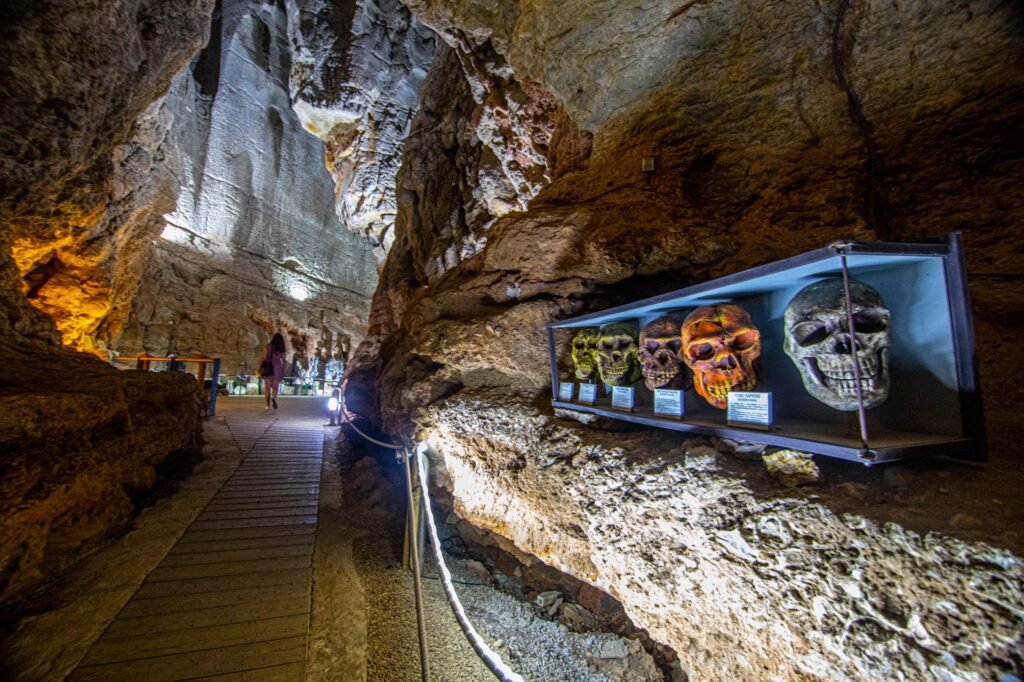
The public route leads through an impressive series of underground chambers, past stalactites, stalagmites and unusual rock formations, toward the underground lake.
The cave is accessible from the road between Benidoleig and Pedreguer.
You don’t need to be an experienced caver to explore the designated visitor section, although comfortable shoes are a good idea.
The cave has been open to tourists since the 1960s, so visiting today is a very different experience from the dangerous explorations of the eighteenth century.
Check the current visiting hours and admission details before setting out.
And while you’re there, take a moment to imagine what those first explorers must have felt when their lights revealed the twelve skulls.
The Treasure That May Never Have Existed
I think that’s the lovely thing about old legends.
Sometimes they begin with something that really happened.
A discovery. An unusual place. A question nobody can answer.
And then, over generations, the story grows.
In Benidoleig, twelve human skeletons became part of a tale about a fleeing king, 150 women and a fortune hidden beneath the mountains.
The treasure has never been verified.
The legendary king remains just that: a figure from a legend.
But the cave is real, and so is the extraordinary history beneath its rocks.
Perhaps the greatest treasure of Cova de les Calaveres was never gold or jewels at all.
Perhaps it’s the thousands of years of human history that the cave has preserved.
Although I must admit, if I ever found myself standing beside a mysterious passage deep underground, I’d probably still wonder what might be hidden around the next corner.