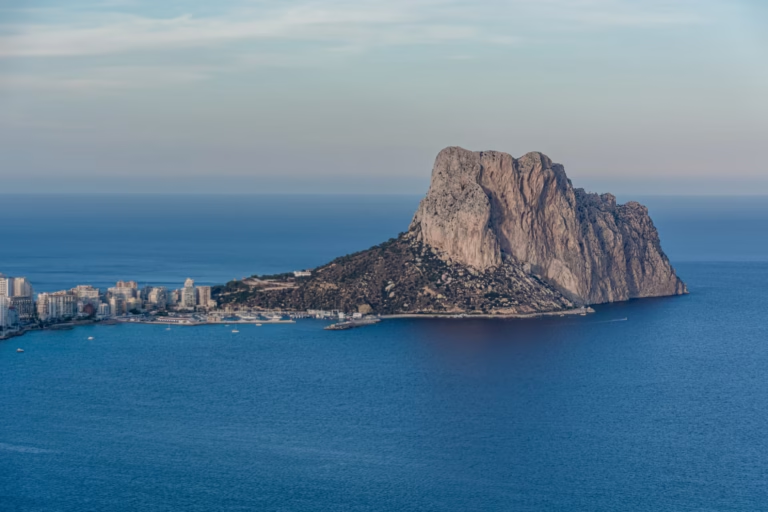
Thousands of people drive between Altea and Calpe on Spain’s Costa Blanca without giving much thought to the enormous gorge beneath the road.
There are tunnels cut through the mountains, bridges suspended above the rocks and, somewhere below, the remains of a much older route.
It’s an impressive landscape, even when you’re simply passing through.
But there’s something rather strange about its name.
Mascarat. The Masked One.
According to local legend, the name belonged to a mysterious man who once wandered these mountains, hiding his face from anyone who came too close.
Some believed he was a dangerous highwayman.
Others thought he was a fugitive fleeing persecution.
And one particularly extraordinary story claimed that the stranger was none other than Judas Iscariot.
Yes, that Judas.
But how did a mountain pass between two Spanish coastal towns become associated with one of the most infamous figures in biblical history?
The Dangerous Pass Between Altea and Calpe
Before the bridges and tunnels were built, travelling between Altea and Calpe was no simple journey.
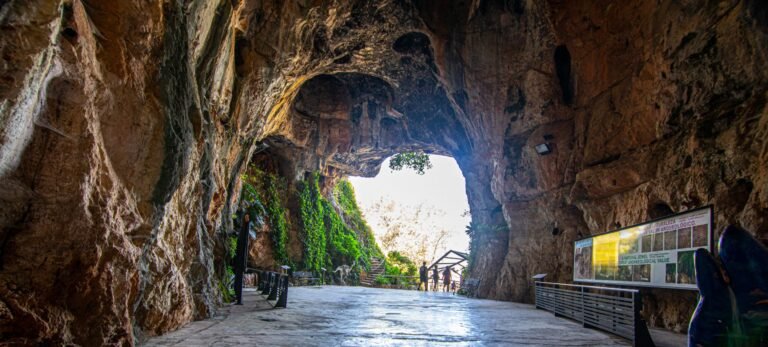
The Barranc del Mascarat, also known as Barranc Salat, cuts through the limestone mountains between the Sierra de Bernia and the Sierra de Toix.
Its walls rise almost vertically, creating a narrow passage that separates the Marina Alta from the Marina Baixa.
For centuries, travellers had to negotiate difficult mountain routes to move between the two regions.
A journey that takes only minutes today could once involve a difficult detour through steep, exposed terrain.
And the mountains provided plenty of places for someone who didn’t want to be found.
Which brings us to the first legend.
The Highwayman Who Hid His Face
According to one of the oldest stories associated with the gorge, a masked bandit once terrorized travellers passing through the mountains.
Nobody knew his real name.
He appeared unexpectedly, robbed those unfortunate enough to cross his path and disappeared again into the surrounding rocks.
The man became known simply as El Mascarat … the masked one.
Some versions describe him as a young man dressed in dark clothing, with a mask concealing part of his face.
Other accounts say that people in a nearby village suspected he might be a local young man who had disappeared without explanation.
But nobody could prove it.
Then, just as mysteriously as he had appeared, the bandit vanished.
For a while, people continued telling stories about him.
And eventually, according to the legend, his nickname became the name of the mountain pass itself.
It’s a wonderfully dramatic explanation.
But it isn’t the only one.
The Stranger Who Appeared in 1609
Another version of the Mascarat legend takes us back to a particularly difficult chapter in Spanish history.
In 1609, King Philip III ordered the expulsion of the Moriscos, descendants of Muslims who had converted to Christianity.
The expulsion had devastating consequences for communities throughout the Kingdom of Valencia, including the villages and valleys of what is now Alicante province.
Families were forced to leave homes and land where their ancestors had lived for generations.
Against this historical background, the legend tells of a strange man who appeared near the Mascarat pass.
He travelled alone.
He avoided conversation.
And nobody seemed to know where he had come from.
The people living nearby began calling him El Mascarat.
Some thought he might be a Morisco leader hiding from the authorities.
Others suspected he was waiting in the mountains, perhaps hoping to organize resistance or escape.
There were even rumors connecting his disappearance with the execution of a rebel leader known as Turiji.
But these details belong to the legend, not to an established historical account of an identifiable man.
What makes the story so interesting is its setting.
The expulsion of the Moriscos really happened, and the surrounding mountains were places where people could seek refuge.
Whether a particular masked stranger actually lived at Mascarat in 1609 is something we cannot establish.
The Man with the Hidden Face
There is another, sadder explanation for the mysterious stranger.
According to a different version of the legend, the man wasn’t a criminal or a fugitive at all.
He was suffering from leprosy.
The disease had affected his appearance, and he supposedly wore a mask to conceal his face from the people he encountered.
Rather than face the fear and rejection of others, he lived alone among the mountains.
Eventually, he disappeared.
Some versions say that a discarded mask was later discovered.
Others tell of an unrecognizable body found among the rocks.
The villagers wondered whether the dead man was the mysterious stranger they had been talking about for so long.
Was he the highwayman?
A lonely man hiding an illness?
Or someone else entirely?
As with the other accounts, there is no reliable evidence establishing the identity of this supposed individual.
But the story adds another layer to the mystery of Mascarat.
And then we come to the strangest version of all.
Was Judas Iscariot Buried at Mascarat?
Of all the stories surrounding the gorge, this one is surely the most extraordinary.
According to a local folktale, Judas Iscariot did not die shortly after betraying Jesus, as described in the Gospel of Matthew.
Instead, the legend imagines that he escaped and began wandering in search of somewhere to hide.
One telling describes him travelling by sea until a violent storm destroyed his vessel.
He supposedly reached the coast near Dénia and eventually made his way into the mountains between Altea and Calpe.
Exhausted by his journey, Judas stopped to rest on a stone near the mountain pass.
The tale even gives this stone a name: La Culada de Judas, referring to the mark he supposedly left behind.
Years, or in some extraordinary retellings centuries, passed.
And when unidentified human remains were found near Mascarat, the story grew into something even stranger.
Some people claimed that the dead man was the masked highwayman.
Others suggested that he was Judas himself.
There is, of course, no historical evidence that Judas travelled to the Costa Blanca, lived in these mountains or was buried here.
The story also contradicts the traditional biblical account of his death.
But as a piece of local folklore, it is remarkable.
It takes a figure from a story known throughout the world and places him in a very specific corner of the Spanish Mediterranean.
And suddenly, an ordinary-looking mountain pass becomes the setting for a legend spanning almost two thousand years.
Does Mascarat Really Mean ‘The Masked One’?
After all those stories, there’s one question we still haven’t answered.
Where does the name actually come from?
The masked highwayman provides an appealing explanation, and the legend is certainly well established in local storytelling.
But another proposed interpretation has nothing to do with a person.
Some writers have suggested that Mascarat derives from an ancient Iberian expression, maka-as, interpreted as ‘cut stone’.
That would make sense in a landscape dominated by dramatic limestone cliffs and a gorge that looks as though the mountain has been split open.
However, this proposed etymology should not be treated as conclusively proven either.
What we can say is that the origin of the name remains disputed in popular and regional accounts.
And perhaps that’s part of its appeal.
A place with such dramatic geography seems almost destined to collect stories.
The Bridges That Changed Everything
The real history of Mascarat is almost as dramatic as its legends.
For centuries, the gorge was a serious obstacle to travel along this stretch of the coast.
In the nineteenth century, engineers began working on a road that would cross the ravine rather than force travellers along the old mountain routes.
The project was extraordinarily difficult.
Tunnels had to be cut through solid rock, and a bridge had to span the enormous gap between the cliffs.
Construction was delayed repeatedly, and storms damaged equipment and unfinished structures.
Finally, in 1885, the original stone bridge was completed.
The arch crossed a gap approximately 32 meters wide, almost 60 meters above the bottom of the ravine.
Later came the railway bridge, opened in 1915, and a modern road bridge that began carrying traffic in 1968.
Today, the old stone bridge remains one of the most striking features of Mascarat.
Looking at it, it’s hard not to imagine how extraordinary that first crossing must have seemed to travellers who had previously struggled through the mountains.
Can You Visit the Mascarat Gorge?
Yes. The Barranc del Mascarat is located between Altea and Calpe in Alicante province, on Spain’s Costa Blanca.
The gorge is best known for its dramatic limestone walls, historic bridges and unusual geological formations.
There is a short walking route through part of the canyon, although access conditions can change following heavy rain, rockfalls or maintenance work.
The Valencian tourism website describes a route of approximately 1.5 kilometers for the return journey.
If you’re planning to explore the gorge, check current local access information before setting out and wear suitable walking shoes.
The terrain is rocky, and the narrow canyon can be dangerous during or after rainfall.
It’s also worth remembering that this isn’t the place for an improvised scramble beneath the bridges. Stay on accessible routes rather than attempting climbing or canyoning sections without appropriate experience and equipment.
Even without venturing far into the ravine, the scenery is extraordinary.
And knowing the legends makes it a rather different experience.
So Who Was the Masked Stranger?
A highwayman who robbed travellers?
A Morisco fugitive hiding from persecution?
A lonely man concealing a disfiguring illness?
Or, in the most extravagant version, Judas Iscariot himself?
The legends offer several answers, but history doesn’t establish any of them.
Perhaps there really was an individual whose appearance or behavior inspired the name.
Perhaps several stories about different people gradually became mixed together.
Or perhaps the name came from the landscape itself, and the masked stranger was invented to explain it.
We may never know.
What fascinates me is how many different stories have gathered around this one narrow passage through the mountains.
Today, cars pass through the tunnels in seconds, their drivers barely noticing the old bridge or the gorge below.
But once you know the stories, it’s difficult to look at Mascarat in quite the same way.
And the next time we drive between Altea and Calpe, I know I’ll be looking at those mountains and wondering about the man behind the mask.
If there ever was one.