Discover the delicate olives of Nice, the fascinating history of Provençal tapenade, and how to make this classic Mediterranean olive spread at home.
There are few things I enjoy more than a little bowl of good olives on the table.
Perhaps some freshly baked bread, a piece of cheese, and a glass of wine alongside them. The sort of simple food that makes a long Mediterranean lunch so enjoyable.
But not all olives are the same.
Some are large and meaty, others intensely salty or slightly bitter. And then there are the tiny, beautifully colored olives from the hills around Nice, on the French Riviera.
They are quite different from the larger green olives we often see in Spanish markets.
Niçoise olives are small, delicate, and wonderfully aromatic, with a flavor that reflects the long olive-growing tradition of southeastern France.
They are also closely associated with some of the region’s most famous dishes.
And then there is tapenade.
A rich, savory olive spread that seems to capture everything I love about Provençal cooking: good olives, capers, anchovies, and olive oil.
It is something you can buy ready-made, of course.
But making your own takes only a few minutes, and once you understand how the ingredients work together, it becomes one of those wonderful little recipes you can adjust to your own taste.
What Are Niçoise Olives?
Niçoise olives are small olives associated with Nice and the surrounding countryside of the French Riviera.
The traditional olive variety of this region is called Cailletier.
These olives are relatively small, with thin skins and firm flesh.
Their color can range from yellowish green and reddish brown to dark purple or almost black, depending on maturity.
Unlike some strongly cured olives, good Niçoise olives have a delicate, slightly bitter flavor without excessive saltiness.
They can have subtle aromas reminiscent of dried fruit, ripe cherries, or prunes.
The result is a very different olive from the large, firm green varieties commonly served as Spanish tapas.
Where Do Niçoise Olives Come From?
The name Nice immediately brings to mind the French Riviera, with its blue Mediterranean sea, hillside villages, and colorful markets.
But olive growing here is much older than the region’s reputation as a holiday destination.
Olive trees have been cultivated in this part of southeastern France for centuries.
The hills around Nice provide a landscape of stone terraces, traditional orchards, and small agricultural holdings.
The local Cailletier olive has become an important part of the region’s culinary identity.
It is used not only as a table olive, but also for olive oil and traditional olive paste.
What Does Olive de Nice AOP Mean?
If you want olives with a guaranteed connection to the area, look for the protected name Olive de Nice AOP.
AOP stands for Appellation d’Origine Protégée, the French equivalent of the European Protected Designation of Origin.
The designation applies to traditional table olives and olive paste produced according to specific rules in the designated area around Nice.
The approved olive variety is Cailletier.
The protected production area covers 99 municipalities in the Alpes-Maritimes department.
The rules describe the olives’ appearance, flavor, preparation, and geographical origin.
An important distinction is that olives labeled simply Niçoise-style do not necessarily carry this protection.
If authenticity matters to you, check for the AOP logo and the protected name.
How Are Olives de Nice Prepared?
Freshly harvested olives are generally too bitter to enjoy straight from the tree.
This bitterness comes partly from natural compounds such as oleuropein.
Different olive-growing regions have developed their own methods of reducing that bitterness.
For the traditional Olive de Nice AOP table olive, the preparation involves whole olives and a controlled brine-curing process.
The olives are not deliberately split or crushed.
They are also not flavored with added herbs or spices under the protected table-olive specification.
This allows the characteristic flavor of the Cailletier variety to remain the main attraction.
During curing, the olives gradually develop their familiar flavor and texture.
The result is a small olive that is particularly pleasant to eat as part of an aperitif or simple Mediterranean meal.
Are Niçoise Olives Black or Green?
Both descriptions can be misleading.
Niçoise olives are often sold as dark olives, but their colors vary naturally.
They may appear brown, reddish purple, dark violet, or nearly black.
This range is characteristic of the traditional product.
They are not necessarily the uniform jet-black color associated with some commercially processed black olives.
When buying them, a mixture of natural dark shades is entirely normal.
What Do Niçoise Olives Taste Like?
Niçoise olives are known for their delicate, balanced flavor.
They have a pleasant bitterness, relatively moderate saltiness, and a fruity character.
Depending on their maturity and preparation, you might notice hints of dried fruit or ripe wine-like aromas.
Their small size also influences how they are eaten.
They are not the sort of enormous olive you stuff with cheese or peppers.
Instead, they are particularly suited to dishes where the olive provides a distinctive but balanced accent.
A classic example is salade niçoise.
Why Are Niçoise Olives Used in Salade Niçoise?
Salade niçoise is one of the most recognizable dishes from the French Riviera.
Although recipes vary considerably, the traditional identity of the salad is closely connected with the ingredients and culinary traditions of Nice.
Olives are an important part of that identity.
Their salty, slightly bitter flavor complements tomatoes, anchovies, and other ingredients.
Some contemporary versions include cooked potatoes or green beans, although these additions are debated among traditionalists.
The small Niçoise olive is particularly well suited to the salad because its flavor is pronounced without being overpowering.
If you use whole olives, remember to warn guests that they contain pits.
What Is Tapenade?
Tapenade is a traditional Provençal spread made from olives, capers, anchovies, and olive oil.
Some recipes also include garlic, herbs, or a little lemon juice.
The ingredients are finely chopped or crushed together to create a thick, richly flavored paste.
It is usually served with bread, toasted baguette slices, or raw vegetables.
However, tapenade is much more versatile than a simple appetizer.
It can also be used to season fish, chicken, roasted vegetables, sandwiches, and savory pastries.
One of the most interesting details is where its name comes from.
Why Is It Called Tapenade?
You might expect the word tapenade to be derived from olives.
But it actually comes from the Provençal word tapeno or tapena, meaning caper.
This gives us a clue about the importance of capers in the original preparation.
Although olives form the base of most modern tapenades, capers provide an essential sharp, briny flavor.
Without capers, you may still have a delicious olive spread, but it is not quite the same traditional preparation.
Was Tapenade Invented in Marseille?
The history of modern tapenade is commonly traced to Marseille in 1880.
According to the well-known account, a chef named Meynier, working at the restaurant La Maison Dorée, prepared a mixture involving capers, black olives, anchovies, tuna, olive oil, and seasonings.
It was originally associated with a preparation served with hard-boiled eggs.
The recipe was later recorded in Provençal culinary literature.
Of course, people around the Mediterranean had been crushing olives with herbs and other ingredients long before the nineteenth century.
So while the familiar named preparation is associated with Marseille, the broader tradition of seasoned olive pastes is much older.
Tapenade vs Olive Paste: What’s the Difference?
This is a distinction worth understanding.
Olive paste is generally made by crushing or grinding olives, often with olive oil.
It may be very simple, allowing the flavor of the olives themselves to dominate.
Tapenade is a more complex preparation that traditionally includes capers and anchovies.
These ingredients change the flavor considerably.
Capers contribute acidity and sharpness.
Anchovies bring saltiness and savory depth.
Olive oil binds everything together and gives the mixture a spreadable consistency.
An especially interesting example is Pâte d’Olive de Nice AOP.
This protected olive paste is made from Cailletier olives and olive oil according to its production rules.
It is not the same product as tapenade.
If you are choosing between the two, think about whether you want to taste mainly the olive or a more complex mixture of olives, capers, and anchovies.
Black Tapenade vs Green Tapenade
The two most familiar versions are black and green tapenade.
Black Olive Tapenade
Black tapenade has a rich, savory flavor.
It is usually made with ripe, dark olives and has a deep color.
The flavor can be earthy, slightly fruity, and pleasantly salty.
It is particularly good with toasted bread, grilled vegetables, and roasted meat.
Green Olive Tapenade
Green tapenade tastes brighter and often slightly sharper.
Green olives are generally harvested before they reach full maturity, giving them a different flavor profile.
Some recipes include almonds or other ingredients to soften and balance the acidity.
Green tapenade can be especially delicious with fish, chicken, fresh cheese, and salads.
Both versions are worth trying.
For our homemade recipe, I prefer a classic black olive tapenade.
How to Make Traditional Black Olive Tapenade
One of the nicest things about tapenade is that it requires no cooking.
All you need is a few good ingredients and a food processor or mortar and pestle.
You can use genuine Niçoise olives if you have them, but because they are small and often sold with pits, preparing them can take some time.
Good-quality pitted black olives are a perfectly practical choice for everyday homemade tapenade.
The most important thing is choosing olives with a flavor you enjoy.
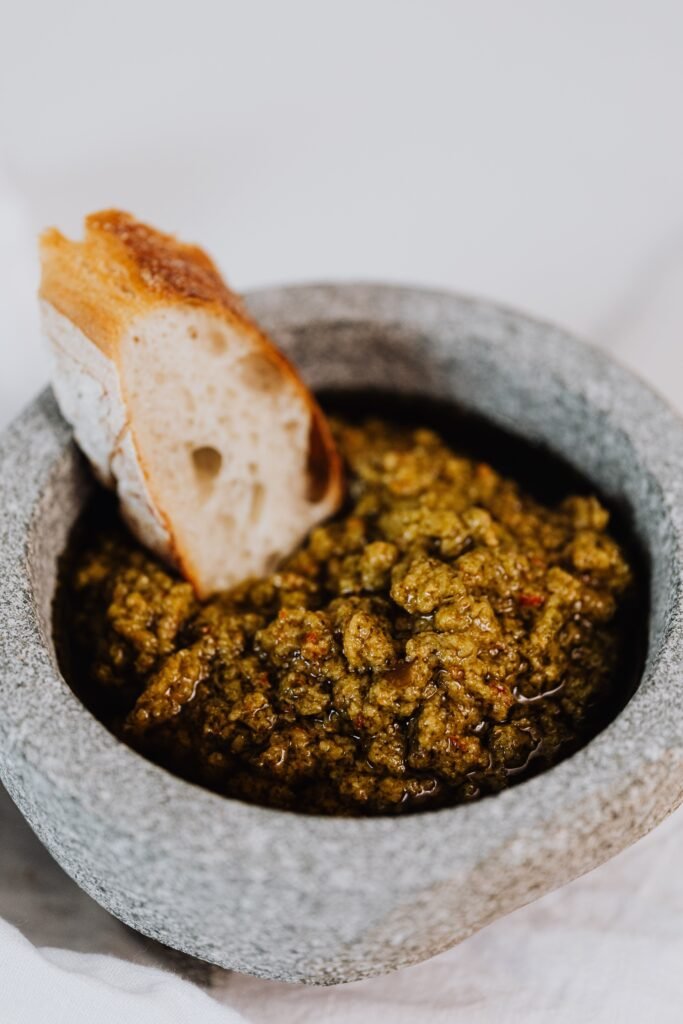
Homemade Provençal Black Olive Tapenade
Makes: Approximately 220–240 g (about 1 cup)
Servings: 8
Preparation time: 10 minutes
Cooking time: None
Ingredients
- 180 g (6.3 oz, approximately 1 cup) pitted black olives, drained
- 15 g (1 tablespoon) capers, drained and rinsed if very salty
- 2 anchovy fillets, drained
- 1 small garlic clove, finely chopped
- 2 tablespoons (30 ml) extra virgin olive oil
- ½ teaspoon finely chopped fresh thyme, optional
- Freshly ground black pepper, to taste
- ½ teaspoon fresh lemon juice, optional
Instructions
Step 1 — Prepare the olives
Drain the olives thoroughly.
If using whole Niçoise olives, remove every pit before processing.
Step 2 — Combine the ingredients
Place the olives, capers, anchovy fillets, and garlic in a small food processor.
Add the thyme if using.
Step 3 — Chop
Pulse several times until the ingredients are finely chopped.
Avoid processing continuously at first. A good tapenade should have some texture rather than becoming completely smooth.
Step 4 — Add the olive oil
With the processor running briefly, add the olive oil a little at a time.
Continue until the mixture forms a thick, spreadable paste.
Step 5 — Taste
Season with freshly ground black pepper.
Taste before adding any salt, as the olives, capers, and anchovies are already salty.
Add a few drops of lemon juice if you prefer a slightly brighter flavor.
Step 6 — Serve
Spoon the tapenade into a small bowl.
Serve with lightly toasted baguette slices, crackers, or raw vegetables.
Isabeau’s Tip
For an especially traditional texture, make your tapenade in a mortar rather than a food processor.
Crushing the ingredients by hand gives you more control over the finished consistency.
And if you can find genuine Olive de Nice AOP, try making a small batch with those olives.
Their delicate fruity flavor creates a particularly interesting tapenade.
What Can You Eat With Tapenade?
Tapenade is one of those useful ingredients that can turn a very simple meal into something special.
Toasted Baguette
Perhaps the most traditional way to serve tapenade.
Spread a thin layer over lightly toasted bread and serve as an aperitif.
Grilled Fish
A small spoonful of black or green tapenade can be wonderful with grilled white fish.
The olives and anchovies bring savory depth, while the olive oil adds richness.
Roast Chicken
Spread a little tapenade over chicken before roasting, or serve it alongside as a condiment.
Use a light hand, as the flavor can be quite powerful.
Mediterranean Vegetables
Tapenade pairs beautifully with roasted eggplant, zucchini, peppers, and tomatoes.
Try a spoonful over warm roasted vegetables just before serving.
Savory Puff Pastry
Spread tapenade thinly over puff pastry, roll it up, slice, and bake until golden.
These little savory pastries make a wonderful appetizer.
Pasta
A spoonful of tapenade can add instant flavor to a simple pasta dish.
Combine it with a little olive oil and some reserved pasta water.
Finish with fresh herbs or roasted tomatoes.
Sandwiches
Try tapenade in a Mediterranean sandwich with tomatoes, roasted peppers, or grilled vegetables.
It also works beautifully in a pan bagnat, the traditional Niçoise sandwich.
Is Tapenade Vegetarian?
Traditional tapenade usually contains anchovies, so it is not vegetarian or vegan.
However, you can make a plant-based olive spread by omitting the anchovies.
For extra savory flavor, try adding a little finely chopped sun-dried tomato.
The result is delicious, although it will differ from traditional anchovy-based tapenade.
When shopping, always check the ingredient list.
Some commercial olive spreads are vegan, while others contain fish.
Is Tapenade Healthy?
Tapenade is made primarily from olives and olive oil, which contribute monounsaturated fats.
It can be part of a varied Mediterranean eating pattern.
However, olives, capers, and anchovies can all contain significant amounts of sodium.
This makes tapenade a condiment best enjoyed in moderate portions.
A little goes a long way, both in flavor and saltiness.
The overall nutritional profile also depends on the ingredients and amount of olive oil used.
How to Choose Good Niçoise Olives
If you want the authentic product from Nice, look for Olive de Nice AOP on the label.
The protected designation indicates that the olives come from the recognized production area and meet the established requirements.
The olives should be small and may show a natural range of colors.
Avoid assuming that darker always means better.
More important are the variety, curing process, freshness, and balance of flavor.
If you are shopping outside France, genuine Niçoise olives may be available through specialist Mediterranean food retailers.
You can also use other good-quality black olives for tapenade.
Just remember that the flavor will be different.
Can You Substitute Kalamata Olives?
Yes.
Greek Kalamata olives can make a delicious tapenade, although the finished flavor will be different.
Kalamata olives are generally larger and have a more pronounced fruity, wine-like character.
They are also commonly preserved in brine and vinegar.
This acidity will influence your tapenade.
Start with less additional lemon juice, taste, and adjust.
For a classic Provençal flavor, genuine Niçoise or other suitable French black olives are preferable.
How to Store Homemade Tapenade
Homemade tapenade should be kept refrigerated in a clean, airtight container.
Because it contains fresh garlic and other perishable ingredients, it should not be treated as shelf-stable.
Keep it at 4°C (40°F) or below and use it within three days.
Use a clean spoon each time.
Do not leave homemade tapenade sitting at room temperature for extended periods.
For longer storage, freeze it in small portions.
Commercial tapenade should be stored according to the manufacturer’s instructions.
Frequently Asked Questions About Niçoise Olives and Tapenade
What are Niçoise olives?
Niçoise olives are small, flavorful olives traditionally associated with Nice and the French Riviera. Authentic Olive de Nice AOP products are made from the Cailletier variety.
Are Niçoise olives the same as Kalamata olives?
No. They are different olive varieties with different shapes, textures, and flavor profiles.
What is traditional tapenade made from?
Traditional Provençal tapenade is made from olives, capers, anchovies, and olive oil. Garlic and herbs may also be added.
Why is tapenade called tapenade?
The name comes from a Provençal word for capers, reflecting their importance in the traditional recipe.
Is tapenade always made with black olives?
No. Both black and green olive tapenades are popular.
Does tapenade contain anchovies?
Traditional versions generally do, but some modern olive spreads omit them.
Can you make tapenade without a food processor?
Yes. A mortar and pestle produces a lovely rustic texture.
Is tapenade the same as olive paste?
No. Olive paste can be made primarily from olives and olive oil, while traditional tapenade also includes capers and anchovies.
How long does homemade tapenade last?
For the recipe in this article, refrigerate promptly and use within three days.
What can I use instead of Niçoise olives?
Other good-quality black olives can be used for tapenade. Kalamata olives are one option, although they produce a different flavor.
A Little Taste of the French Riviera
One of the things I love about Mediterranean cooking is how much flavor can come from just a handful of ingredients.
Olives, capers, anchovies, and good olive oil.
Individually, they are familiar ingredients.
Together, they become something that has been part of Provençal food culture for generations.
And behind those tiny Niçoise olives is another story: old olive groves, stone terraces, and a regional tradition that continues to shape the food of the French Riviera.
You can certainly buy a jar of tapenade in the supermarket.
But making your own is such a lovely little kitchen project.
It takes only a few minutes, you know exactly what goes into it, and you can adjust the flavors to suit your taste.
Serve it with good bread, a few olives, perhaps some cheese, and enjoy one of the simplest pleasures of Mediterranean cooking.