
I’ve eaten Fettuccine Alfredo so many times during our travels through Italy, and it’s still one of my favorite pasta dishes.
What I love most is how something made with so few ingredients can taste so wonderful.
In Italy, the original Roman version is nothing like the Alfredo sauce you often find in American restaurants. There’s no heavy cream, no garlic, and certainly no need to add chicken.
Just fresh fettuccine, good butter and Parmigiano Reggiano.
And yet the finished pasta is beautifully creamy.
The dish was made famous by Alfredo di Lelio, a Roman restaurateur who prepared a particularly rich version of pasta with butter and Parmesan for his wife, Ines, in the early twentieth century.
According to the story, she loved it so much that he eventually added it to the restaurant menu.
Years later, Hollywood stars Mary Pickford and Douglas Fairbanks enjoyed the dish during their visit to Rome and helped make it famous in America.
The recipe travelled across the Atlantic, but somewhere along the way it changed considerably.
Cream became a common ingredient, and eventually chicken, garlic and other additions followed.
There’s nothing wrong with enjoying those versions, but they’re not the original Roman dish.
Three Ingredients, One Important Technique
The secret to authentic Fettuccine Alfredo is something Italians call mantecatura.
It’s the technique of combining hot pasta, butter, finely grated cheese and a little starchy cooking water until everything comes together in a smooth, creamy sauce.
It sounds simple, and it is, once you know what you’re doing.
The butter needs to be soft, the cheese must be grated extremely finely, and the pasta should be hot enough to bring everything together without overheating the cheese.
I also like to warm the serving platter beforehand. It’s a small detail, but it helps enormously.
When the sauce is right, it coats every strand of pasta without leaving a pool of melted butter at the bottom of the plate.
And that, to me, is what makes a really good Fettuccine Alfredo.
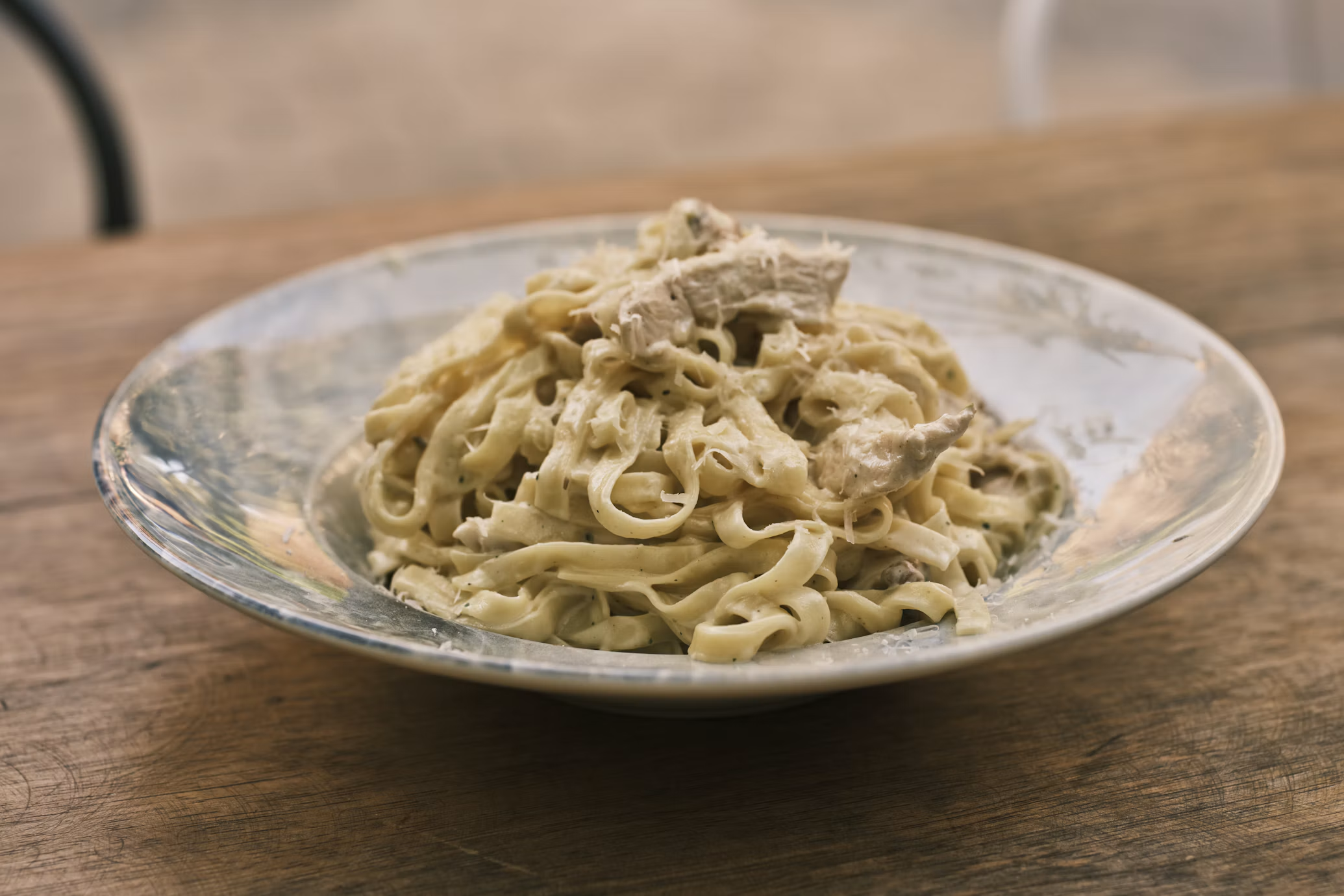
Authentic Fettuccine Alfredo – Original Italian Recipe Without Cream
Ingredients
- 400 g 14 oz very thin fresh egg fettuccine
- 160 g 5.6 oz / approximately 11 tbsp good-quality unsalted butter, softened to room temperature
- 280 g 9.9 oz Parmigiano Reggiano, preferably aged 24 months, very finely grated and sifted
- Fine salt for the pasta cooking water
- Hot starchy pasta cooking water as needed for emulsifying the sauce
Method
- Remove the butter from the refrigerator well before cooking so it becomes soft and spreadable, but not melted. Cut it into small pieces and distribute it across the bottom of a large, gently warmed serving platter or heatproof bowl.
- Finely grate the Parmigiano Reggiano using a very fine grater. For the smoothest possible sauce, pass the grated cheese through a fine sieve to remove larger pieces. Set aside.
- Bring a large saucepan of water to a boil. Season lightly with salt, remembering that Parmigiano Reggiano is already quite salty. Warm your serving platter if you haven’t already done so, making sure it is comfortably warm rather than extremely hot.
- Add the fresh fettuccine to the boiling water. Cook until just tender, following the instructions for your particular pasta. Very thin, freshly made Roman-style fettuccine may take only 20–30 seconds, while thicker fresh pasta usually requires longer.
- Before removing the pasta, reserve approximately 250 ml (1 cup) of the hot cooking water. You may not need all of it.
- Lift the fettuccine directly from the water using a pasta fork or tongs, allowing some cooking water to accompany the noodles. Transfer immediately to the warm platter containing the softened butter.
- Gently lift and turn the hot fettuccine to begin melting the butter and coating the strands. Avoid breaking or crushing the delicate pasta.
- Sprinkle a portion of the finely grated Parmigiano Reggiano over the pasta. Add a small splash of the reserved hot pasta water and continue lifting and turning the noodles, allowing the cheese and butter to combine.
- Gradually add the remaining Parmigiano Reggiano in several additions, tossing continuously and adding small amounts of hot pasta water whenever the mixture becomes too thick.
- Continue the mantecatura until the butter, cheese and cooking water have formed a smooth, glossy sauce that coats every strand of fettuccine. The sauce should be creamy and fluid, without visible lumps of cheese or separated butter.
- If the sauce becomes too thick, add a little more warm pasta water and continue tossing. If it is too thin, continue mixing briefly until the sauce coats the pasta, taking care not to let it cool completely.
- Serve immediately on warmed plates. Authentic Fettuccine Alfredo needs no cream, garlic, chicken or additional garnish.