Somewhere in the mountains of Catalonia, there is a staircase carved into the rock.
It leads toward an ancient sanctuary, high above the valleys of Ripollès, where the mountains rise steeply and the forests stretch into the distance.
At first glance, there’s nothing particularly frightening about it.
Pilgrims have climbed these steps, travelers have stopped to admire the scenery, and visitors still come to see the beautiful sanctuary of Montgrony.
But according to an old Catalan legend, these steps are connected to a terrible betrayal.
And to a man who has been paying for his dishonesty ever since.
His name was Count Arnau.
The story says that he died centuries ago.
But apparently, nobody told him he could stop riding.
The Count Who Cheated His Workers
Long ago, Count Arnau ruled over lands in the mountainous region of Ripollès.
He was wealthy, powerful and accustomed to getting his own way.
One day, he ordered a staircase to be cut through the rock leading to the sanctuary of Montgrony.
It was an enormous task.
The workers had to carve each step from the solid mountainside, using little more than hand tools and their own strength.
To persuade them to undertake the work, Arnau made a generous promise.
For their labor, they would receive a measure of wheat for every step completed.
And not just an ordinary measure.
According to one version of the story, each measure was supposed to be filled so generously that the grain rose above the rim.
The men agreed.
They spent their days cutting into the mountain, gradually creating a staircase where there had once been only rock.
And when the work was finally complete, they came to collect their payment.
Count Arnau had the wheat brought out.
But before the men received it, he ordered the grain to be scraped level with the top of each measuring container.
Not a single extra grain was allowed.
He had given them wheat, just as he had promised.
But he had deliberately withheld the generosity that had persuaded them to accept the work.
It was a clever trick.
Or so he thought.
A Promise That Followed Him Beyond the Grave
The people remembered what Count Arnau had done.
And according to the legend, so did heaven.
When Arnau eventually died, he was not allowed to rest.
His dishonesty toward the workers became one of the reasons for his eternal punishment.
Instead of finding peace, he was condemned to wander the mountains forever.
And this is where the story becomes truly terrifying.
The Black Horse and the Eternal Hunt
Imagine a cold autumn night in the mountains.
The villages are dark, the last fires are burning low, and the forests have become silent.
Then, somewhere far above the valley, a sound breaks through the darkness.
A hunting horn.
Long and terrible.
A moment later, you hear hooves.
And then the dogs begin to howl.
According to later versions of the legend, Count Arnau rides through the night on a black horse, sometimes described as surrounded by flames.
His hunting dogs race behind him.
And following them comes a dreadful procession of restless, condemned souls.
The entire company sweeps across the mountains, driven by a punishment that never ends.
Some stories describe the horse galloping over the ground, while others imagine the terrifying procession passing through the night sky.
The count cannot stop.
He cannot dismount.
And no matter how far he rides, he can never escape his fate.
The Night of Souls
The legend becomes particularly unsettling during the autumn days traditionally associated with remembering the dead.
In Catalonia, the period around All Saints’ Day and All Souls’ Day has long been connected with stories of wandering spirits and the boundary between the living and the dead.
Some versions of Count Arnau’s legend place his ghostly return on these nights.
Imagine hearing the distant sound of a hunting horn while standing outside a mountain village.
You look toward the dark slopes.
Nothing.
Then you hear the dogs.
And suddenly, perhaps you’d rather be indoors.
Because according to the stories, meeting Count Arnau and his ghostly procession is not an experience anyone should wish for.
Is Count Arnau a Real Historical Figure?
This is one of the most fascinating parts of the legend.
Count Arnau is one of the best-known supernatural figures in Catalan folklore, but the legendary character cannot be confidently identified with one historical nobleman.
His story developed over centuries through traditional songs, local legends and literary retellings.
The oldest known versions of the famous Count Arnau song are generally associated with the late sixteenth or early seventeenth century.
In the song, his ghost returns to speak with his widow, and his eternal punishment is connected with the wrongs he committed during his lifetime.
Some traditions focus on his failure to pay workers fairly.
Others tell stories about forbidden relationships, religious transgressions and his extraordinary pride.
Over time, these different traditions blended into the terrifying image of a condemned nobleman riding endlessly through the mountains.
The Real Staircase at Montgrony
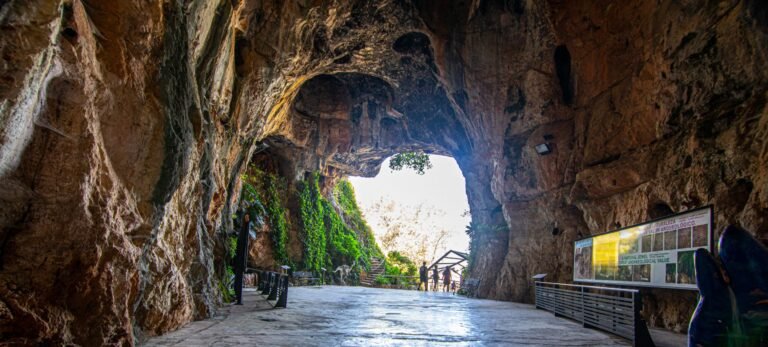
Unlike Count Arnau’s ghostly horse, the stone staircase connected with the legend is very real.
The Sanctuary of Montgrony stands in the municipality of Gombrèn, in the Catalan region of Ripollès.
It’s a remarkable place, built against a steep limestone cliff with magnificent views of the surrounding mountains.
The steps cut through the rock lead toward the chapel dedicated to the Virgin of Montgrony, while another section continues toward the Romanesque church of Sant Pere de Montgrony.
For centuries, local stories have connected these stairways with Count Arnau and his broken promise.
The steps have undergone repairs and restoration over time, so the staircase visitors see today should not be regarded as proof of the legendary events.
But it is wonderful to think that a real place can preserve such an extraordinary story.
You can stand on the very mountain where generations of people imagined Count Arnau making his terrible bargain.
And perhaps wonder how the story began.
A Ghost Story with a Moral
What I find particularly interesting about this legend is that its central message isn’t really about ghosts.
It’s about injustice.
Count Arnau was a powerful man who believed he could take advantage of those who worked for him.
He found a way to keep the letter of his promise while betraying its meaning.
And in the world of the legend, that was enough to condemn him forever.
It’s a remarkably powerful story about greed, dishonesty and the consequences of treating other people unfairly.
The supernatural punishment may belong to folklore, but the moral has survived for centuries.
And If You Hear a Hunting Horn Tonight…
I love discovering these old Mediterranean legends because they reveal a side of Spain that is so different from the familiar images of beaches, sunshine and colorful villages.
The mountains have their own stories.
And some of them are wonderfully dark.
Count Arnau’s eternal ride is one of those tales that stays with you.
A broken promise.
A black horse.
A pack of howling dogs.
And a hunting horn echoing through the mountains long after its owner should have disappeared into history.
So if you’re ever spending an autumn evening in the Catalan mountains and hear a distant horn above the trees, perhaps remember the story of Count Arnau.
And if the dogs begin to howl…
Maybe it’s time to close the windows.
Sleep tight.